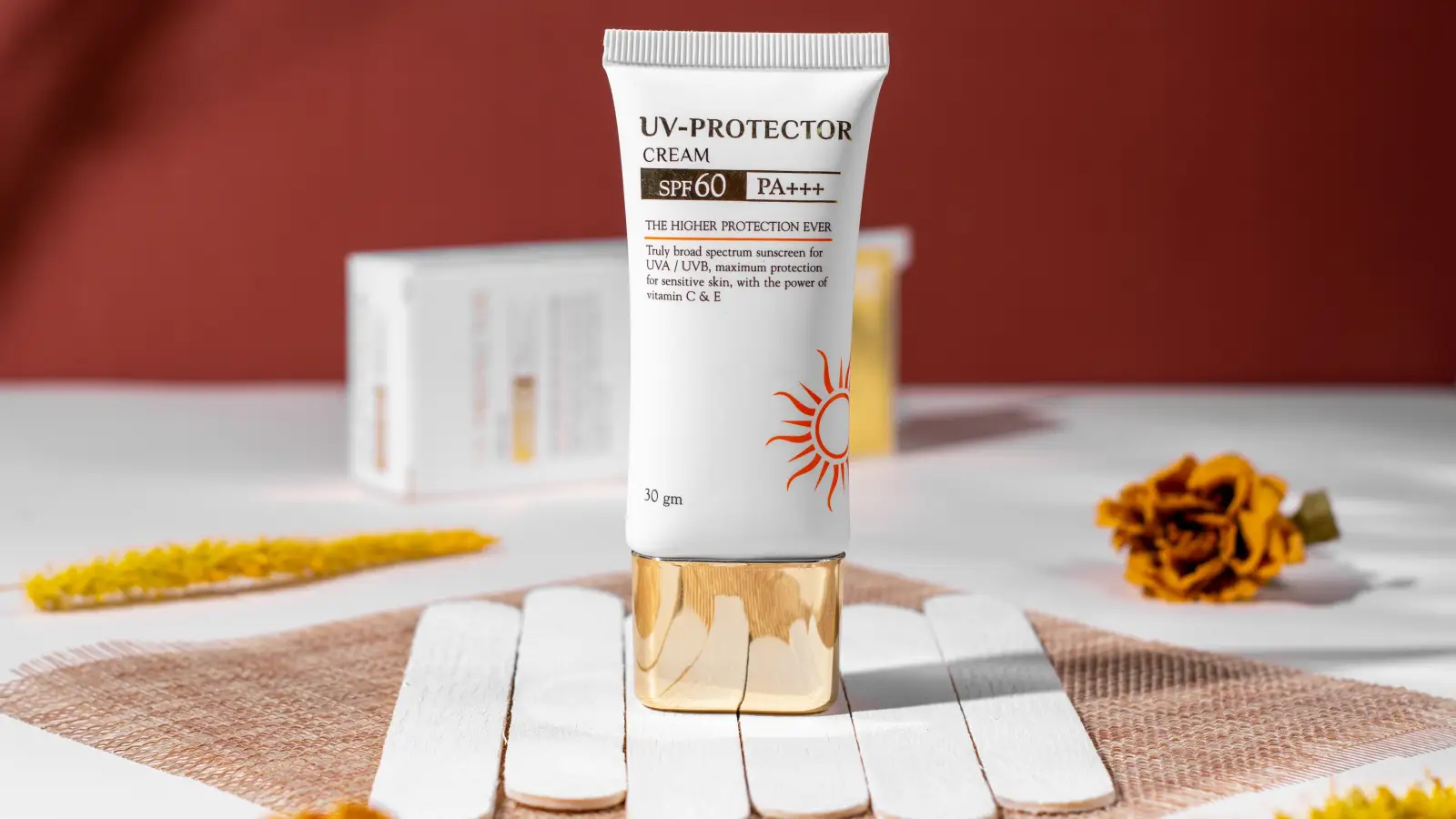
Tinted Sunscreens for Melasma: What the Label Should Include
A sunscreen for melasma must satisfy three label criteria: a broad spectrum statement, a high UVA protection rating (PA++++), and iron oxides. Standard UV filters block UVB and UVA, but they do not protect against visible light, a documented trigger of melasma pigmentation, especially in skin of color. Iron oxides provide that missing visible light shield. This article details exactly what to read on the label and why each element matters.

Radiation Bands Relevant to Melasma
Melasma pigmentation is triggered by three wavelength ranges:
- UVB (290–320 nm): Damages skin surface; SPF indicates protection level.
- UVA (320–400 nm): Penetrates to the dermis, driving pigment production year-round and through glass.
- Visible light (400–700 nm): Particularly the blue-violet portion, induces hyperpigmentation in melasma. Studies show the effect is more pronounced in darker skin phototypes.
A “broad spectrum” label confirms that a sunscreen filters both UVB and UVA, but it sets no mandatory degree of UVA protection. The PA system quantifies UVA protection but ignores visible light. Iron oxides — pigments that absorb visible light — appear only in tinted sunscreens. Therefore, a label adequate for melasma accounts for all three bands.
The Triple Shield Label Check Framework
Read a sunscreen label by checking three independent elements in sequence. Each check addresses one of the three radiation triggers. Skipping a check leaves a known aggravation pathway unblocked.
Check 1: Confirm the Broad Spectrum Claim
In the US, the “broad spectrum” designation requires a critical wavelength of at least 370 nm, meaning the product absorbs 90% of UV radiation at that point. Without it, the sunscreen covers UVB only, leaving UVA unprotected. For melasma, this is the baseline requirement. An SPF of 30 or higher is recommended; SPF 50+ gives greater tolerance for under-application.
Label standard: The term “broad spectrum” appears prominently, typically near the SPF number.
Check 2: Verify a Quantified UVA Rating
UVA is a potent melasma trigger. The PA rating — derived from persistent pigment darkening (PPD) testing — categorizes UVA protection:
- PA+ = PPD 2–4
- PA++ = PPD 4–8
- PA+++ = PPD 8–16
- PA++++ = PPD ≥16
A PA++++ rating indicates the strongest commercially available UVA shield. For melasma, PA+++ or lower may not provide sufficient control, particularly during prolonged sun exposure. If a product lacks a PA rating but carries the European UVA circle (guaranteeing a UVA-PF at least one-third of the SPF), it offers some UVA assurance, but without a number, the actual level remains less precise.
Label standard: The packaging states “PA++++” or “PPD 16+” unambiguously, not buried in fine print.
Check 3: Locate Iron Oxides in the Ingredient List
This is the visible light protection check — and the one most often omitted. Iron oxides are listed as:
- CI 77491 (red iron oxide)
- CI 77492 (yellow iron oxide)
- CI 77499 (black iron oxide)
Together, they absorb wavelengths across the visible spectrum, including the blue light responsible for melasma darkening. Neither untinted chemical sunscreens nor pure mineral sunscreens (zinc oxide, titanium dioxide) provide comparable visible light blocking. Zinc oxide and titanium dioxide scatter some visible light, but their efficacy below 400 nm drops off significantly; iron oxides are far more effective.
To verify, turn the bottle over and read the complete ingredient panel. If “Iron Oxides” or any CI 77491/77492/77499 appear, the sunscreen contains a protective pigment. The tint must be visible on skin — a product that goes on completely sheer may have a concentration too low to be useful. For darker skin tones, a shade that matches the complexion is more likely to contain sufficient iron oxide than a translucent “universal tint.”
Label standard: Iron oxides appear among the first portion of the inactive ingredients, and the formula leaves a discernible beige, tan, or brown cast.
Applying the Framework: A Real-World Label
A person with medium-brown skin and melasma examines two products.
Product A: Front label reads “Broad Spectrum SPF 50+ PA++++ Radiant Tint.” Ingredient list includes Titanium Dioxide, Mica, Silica — no iron oxides. Checks 1 and 2 pass. Check 3 fails. This product offers no visible light protection.
Product B: “Broad Spectrum SPF 40 Tinted Mineral Sunscreen.” The front shows no PA rating. The ingredient list includes Iron Oxides (CI 77491, CI 77492, CI 77499). Check 1 passes minimally (broad spectrum). Check 2 is uncertain; UVA coverage is undefined. Check 3 passes. The product lags on UVA.
The optimal product combines all three: an explicit broad spectrum claim, PA++++, and iron oxides. When no single product fulfills all checks, a layered approach works — apply a PA++++ sunscreen first, then a mineral powder or foundation with iron oxides over it — but this requires technique to maintain an even protective film.
Common Failures in the Check Sequence
These three errors account for most inadequate sunscreen choices in melasma management.
Stopping After “Broad Spectrum” Without a PA Rating
Many US sunscreens list “broad spectrum” but offer no PA or PPD quantification. For skin of color, where UVA-driven pigmentation can persist for weeks, the actual UVA protection matters. A broad spectrum label alone provides no information on whether the UVA coverage is marginal or robust. Without a PA level, the product’s suitability for melasma remains uncertain.
Assuming an Untinted Mineral Sunscreen Blocks Visible Light
Zinc oxide and titanium dioxide scatter a fraction of visible light, but the attenuation is weak, especially above 400 nm. Clinical data on melasma patients show that only tinted sunscreens containing iron oxides meaningfully reduce visible light-induced pigment formation. An untinted mineral sunscreen, regardless of SPF, leaves the visible light pathway unblocked.
Selecting a “Tinted” Product That Lacks Iron Oxides
The term “tinted” is unregulated. A sunscreen can appear tinted from mica, synthetic dyes, or titanium dioxide alone. Without iron oxides on the ingredient list, the color serves appearance only, not photo-protection. This error is frequent with sheer “universal” tints — their pigment load is insufficient to shield visible light, and they rarely contain iron oxides.
Quick Reference
| Label Check | Purpose | What to Find |
|---|---|---|
| Broad Spectrum | Guarantees UVA/UVB coverage | “Broad Spectrum” on front |
| PA Rating | Measures UVA strength | “PA++++” or “PPD 16+” |
| Iron Oxides | Absorbs visible light | “Iron Oxides (CI 77491, CI 77492, CI 77499)” in ingredients |
FAQ
Does PA++++ protect against visible light?
No. PA ratings only measure UVA. Visible light requires a separate filter, specifically iron oxides. An untinted PA++++ sunscreen still leaves skin exposed to visible light’s pigmentation effects.
Can mixing foundation with sunscreen add visible light protection?
Mixing dilutes the sunscreen film and can compromise UV evenness. Foundation may not contain iron oxides, and if it does, blending reduces its pigment concentration. For reliable protection, use a tinted sunscreen that already passes all three checks, or layer a dedicated sunscreen first with an iron oxide powder on top.
How can I tell if a tinted sunscreen has enough iron oxides?
Check the ingredient order — iron oxides listed higher indicate greater concentration. Practically, the sunscreen should leave a visible tint on your skin. A formula that turns completely transparent likely has insufficient pigment for dependable visible light protection.
Is SPF 50 enough for melasma if I’m indoors?
SPF measures UVB. UVA passes through glass, and indoor visible light sources (screens, LEDs) can also contribute to melasma darkening, though at lower intensity than sunlight. A broad-spectrum, high-SPF untinted sunscreen will block UVA but not visible light. Indoor melasma management still benefits from a tinted sunscreen containing iron oxides.
Begin with Iron Oxides, Then Work Backward
The Triple Shield Label Check for melasma runs: broad spectrum, quantified UVA rating, iron oxides. Most shoppers start with SPF and end at broad spectrum. The practical sequence is to start with step three — check for iron oxides first — and eliminate all products that lack them. Then verify the PA rating, then broad spectrum. This order prioritizes the wavelength most missed by standard sunscreens.
Pigment Curious
We are people who want to better understand skin pigmentation, dark spots, and how different skin tones respond to skincare and professional treatments. We look beyond simple beauty claims, focusing on scientific evidence, clear explanations, and practical knowledge that helps people make more informed decisions about their skin.