Fraxel vs. Ablative Lasers: Why Gentler Wins
If you’re reading this, you’re probably wondering whether a laser that doesn’t torch your entire face can still deliver enough improvement to justify skipping the legendary “gold standard” fully ablative CO2. The answer, for the vast majority of people, is a resounding yes. Fractional laser technology—the kind that treats tiny columns of skin and leaves the surrounding tissue untouched—dominates the modern landscape because it slashes downtime and dramatically cuts the risk of triggering post-inflammatory hyperpigmentation, especially on melanin-rich skin. A fully ablative CO2 laser still deserves a niche for deep, static wrinkles in lighter skin types willing to wear raw, weeping skin like a badge of honor for weeks, but that’s a shrinking corner of the patient population, and for good reason.
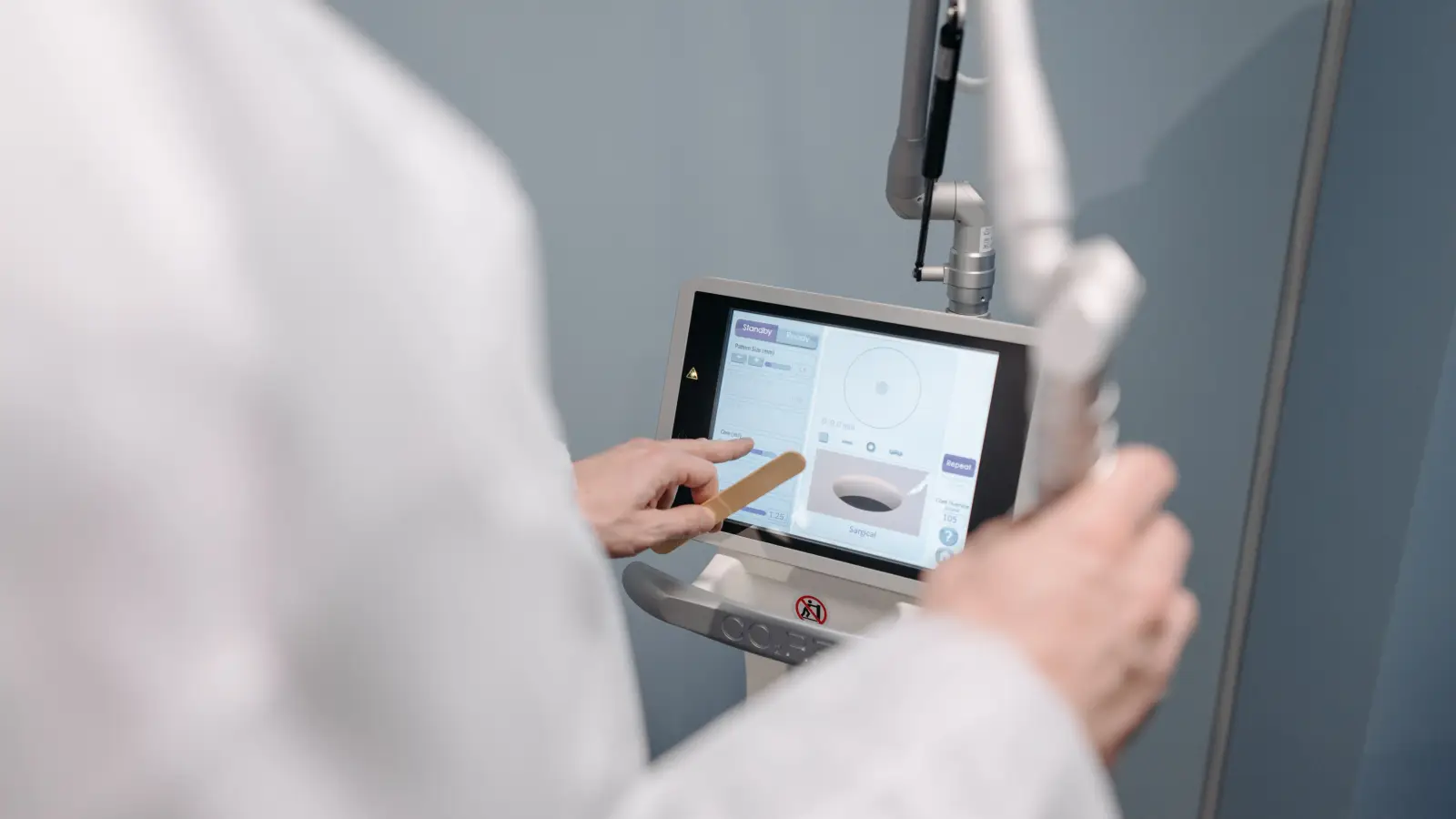
The real story isn’t “which laser is best,” it’s which laser best matches your willingness to trade pain, privacy, and pigment safety for a faster collagen payoff. What follows breaks that trade-off down by what you’re actually trying to fix.
Verdict by Scenario
| If you mainly need… | Winner | Because… |
|---|---|---|
| Maximal wrinkle ablation and skin-tightening in one shot | Full-field ablative CO2 | Creates the deepest wound-healing response, but at the cost of high pigment and downtime risk |
| Visible texture improvement and fine-line softening without hiding at home | Non-ablative fractional (Fraxel Dual) | Multiple gentle passes build collagen while you’re still showing up to Zoom calls by day three |
| Acne scar remodeling on Fitzpatrick IV–VI | Fractional non-ablative or mild fractional ablative | The untreated “islands” of skin heal so fast that PIH barely gets a foothold |
| Sunspots, lentigines, or melasma on darker skin | Pigment-specific fractional (e.g., 1927 nm) | Precisely targets melanin without a full epidermal peel, keeping melanocytes calm |
| Aesthetic rejuvenation with near-zero visible downtime | Non-ablative fractional | Redness and bronzing resolve in three days; that’s the price of a long weekend, not a sick leave |
The Scenarios
Chasing Wrinkles: Why the “Big Gun” Still Exists
When deep nasolabial folds or lateral canthal crow’s feet are the entire agenda, full-field ablative CO2 still sits on the throne—for a very narrow audience. It vaporizes the epidermis and a significant layer of dermis at once, triggering a collagen cascade that tightens skin and erases rhytids in a way that fractional devices, even ablative fractional, can’t match in a single session. But the reality check is brutal: two weeks of oozing skin, occlusive goop, and an additional month or more of vivid redness. On Fitzpatrick skin types IV and above, the odds of PIH can soar past 50%, and hypopigmentation isn’t unheard of.
Fractional CO2 (like the now less-common Fraxel Re:pair approach) tried to split the difference by abating the ablation into columns, but even that demands a solid week of crusting and still triggers more melanocyte drama than most darker-skinned patients should gamble on. The smarter play for almost anyone with melanin: multiple sessions of non-ablative fractional laser with a bit of fractional micro-needling to nudge collagen, slowly. You’ll get 70% of the tightening without the pigment storm.
When Pigmentation Is the Star (Spots, Melasma, Uneven Tone)
This is where the gentler fractional approach wallops full ablation. The Fraxel Dual’s 1927 nm handpiece, for instance, fires superficial light that shatters melanin while the fractional pattern leaves skin bridges intact, preserving barrier function and keeping the melanocyte’s panic button firmly unpressed. Standard non-ablative non-fractional gadgets like IPL can fade spots but don’t remodel dermis, so texture stays rough. Fully ablative CO2 often does the opposite—it strips pigment along with the entire epidermis, but the thermal injury frequently wakes up deeper melanocytes, causing a rebound pigmentation that’s darker and more stubborn than what you started with.
For Fitzpatrick III–VI, this scenario is lopsidedly won by fractional non-ablative pigment-targeting wavelengths. The data is clear enough that many dermatologists who work predominantly with skin of color won’t even offer full-field ablative for pigment unless the patient first passes a test spot with a long observation period. Gentler wins—not because it’s kinder, but because it doesn’t create new problems.
Acne Scars: Why Fractional Columns Are a Scar’s Worst Nightmare
Scars demand dermal remodeling, and that requires injury. The question is how much. Fractional lasers, whether non-ablative (1550 nm) or ablative (CO2), create vertical channels of damage that heal inward from the walls, dragging skin together and replacing disorganized scar collagen with fresh, organized bundles. Float some intact tissue between those channels and healing happens on a timeline of days, not weeks.
In a patient with Fitzpatrick IV and rolling boxcar scars, a series of five Fraxel Dual sessions at moderate density can deliver 50–70% scar elevation with a PIH risk under 5%. Swap that for a single fully ablative CO2 session, and the same patient may swap scars for pigment patches that linger longer than the social downtime. The trade-off isn’t just about results—it’s about which aesthetic problem you’re willing to trade in for a new one. For most, the gentler, fractional column approach wins.
The Downtime Dilemma: When You Can’t Hide for a Month
If your work calendar, social life, or emotional bandwidth can’t stomach raw, weeping skin, non-ablative fractional lasers are the only sensible starting point. After a Fraxel Dual treatment at therapeutic settings, most people walk around with a sunburned glow for two days, then light brownish bronzing that peels like a mild sunburn by day five. You can apply mineral makeup by day three and attend a dinner with friends.
Non-fractional non-ablative lasers (like IPL or low-fluence Nd:YAG) promise “no downtime,” but the price is often only a dusting of improvement—good for a quick brightening, terrible for texture. Ablative fractional CO2 lands somewhere in between, with five to seven days of micro-crusts and a week of bright pink, but even that is a significant step up in recovery. For the downtime-minimizing patient, fractional non-ablative isn’t the compromise—it’s the feature.
Where They’re Basically the Same
Stop weighing these differences because they’re negligible: all these lasers stimulate collagen for months, so the end collage underneath can look similar after a series of fractional sessions versus one big blast. Infection risk is low regardless, but only if you follow the unglamorous aftercare—occlusive ointment, gentle cleansing, no picking. None of these methods are safe during pregnancy, active isotretinoin use, or a recent sunburn. Every single one demands militant sunscreen use for months afterward; skip that and the new collagen will degrade under UV before it ever tightens. On these points, the differences are so tiny they don’t belong in your decision matrix.
Deal-Breakers
Full-field ablative CO2 is instantly off the table if you:
- Have Fitzpatrick skin type IV–VI or a history of PIH, without a dermatologist who has a long, honest talk about monitoring a test spot first.
- Cannot carve out 10–14 days for wound care and zero social interaction.
- Have active acne, open wounds, or a fresh tan.
Non-ablative fractional lasers may not be your path if you:
- Need a single-session dramatic tightening for heavy laxity and deep folds—multiple gentle sessions can inch toward it but won’t replicate a full CO2 peel.
- Are unwilling to return for three to five sessions over months; the regeneration arc requires patience.
Run-of-the-mill non-ablative, non-fractional devices (IPL, etc.) are a non-starter when:
- The goal is scar remodeling or pore tightening—they lack the columnar injury needed for any meaningful dermal restructuring.
Pricing Notes
U.S. pricing for fractional laser sessions varies widely, but a rough rule: one session of non-ablative fractional can range from a few hundred to over a thousand dollars for the full face, with a series of four to five often landing in the same ballpark as the multi-thousand-dollar price tag of a single fully ablative CO2 treatment. The single session’s cost may seem appealing, but factor in the indirect expense—lost wages, follow-up visits, and potential pigment correction treatments—and fractional often emerges as the better total value, especially for darker skin tones where complication costs are real.
FAQ
What’s the real downtime after Fraxel compared to a fully ablative laser?
After a typical non-ablative fractional Fraxel treatment, you’ll be pink and mildly swollen for two days, then bronzing and flaking for another three or four. Full-field CO2 leaves you raw and oozing for one to two weeks, with persistent redness often lasting months. They aren’t even in the same league.
Can fractional lasers match CO2 for deep wrinkles?
In a word, no—not in a single session. Fractional non-ablative can soften fine lines and moderately improve deeper creases over a series, but the dramatic tightening and wrinkle ablation of a full CO2 pass is unmatched. Fractional CO2 may get you closer, but still needs multiple sessions and carries more pigment risk than non-ablative fractional.
Which laser is actually safe for dark skin?
Non-ablative fractional lasers with a superficial head (like the 1927 nm Thulium on Fraxel) or longer non-fractional wavelengths like 1064 nm Nd:YAG tend to have the best safety profile, because their thermal injury is limited and fractionation spares the surrounding melanocytes. Full-field ablative CO2 is a gamble most dermatologists familiar with skin of color won’t make unless a long-watched test spot shows no PIH.
Does one full CO2 session really save money over multiple Fraxel visits?
Rarely. The sticker prices often end up comparable, but the hidden costs—time off work, complication management, and the psychological toll—tip the scales. Fractional’s gentler approach often means a lower total cost-of-ownership, not just a lower upfront fee.
For the majority of patients—especially anyone with melanin-rich skin or a life that can’t be paused—the gentle fractional laser wins by a wide margin. The only question that matters: are you willing to exchange weeks of visible wound healing for deeper, faster wrinkle reduction, or does your skin tone and reality demand the safer, incremental route?
Pigment Curious
We are people who want to better understand skin pigmentation, dark spots, and how different skin tones respond to skincare and professional treatments. We look beyond simple beauty claims, focusing on scientific evidence, clear explanations, and practical knowledge that helps people make more informed decisions about their skin.