How to Diagnose Foundation Texture Problems on Deep Skin
Foundation texture problems on deep skin are diagnosed by time stamp and location, not by brand or shade: product that pills within the first minute of blending points to prep or a formula conflict, break-up around hour three to five points to oil and oxidation, and settling into pores and lines at the end of the day points to powder and technique. Work the chain in that order, prep then formula then tool then setting, and change one variable at a time. Texture in foundation wear is a cosmetic layering outcome, not a skin condition, and it responds to application choices long before it responds to a new bottle.
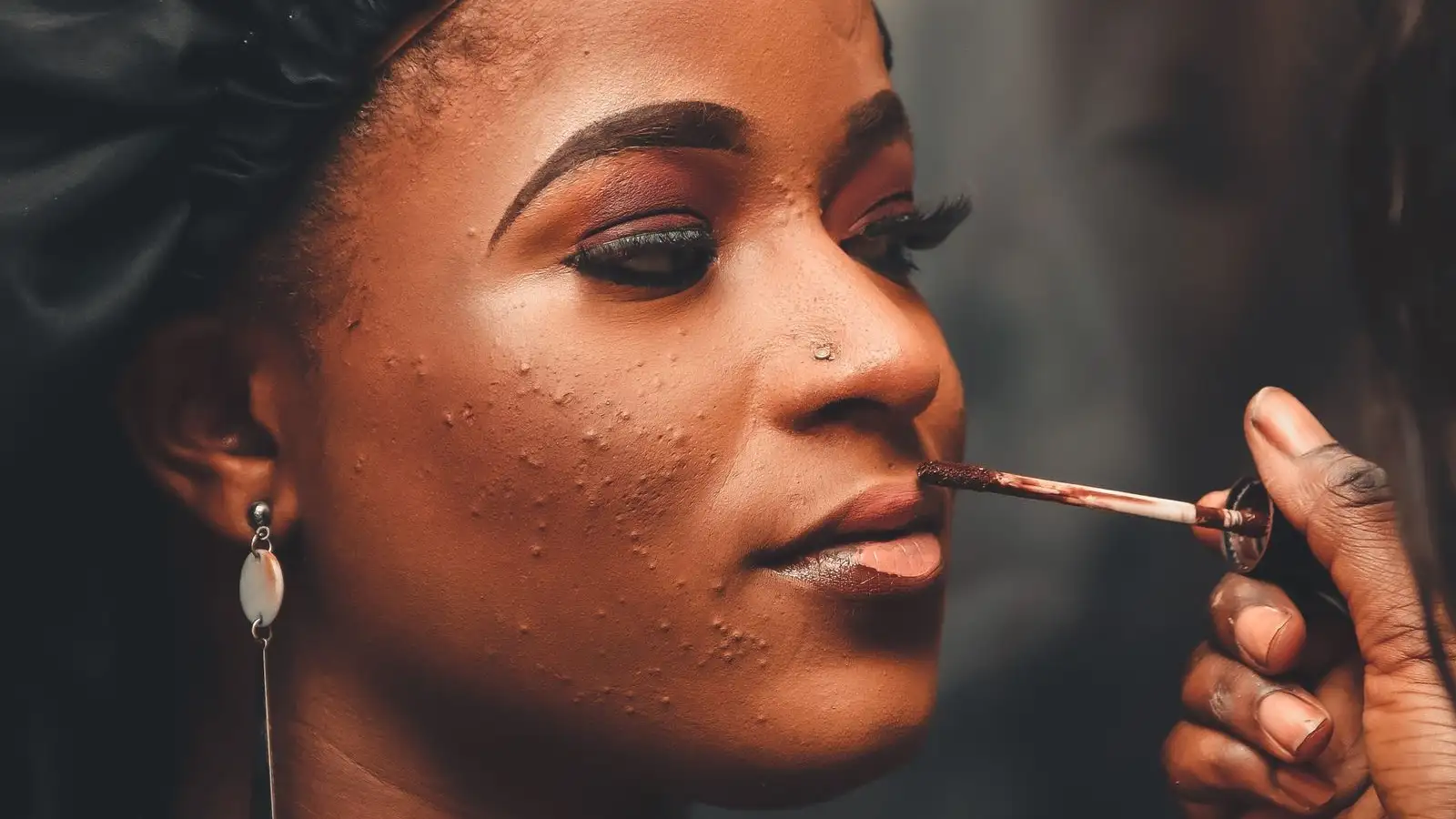
I do my diagnosis standing at a window, not sitting at a vanity. Mid-morning, curtains open all the way, a hand mirror tilted so the daylight comes in from the side and rakes across my cheek instead of hitting it straight on. Flat light flatters the product. Raking light tells the truth. When I tilt that mirror the other way and the texture vanishes, I know I am not looking at my face. I am looking at a film sitting on top of it.
That reframe is the whole job. Everything below is how I get from the foundation is bad on me to the foundation pilled because my sunscreen was still wet.
Read the clock before you read the label
I ask three questions, in this order, and I do not let myself answer them out of order.
When did it go wrong? Minute one, hour four, or hour eight.
Where did it go wrong? Hairline and jaw, or the center of the face, or pores and expression lines.
What was still moving underneath? Prep, formula, tool, setting.
Most people I know jump straight to the last one. They replace the foundation, and the problem follows them to the new bottle, because the foundation was never the thing that changed.
The first minute: pilling, streaking, grab
Pilling is small rolled balls of product that appear the second you blend. It has almost nothing to do with your skin and everything to do with two layers disagreeing about what they are.
The classic version: a silicone-heavy primer or a silicone-based sunscreen still sitting tacky on the face, and a water-based foundation going over it. The foundation grabs, the layers lift each other, and you get little crumbs along the jaw and at the hairline. The same thing happens when you go back over an area that has already started to dry. The brush lifts the half-set film instead of smoothing it.
What I check, in order:
- Is my sunscreen actually dry, or only dry enough to touch? A tacky base is the number one cause of first-minute pilling I see.
- Do my primer and foundation sit on the same side of the silicone line?
- Am I going back over the same patch more than twice?
The fix is usually a wait, not a purchase. Sixty to ninety seconds between skin prep and the first pass of foundation buys more than a new formula does.
Hour three to five: break-up, along the center of the face
This is the one that gets mislabeled as bad foundation for oily skin. It is really two processes running at once.
Oil comes up through the pores. It dissolves and lifts the film of foundation from underneath, so the product separates instead of wearing thin. You see it first around the nose, then the forehead, then the chin, the areas with the densest oil activity.
Oxidation runs alongside it. Pigment in the formula reacts with skin oil and air and shifts slightly. On deep skin that shift is often toward orange, or toward a duller, flatter version of the original tone, and once the color moves the texture becomes more visible too, because now there is a faint edge between the foundation and the skin at the perimeter of the face.
What I check:
- Did the color change, the finish change, or both? Color change means oxidation. Finish change means oil.
- Did my prep underneath include anything mattifying, or did I prep like it was a dry-skin day?
- Is the area of break-up exactly the area with the most oil, or is it everywhere?
If it is everywhere, the formula's oil-absorbing load is wrong for the day, and a thin layer of blotting and re-pressing does more than a full re-do.
Hour eight and beyond: settling, ash, and pooling
Settling is not the foundation sliding off. It is the product migrating down into the texture it is resting on and filling the spaces, so pores and fine lines read deeper than they did at nine in the morning.
Two things make it worse on deep skin specifically. First, powder. Loose powder applied too heavily, especially a translucent powder with a strong white base, flattens the tone underneath and reads gray in the areas where the face already has less light, under the eyes and around the mouth. Second, the foundation's own base. A formula with a lot of pink or ash in the base leaves a veil over the face, and a veil is a lighter layer sitting over a darker one. Contrast goes up. Every bump you have is now outlined by a slightly paler film.
What I check:
- How much powder is going on, and where. Under-eye baking with a white-based translucent powder is the most common source of grayness I see on deep skin.
- Did the foundation dry down, or did it stay wet? A wet-finish formula plus powder is cake. A wet-finish formula without powder is transfer.
- Is the setting spray going on before the powder has set, or after?
Why deep skin reads texture differently
Two things sit on top of the normal texture mechanics when your skin is deep.
The first is cast. Physical sunscreens and some setting powders leave a faint white or gray film. On lighter skin that film is roughly the same value as the skin, so it disappears into the tone. On deep skin it does not disappear; it becomes a layer. And a layer makes texture visible the way a sheer stocking makes the surface underneath visible. The product is not creating the bumps. It is lighting them.
The second is contrast at the edges. Where a foundation is slightly too light or slightly too ashy, the boundary at the hairline and the jaw becomes a visible line. That line draws the eye, and the eye then reads everything near it, a pore, a dry patch, a raised follicle, as part of the same problem. Often the entire texture issue is one slightly-off shade edge making me stare at a spot I would otherwise never notice.
The test is cheap. Blend a small patch down the neck and look at it in daylight at a window. If the texture you were worried about stops being noticeable once the color matches, the color was the problem.
The adjustment order, and why you do not skip ahead
I go in this sequence, and I only change one thing at a time.
Prep
Wait times first. Let the sunscreen dry down. Let the moisturizer absorb. Skip the mattifying primer if you already prepped for dry skin, and skip the rich cream if your T-zone is already going to break up by noon.
Formula
Water, silicone, or oil base, and how it dries down. Match the dry-down to the zone you are most worried about, not to your whole face. A formula that dries matte will look smooth on the forehead and tight on the cheek. Nothing is universal.
Tool
A damp sponge presses and sheers. A dense buffing brush moves product and pushes it into pores. Fingers give the thinnest, warmest layer and are the most likely to pill if you keep working the same spot. If you see brush streaks, your brush is too stiff or your product is already setting.
Setting
Powder type, amount, and placement. A light dusting of a finely milled powder, pressed once with a clean puff where you break up most and left off everywhere else, solves more end-of-day texture than any full-face set. Setting spray goes on after the powder has settled, not on top of wet powder.
The same bottle will behave differently across your face
This one trips people up more than any formula. Pores, oil, and dryness are not evenly distributed. My forehead and nose will break up by one in the afternoon while my cheeks still look freshly applied. My jaw is dry and will pill before anything else does. That is not the foundation being inconsistent. That is my face.
So I stopped applying one formula at one thickness everywhere. Thin, pressed layers where I am oily. Slightly more product, patted rather than swept, where I am dry. That single change did more for me than three years of switching brands.
What I still cannot fix
A few honest limits.
If the product and the prep are a genuine mismatch, a heavy silicone primer under a water foundation, no technique is going to save it. You either change the primer or change the foundation.
Heavy coverage over dry, textured patches will always show something. There is no application method that makes a full-pigment matte formula look like bare skin on a rough patch. You can lessen it. You cannot erase it.
And a formula that oxidizes badly on you will keep oxidizing. You can blunt it with a slightly cooler base or a gripping primer, but you cannot stop the chemistry. Some bottles are just not yours.
Everything else, the pilling at minute one, the shine and separation at hour four, the gray under the eyes at hour eight, is a variable you can move. Start with the clock and the location, then work the chain in order. Your skin was never the problem.

About the author
The Undertone
The Undertone is a byline for people who learned foundation on brown skin by swatching, mixing, and checking color in real light. They share a practical focus: if the depth and undertone are right, the formula will follow.
More about us