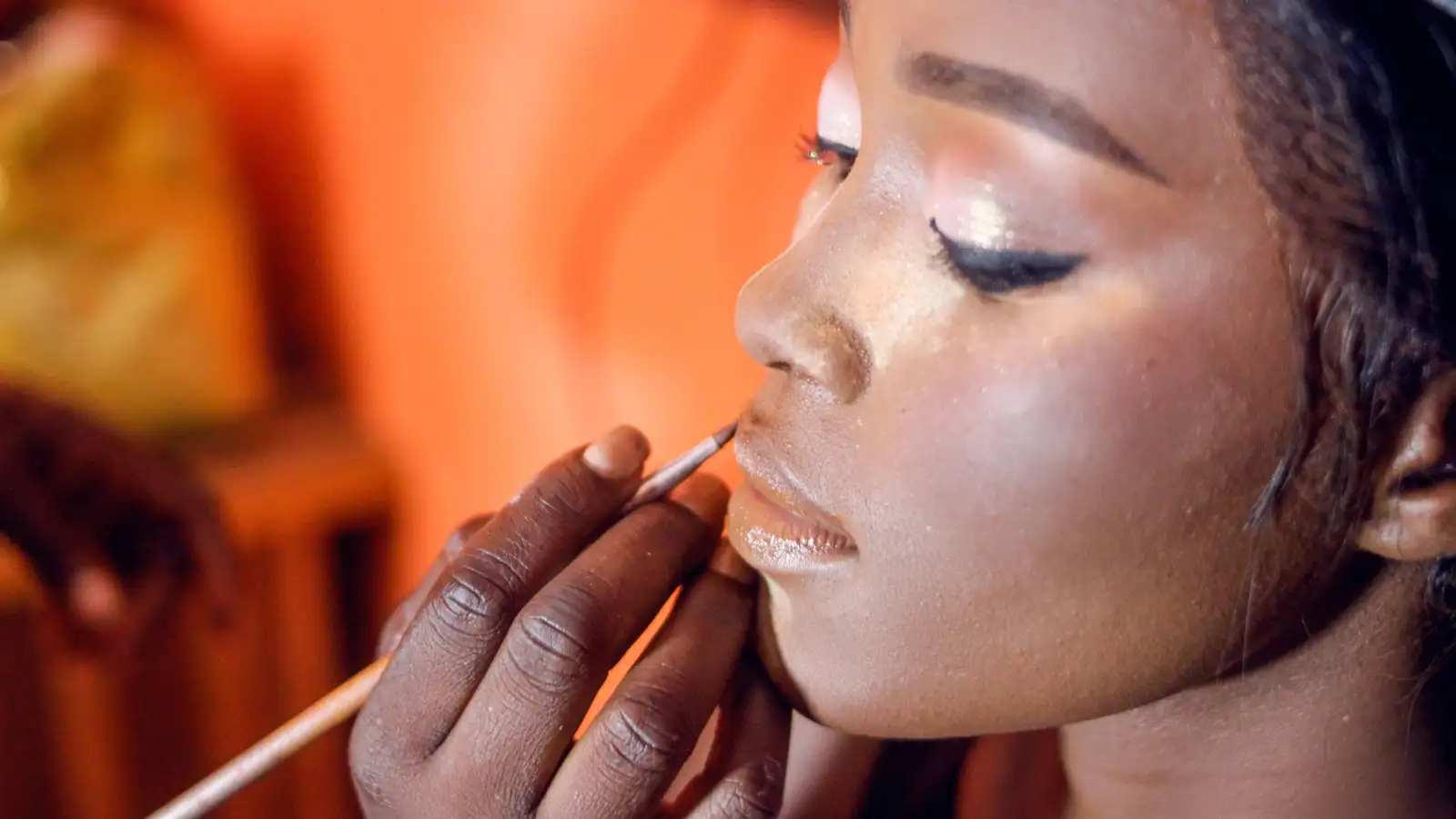
Your Foundation Isn't Too Light, Flashback Is Making It White
Your foundation isn't too light. What you're seeing in that photo is flashback: light from the camera's flash hitting the surface of your makeup, bouncing off reflective particles suspended in the formula, and coming straight back into the lens. The shade was never wrong. The reflectance is. You can confirm it in about ninety seconds, in a dark room, using the phone already in your hand.

I've run that test more times than I can count, and the moment before it always goes the same way. You finish your base and the mirror tells you everything is fine. The jawline blends. The forehead matches. The color reads even. Then someone raises a phone in a dim room, the flash pops, and there you are, two shades paler than the people standing next to you, as if someone traded your face for a paper cutout. You walk back to the mirror. Still fine. That gap between the mirror and the photo is the whole story, and once you understand what fills it, you stop hunting for a darker shade you never needed.
The mirror was never going to show you this
A mirror shows you reflected color. A flash shows you reflected light. Those are different problems, and your eye is a poor judge of the second one because it adapts. In a bathroom you're standing in diffuse light from every angle, and your brain quietly white-balances whatever you look at. A flash is a single, hard, direct burst aimed at one spot on your face. Whatever sits on the surface of your skin either absorbs that burst or throws it back.
Titanium dioxide and zinc oxide throw it back. That isn't a defect in those ingredients; it is literally their job. They scatter light. In a sunscreen, that scattering is the protection. In a foundation, that scattering is what lets pigment spread evenly across your skin instead of settling in patches. It's also what makes you read as a light source in a photograph.
You can feel it on your hand. Tap out a dot of a full-coverage liquid and smear it thin. It goes from opaque to a faint silvery sheen at the edges. That sheen is the same reflection you're seeing in the photo, just spread across your whole face instead of the edge of your hand.
Silica and certain micas do the same thing
Silica shows up in a lot of powders and in some liquids, and it's there to absorb oil and blur. Micas are there for slip and a soft glow. The finer, more pearlized grades of mica reflect at exactly the angles a flash wants. So it isn't only the two big mineral filters. It's anything you put on your skin whose job is to bounce light.
That's why the label check is worth doing in the store instead of in the car with the receipt. Read the list and look for titanium dioxide, zinc oxide, silica, and mica. One of them sitting low is usually harmless. Three of them stacked near the top is a formula that will probably light up.
The test I actually run: one side of your face
Wait until it's dark outside, or stand somewhere you can genuinely make black. A closet. A windowless bathroom. A hallway with the lights off and no screen glow. Hold your phone at arm's length with the flash on and take one picture of your face. Then look at it.
The part that matters is having bare skin in the same frame as made-up skin. If you've already done your whole face, wipe a strip along one side of the jaw, down to skin. In the dark, with the flash, that bare strip is your control. It tells you what the camera does in that room. The other side tells you what the makeup adds.
Then shoot again, with a thin layer of your setting powder over one half and nothing over the other. Now you have three zones in one image: bare, foundation only, and foundation plus powder. You can see exactly which layer is causing the trouble, which means you can fix one thing instead of replacing your whole routine.
I test powder separately for a reason. Powder is a pressed layer of particles sitting on top of your base, and if those particles reflect, they are the outermost surface the flash hits first. I've watched people cycle through five foundations while their powder was the actual culprit the entire time.
Reading what comes back
Bare skin looks like skin. Foundation-only looks chalky, pale, or faintly luminous, as though it's giving off light rather than sitting on your face. That's flashback. Foundation plus powder looks worse than foundation alone. That's powder stacking on top of the same problem. You'll usually see it worst on the high points of your face, the tops of the cheekbones, the bridge of the nose, the center of the forehead, because that's where the flash lands straight on and the product is thickest.
Here's the honest caveat. In the dark, with a flash, you're looking at a worst case. Real rooms are dim, not black. The test tells you direction, not verdict. A formula that glows white in total darkness will read slightly pale at a reception. A formula that looks like bare skin in total darkness is a formula you can stop worrying about.
Which problem you're actually looking at
I've watched a lot of money go toward the wrong fix because three different problems all get described the same way: my face looks wrong. They don't behave alike, and if you can tell them apart, you save yourself a rebuild.
Flashback only appears when a direct flash fires. Your face in the mirror is right. Your face in daylight is right. The only evidence is the photograph. That's the signature.
Oxidation is a change in the product after it's on your skin, usually the oils in your skin and the air working on the pigments over a few hours. It moves toward darker and more orange. You see it in any light, not just in a flash photo, and you see it before any photo happens. If your jaw goes orange by eight in the evening, that's oxidation, and a flash test will tell you nothing about it.
Ashiness is a gray or dull cast you can see with your own eyes, in person, in ordinary light. No camera required. That one is about undertone mismatch, pigment sitting too cool or too neutral for your skin. If it's gray in the mirror, it isn't flashback.
Three problems, three fixes. The photo only helps you with the first one.
What actually brings it down
Less product, mostly. Not a different product. Less of it.
Every layer of a light-reflecting formula adds to the reflection. If you're used to building full coverage, you are also building a mirror. I usually thin the base where the camera will look straight on and keep the heavier coverage where it won't matter, under the jaw, at the hairline, behind the ear. Nobody has ever photographed my jawline from underneath and complained.
If you're picking a formula for a night where flashes will be everywhere, look for a lower load of the reflectors, meaning fewer of those four ingredients and further down the list. The tradeoff is real and I'll say it plainly: those ingredients are part of what makes a formula cover well and feel smooth. Cut them back and you often get something sheerer and less long-wearing. There's no version of this where you keep everything. Decide which one matters for that night.
Powder is usually the easiest variable to change. If your test showed foundation-only looking fine and powder making it worse, leave the powder off for that event, or use it only where you genuinely get oily and nowhere near the center of your face. A little shine is a much smaller problem in a photograph than a white panel across your nose and cheeks.
And the thing I wish someone had handed me years ago: you can be photographed beautifully in a formula that flashes back, as long as the flash never fires toward you. Ambient light, candlelight, light through a window. None of that does this. So find out what the room will actually look like before you rebuild your routine around one bad photo from a dark hallway.
What I still can't predict
I can't read a label and promise you how a formula will behave. Percentages aren't printed. Position on an ingredient list is a rough proxy and nothing more, and two products with almost identical lists can behave differently because of how finely the particles are milled and how the formula dries down. Testing is the only real answer.
I also can't promise it plays out the same on every face. Oily skin, dry skin, and how heavily you've set your base all change how that surface reflects. What I can tell you is that the test costs one photo in a dark room, and it's the difference between buying a darker shade you don't need and simply using less of the one that already matches.

About the author
The Undertone
The Undertone is a byline for people who learned foundation on brown skin by swatching, mixing, and checking color in real light. They share a practical focus: if the depth and undertone are right, the formula will follow.
More about us