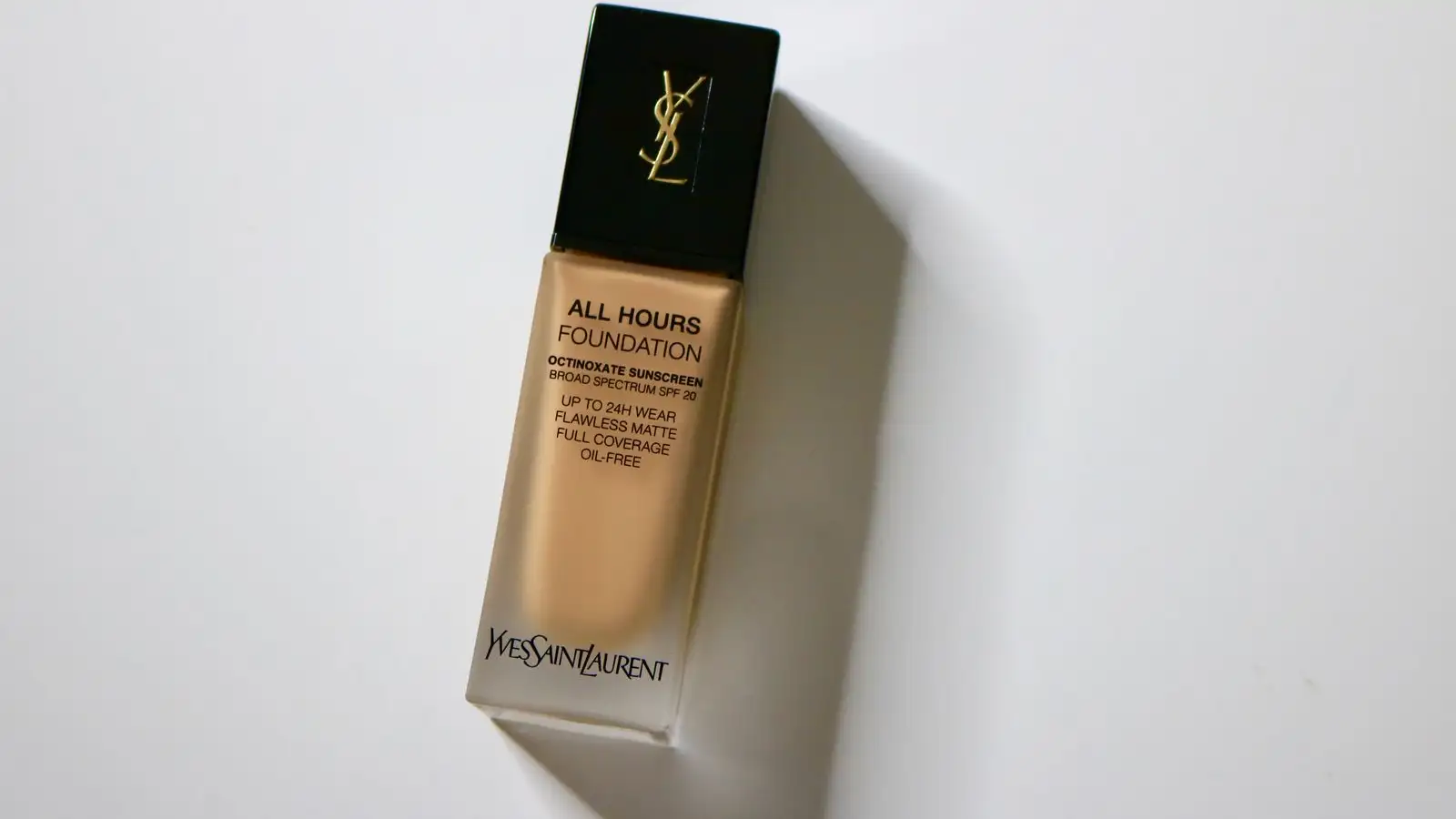
Your serum foundation has a coverage ceiling built in
Your serum foundation has a coverage ceiling, and it was set in the lab long before you touched it. A thin, watery base — mostly water, light emollients, and film formers — can only hold so much solid pigment before it stops behaving like a liquid: it thickens, it drags, it breaks into patches. Formulators know this, so they settle on a solid content the base can carry and build the product around it. That number is your ceiling, and it sits in the bottle, not in your technique.
I found mine on a weekday morning, six minutes before I had to be out the door. Daylight through the bathroom window, no overhead bulb, which is the only light I trust anymore. I had a watery foundation smeared on the back of my hand and I was on my third pass over the same cheek, telling myself the coverage was building.
It wasn't. It was moving.
The product had gone from a thin even layer to something that slid when I touched it — a faint wet shine along the top of the cheekbone, patchy near the jaw, thinning under the eye where I'd pressed hardest. I wet the sponge and bounced it again, and that's when I saw the real problem. The sponge was picking up the pigment I'd just laid down and carrying it away. Every pass added a little and removed a little, and the two were meeting in the middle.
That's the moment the idea landed for me: coverage isn't something you do to a foundation. It's something the foundation is able to hold.
What "serum" actually tells you about the base
The word on the front of the bottle isn't a category so much as a texture promise. It means the base is thin. Low viscosity. Usually water-forward, sometimes built on volatile silicones that flash off and leave film behind, sometimes both — but the defining trait is that it flows fast and levels out on its own.
That thinness is exactly what caps it. Solid pigment is heavy, and it wants to settle, clump, or separate. Water and light emollients are poor at keeping it suspended. Push the solid content too high and the formula stops being the product you bought: it thickens in the bottle, it stops spreading, it won't lay down a film. So the ceiling isn't laziness or cheapness. It's chemistry, and it's the same chemistry in a $9 bottle and a $90 one.
Which is why a serum foundation can look beautiful for fifteen seconds and then reveal everything. High water content, low solid content, and a film that clings to the shape of the skin instead of covering it.
The hand test I use now
Before anything goes on my face, I put one drop on the back of my hand and spread it with a finger, watching how far it travels before it starts to drag.
A watery base glides a long way and then suddenly grabs. That grab is the solid content announcing itself — the point where the liquid can't carry the pigment any further without breaking. A cream doesn't do that. It holds a ridge where the finger lifted, and the ridge stays. Same drop size, completely different amount of stuff in it. That ridge, or the absence of it, tells me more about coverage potential than any word printed on the bottle.
Where each format's ceiling sits
Liquid foundation comes in two structurally different families and they do not share a ceiling. A thin, watery liquid — the kind sold as a serum, a skin tint, a sheer fluid — sits at the bottom, because a low-viscosity base can't hold much solid without destabilizing. A standard liquid with more emollient and gum content sits above it. Same bottle shape, same shade name, different physics underneath.
Cream and stick formats hold more pigment and more wax. The wax is the workhorse: it gives the base a structure, a lattice, that keeps heavy pigment suspended and stable at a much higher load. That's why they reach real opacity in a single pass. The trade is that they follow what's underneath. Every pore, every fine line, every dry patch shows through more honestly, because the film sits thicker and conforms to the surface instead of shrinking into it. You get coverage, and you also get a very accurate map of your skin.
Powder is the odd one out. It builds coverage by piling more powder on top, which genuinely works — but on deep skin, layers of powder mean layers of light-scattering particles. Keep piling and the shade starts drifting lighter and grayer than the foundation beneath it. Not because the powder is wrong, but because you've laid a pale film over a rich one. If you're building coverage with powder on deeper skin, match the powder to your depth and undertone, and stop before the tone shifts. That's usually one pass earlier than you think.
"Medium" is not a number
This is where most of us get lost. "Medium coverage" describes a band, not a measurement, and that band gets measured by spreading a single layer on a flat surface. So a medium serum and a medium cream can both be labeled medium and land at completely different opacity on an actual face. One gives you your skin with the redness softened. The other gives you a new surface.
If you've ever bought a "medium" of one format, loved it, then bought a "medium" of another and felt like you'd been lied to — you weren't. You crossed from one ceiling into another without knowing the ceilings were there.
Layering, and why two thin layers can still fail
When a serum won't build, the instinct is to layer something under it or over it. That can work, but only if the films get along.
Water-based and silicone-based films don't always bond. When they don't, the top layer slides, separates, or pills into little rubbery flecks you can't blend out — and this happens regardless of what coverage level either product claims. I've watched a perfectly good mid-coverage liquid roll up into crumbs over a base it disagreed with. The coverage I was trying to build never mattered, because it never stayed on the skin.
You can usually feel the family within a minute on the back of your hand. Silicone-forward films go dry and silky and stop moving. Water-forward ones stay a touch tacky and take longer to settle. That difference is invisible when you wear one product alone. It becomes everything when you stack.
Before I layer, I think about what kind of film each one dries into. Same family, predictable. Mixed families, gamble.
Working with the ceiling instead of against it
Knowing the ceiling changed what I buy and how I use it.
I treat a watery foundation as a first layer, not a full face. It goes on thin and even, and I let it be what it is — a tone-evening film with a good finish. That's a real job, and it looks like skin, which is the whole point.
Opacity then goes where skin actually needs it. Cream concealer on the spot, the shadow, the one patch by the jaw. A small dense product in a small area does what a large thin product never will.
I stop bouncing the sponge when I'm trying to build. A damp sponge is a pigment-removal tool as much as a blending tool. If I'm adding coverage, I press with fingers or a dense brush and save the sponge for edges.
And I keep powder near my own depth. Not translucent, not "universal." Those words describe a powder designed to disappear on someone, and it usually isn't me.
When I want a different result, I switch formats rather than switching technique. If I need my skin to vanish, I reach for the format whose base has room for that — cream, stick, a properly matched powder — instead of layering a thin one four times and ending up with a wet, patchy version of the same face.
The ceiling isn't a defect in a serum foundation. It's the price of the texture: the way it sinks in, the way it refuses to sit on top, the way it reads like skin in daylight. What it can't do is pretend to be a cream. Once I stopped asking it to, I stopped fighting my own makeup every morning — and I started buying the format that matched the job instead of the word on the label.

About the author
The Undertone
The Undertone is a byline for people who learned foundation on brown skin by swatching, mixing, and checking color in real light. They share a practical focus: if the depth and undertone are right, the formula will follow.
More about us