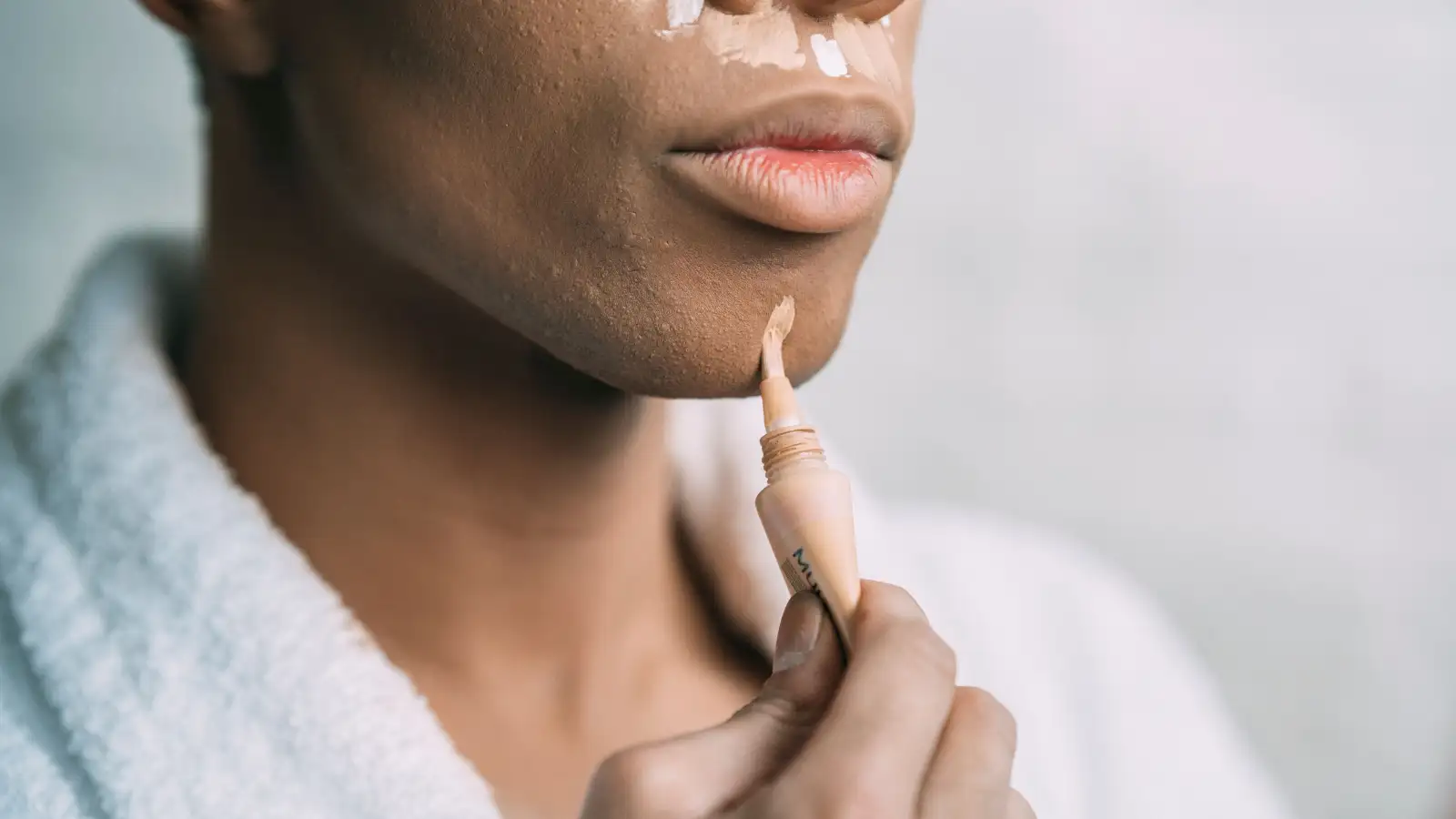
Correcting Dark Spots Before Foundation on Brown Skin
Corrector and foundation have to be chosen as a pair, and the corrector's depth should sit at the depth of the skin surrounding the mark, not at the depth of the mark itself. On brown skin a corrector is not a dot of color that disappears under whatever goes on top of it; it is the bottom half of that area's color, and most foundations are translucent enough that you keep seeing both layers at once. Get the corrector's depth right and a foundation you already own starts reading true across the spot. Get it wrong — lighter, pinker, cooler than the skin around it — and a foundation that matched at your jaw turns gray in exactly the place you were trying to fix.

I do this at a window around four in the afternoon. Mirror propped against the glass, one bottle of foundation I am trying to make work, and a corrector I have already decided is wrong. Four o'clock matters, because that is close to the light a face actually lives in, and because the bathroom bulb at seven in the morning is warm enough to flatter anything. If a correction looks right at the window and wrong in the bathroom, the window was telling the truth.
Judge the mark against its neighbors, not against the mark
The first thing I look at is not the spot. It is the skin beside the spot.
A dark mark sitting in a field of brighter skin reads darker than its own pigment, because the eye compares instead of measuring. That is the trap. You look at the mark, decide it is very dark, and reach for the heaviest, most opaque corrector you own — when the size of the correction is actually set by how far the mark sits from the surrounding tone, not by how dark the mark looks on its own.
Then the hue. Turn the cheek toward the window, then away from it. If the mark goes blue-gray or ashy in daylight, it is the cool kind, and it wants peach or salmon at medium depth and orange at deeper depths. If it stays warm and russet — red-brown, violet-brown — it is pulling the other direction and it wants green. Correctors work by cancelling, and cancellation runs on the opposite side of the color wheel from the thing you are cancelling. That much is in every guide.
What most guides skip is the second half: the corrector also has to sit in the same undertone family as the skin around the mark. A peach that is right for a warm golden-brown cheek will turn pink and chalky on an olive-brown cheek a step deeper. Depth and undertone, both, every time. And the back of your hand is not a test surface. It is lighter than your face and it will lie to you.
Where light and pink correctors go wrong
Here is the part that took me years to stop arguing with.
A corrector that is lighter than the skin around it does not just sit on the mark. It raises the value of that whole patch. The foundation over it is not opaque paint — you are looking through it. So the area underneath reads lighter, and if the corrector is also pinker or bluer than the surrounding skin, it reads desaturated at the same time. Lighter plus desaturated is gray. That is the gray cast. It is not the foundation oxidizing and it is not your skin chemistry. It is a value mismatch sitting under a coating.
The fix is not a more opaque foundation. The fix is a corrector whose depth matches the skin around the mark and whose hue does the cancelling. If your corrector is making the area lighter rather than simply less noticeable, the depth is wrong. And a corrector that is too light shows up in flash photography before it shows up in a mirror, which is a special kind of surprise at an event.
Press, do not sweep
Corrector goes on the mark. Not on the cheek.
I tap it in with a fingertip or a small flat brush, one thin layer at a time, and I press rather than drag. Pressing keeps the product where I put it. Sweeping pulls it across the whole cheekbone, and then two things happen at once: the mark is barely corrected, and the skin around it has shifted lighter. Now the foundation over that cheek does not match the rest of the face and you blame the foundation. I have done that. It is a twenty-dollar mistake and it always feels like the bottle's fault.
Thin layers also let you stop. Two thin taps built to the right depth look like skin. One thick tap, spread around to even it out, looks like something applied.
The combination changes what your foundation reads
This is what makes correction a pairing problem instead of a step.
Put a corrector under a matched foundation and that foundation is now sitting on a different value. It will read a notch lighter or a notch deeper over the corrected area than it does on the rest of your face. If you matched the foundation on bare skin at the jaw, you matched it to the wrong thing.
So I re-check the whole combination on the jawline and down onto the neck, with the corrector already on the marks. Foundation swiped over a corrected cheek, then over the jaw, then a stripe onto the neck, by a window, no store lights. If the corrected area wants a foundation a half-step deeper, that is information — and it usually means the corrector is a shade too light, not that you need a second foundation. One foundation that reads slightly light over the corrected spots is worth more than two foundations that each work in one place.
Under the eye, the moisturizer is the whole game
Under-eyes go ashy for a boring reason: too much sitting underneath, so the corrector rides a slick surface, slides, collects in the one line it can find, and dries down gray at the edges.
The under-eye area needs enough moisturizer to stop the corrector from dragging, and no more. One thin film, warmed between two fingers, pressed in. Then wait a minute or two — go do something else — and blot whatever is still on the surface. If you can feel product there, there is already too much for corrector to sit on.
One more thing about depth under the eye. That skin usually runs one to two steps deeper than the cheek because of the socket, and the shadow adds more on top of that. So a corrector that matches your cheek exactly can still read light under the eye. Slightly warmer and slightly deeper than you would guess is the better starting point. And if you also want a lighter concealer there, you are stacking two lighteners; when it goes gray, thin the corrector before you change the concealer.
When it looks heavier than your skin
Cream corrector plus foundation over the same square inch will look heavier than the skin around it. When that happens most people thin the foundation, and that is backwards.
The corrector is the layer that exists only to shift hue, so it is the layer that can shrink. I take the corrector down to a sheer tint that still moves the color, keep the foundation at its normal coverage, and press rather than blend.
If the mark comes back through the thinner corrector, do not answer it with more of a light corrector. Use a corrector one step deeper in a smaller amount. A deeper corrector used sparingly ends up looking lighter over the whole patch than a light corrector used generously, because the light one is lifting the value of everything on top of it. Depth is not the same thing as amount, and that single confusion causes more gray patches than anything else I know of.
Sunlight a couple of hours in is the last check. Cream formulas can shift as they warm on the face, and a combination that looked paired at four in the afternoon can look a half-step off by six. When it does, it is almost always the corrector, not the foundation.

About the author
The Undertone
The Undertone is a byline for people who learned foundation on brown skin by swatching, mixing, and checking color in real light. They share a practical focus: if the depth and undertone are right, the formula will follow.
More about us