The Primer Match That Decides Foundation on Deep Skin
A primer and a foundation only work together when both are built on the same base family — silicone over silicone, water over water, oil over oil. Read the first five ingredients of each bottle before either one goes on your face. When one leads with dimethicone or cyclopentasiloxane and the other leads with water, glycerin, or butylene glycol, the foundation is going to pill, separate, or pull gray on deep skin, no matter how good either product is by itself.
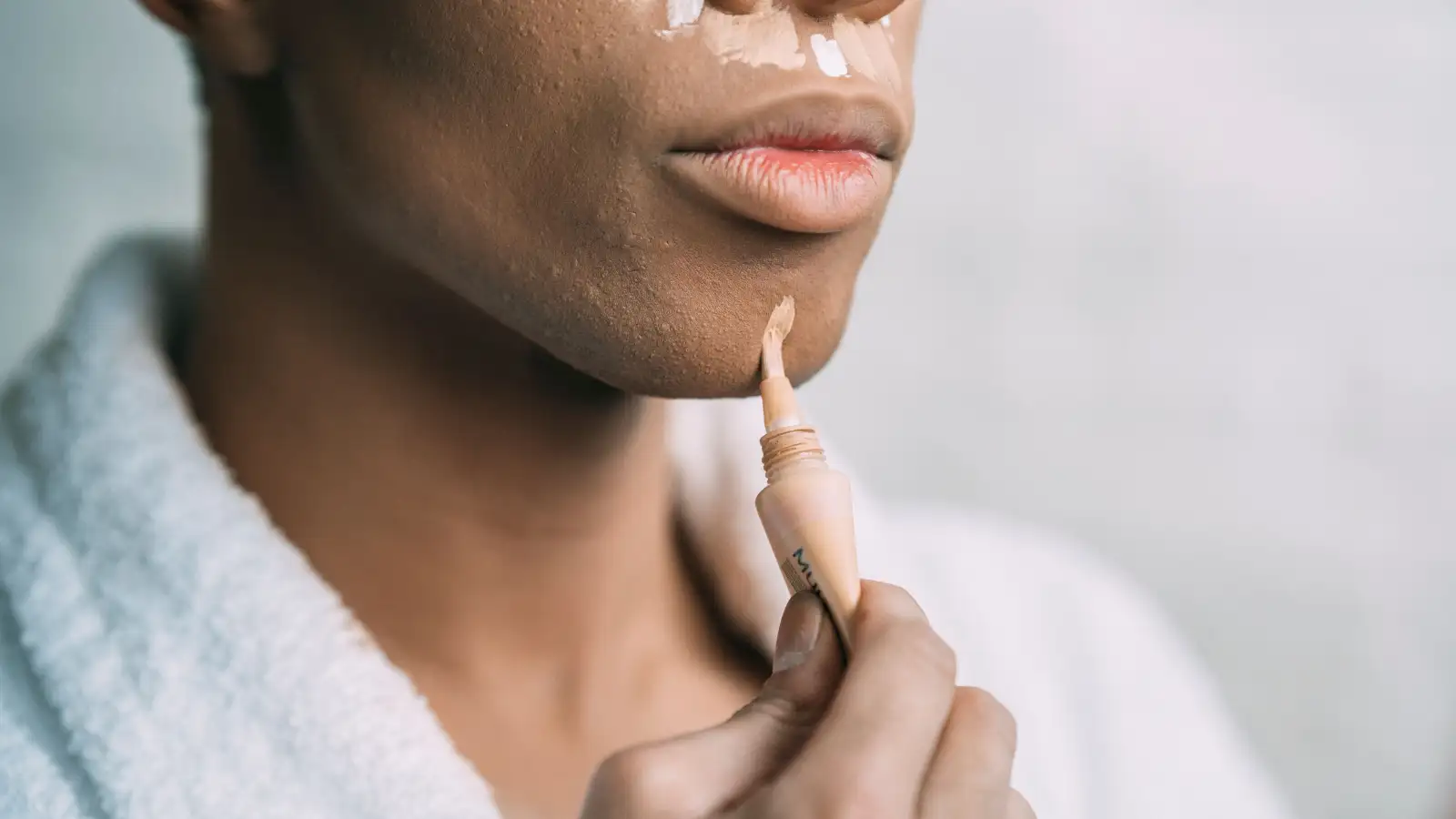
Stand at my sink with me for a minute. It's a weekday, about 7:40 in the morning, and the light over the mirror is that flat yellow that makes everything look two shades warmer than it actually is. I have foundation on the left half of my face and nothing on the right, and I'm watching the right side fail in real time. Every pass of the brush along my jaw is rolling the foundation up into small beads the color of a pencil eraser. Underneath the beads the skin is a completely different, duller tone than the side that went on bare. Same bottle. Same brush. Same amount. The only difference is that the right side had a primer underneath it.
That was the morning I stopped thinking of primer as a step in a routine and started thinking of it as a film. Once you see it that way, the failures stop looking random.
A base is a film, and films have to like each other
Every base product — primer, foundation, tinted moisturizer, skin tint — dries down into a film. The film is made of whatever liquid carried the pigment plus whatever film former is dissolved in it. Three families show up over and over.
Silicone-based. Dimethicone, cyclopentasiloxane, dimethicone crosspolymer, trimethylsiloxysilicate sitting near the top of the list. The volatile silicones flash off and leave a dry-touch, faintly slippery sheet that water cannot get through.
Water-based. Water first, then glycerin or butylene glycol, held together by an emulsifier and set by a water-soluble film former — VP/VA copolymer, PVP, acrylates copolymer. The water evaporates and the polymer grabs. Thinner film, closer to skin, more breathable.
Oil-based. An oil or an ester leads — caprylic/capric triglyceride, squalane, jojoba — usually with wax behind it. Emollient, mobile, and it has plenty of grab of its own.
Here is the part that primers almost never get sold on. Films stick to skin, and to each other, based on chemistry — not on price, not on how the bottle looks, not on how the primer felt on the back of your hand. A water-based foundation's film former needs a surface it can wet and mesh into. Bare skin gives it that. A dry water-based film gives it that. Silicone does not. Silicone gives it a slick, low-friction, water-repellent sheet. The foundation lands on top, and then it just lives there, unanchored.
That is the whole mechanism behind the eraser beads on my jaw. The brush drags the top layer, the bottom layer refuses to let go of anything, and the pigment rolls up instead of settling.
Read the first five ingredients, not the front of the bottle
"Water-based" on a label is marketing. The list is the fact.
Line the two bottles up and read down. If dimethicone or cyclopentasiloxane is first or second, that primer is a silicone film and it wants a silicone foundation on top of it. If water is first and there's no silicone in the top five, it's a water film and it wants a water foundation or bare skin. If an oil or an ester is first, it's an oil film and it wants an oil-based or cream base.
One honest caveat: in the US, ingredients present at 1% or less can be listed in any order after the ones above 1%, so a film former sitting eighth on the list is there in a small amount. It still matters, but read the top of the list as the architecture and the bottom as trim.
The other caveat is hybrids. A water-in-silicone emulsion can start with water and still have cyclopentasiloxane second and a silicone emulsifier like PEG/PPG-18/18 dimethicone holding it together. Those are genuinely two-faced products. They can work with either family, or with neither. You cannot read your way out of a hybrid. You have to test it.
Why the wrong film turns deep skin gray, not just patchy
Medium skin wearing a water foundation over a silicone primer usually gets something that reads as soft focus or slightly powdery. Deep skin gets ash.
The silicone film has a scattering quality — it's diffuse, slightly milky, and it does not absorb. So you end up with three layers instead of two: your skin, a pale scattering sheet, and then pigment floating above it. Add that the foundation, because it never meshed, never picks up any of your skin's warmth. It shows only its own color, dry, at full strength. On deep skin that combination desaturates hard, and desaturation reads cool. Cool plus dark equals gray, or sometimes a lavender cast around the perimeter of the face where the film is thickest.
A powder layer will not fix this. Neither will more foundation. Adding pigment on top of a scattering sheet just gives you more pigment sitting on a scattering sheet.
Gripping primers and the two-sticky-surfaces problem
There's a whole category of primer built to grip — tacky resins, often the same VP/VA copolymer or acrylate chemistry that's already in a long-wear foundation. The pitch is that it holds foundation in place. Sometimes it does. Sometimes it makes the foundation move more, and people can't figure out why.
Picture two pieces of tape pressed sticky side to sticky side. They hold onto each other beautifully. The whole sandwich still slides across the table. That's what happens when you layer a tacky primer under a tacky foundation. The two films bond to each other and the pair floats over your skin as one unit, migrating toward your hairline over the course of a day, bunching in the nasal folds, and printing off onto anything that touches your face.
Grip needs an anchor. Skin is the anchor. Two grippy films stacked with nothing holding the bottom one down is not grip.
Cream and stick foundations change the math entirely
Everything above assumes a thin liquid foundation. Cream and stick formulas behave differently, even when the base families match on paper.
A cream or stick has a lot of wax and oil, which means it has slip and grab of its own before you add anything. Put a tacky gripping primer under it and the primer's tack catches the cream before the cream can glide — you get dragging, skipping, and pigment that pulls unevenly across the cheek instead of laying flat. The primer didn't fail. It was the wrong tool for that formula.
Cream and stick bases want slip underneath, or clean skin. If you love a gripping primer, keep it for your thin liquids. Under a stick, it works against you.
The jawline test, and what a failure looks like in two minutes
You don't need to commit a whole face to find out. Do this on a morning when you're not going anywhere.
Let your skincare settle first. Ten minutes at least. A rich moisturizer is its own film, and testing over wet skincare teaches you nothing.
Pick one strip of jaw — two fingers wide, running from mid-jaw down toward the neck. Primer on that strip only. Leave the mirror-image strip on the other side bare. Wait about sixty seconds so a gripping primer can actually set.
The same foundation, the same amount, the same tool on both sides. One side is your control. That's the entire point.
Now watch in stages. At thirty seconds: is the primed side dragging under your fingers or brush? Pilling is a fail, and it's a fail within the first few strokes. At two minutes: compare the two colors side by side in daylight, not mirror light. A primed side reading cooler or grayer than the bare side is the ash problem showing up early. At ten minutes: look for streaks and patchiness, and for a visible edge where the primer strip ends and color changes. At two hours: check the hairline and the creases beside your nose. A foundation that has migrated off the primed side and left a clean border is telling you the film never anchored.
Where the rule bends
Two mismatched films can sometimes be forced to cooperate with a thin dusting of setting powder in between, which gives the top layer something rougher to grab. It genuinely works sometimes. It also changes the finish, adds a layer, and on deep skin it can trade ashiness for flatness — you get an even, correct shade that reads dull because there's now powder texture sitting between your skin and your color. That trade is real and you should make it knowingly.
And the hybrids again. The only honest answer for a water-in-silicone foundation is that the ingredient list gets you a hypothesis, and the jawline gets you an answer.
If I could leave you with one habit, it's this: buy the primer to match the foundation you already love, not the other way around. The foundation carries the color, and the color is the hard part on deep skin. The primer is a film. Make it the right film.

About the author
The Undertone
The Undertone is a byline for people who learned foundation on brown skin by swatching, mixing, and checking color in real light. They share a practical focus: if the depth and undertone are right, the formula will follow.
More about us