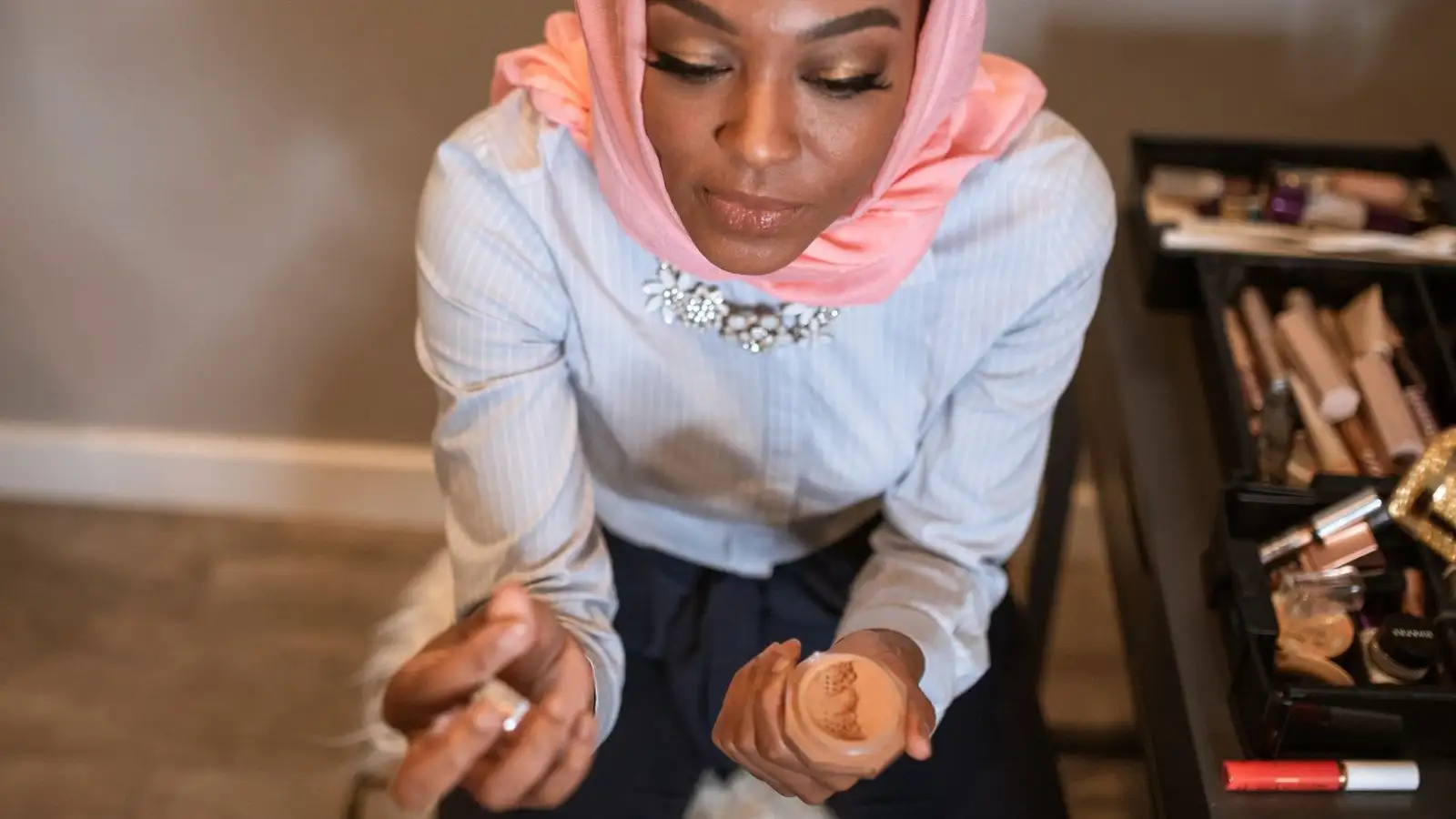
Liquid Cream Stick or Serum Foundation on Mature Deep Skin
The formula that reads truest on mature deep skin is the one whose base matches what your skin is doing that morning, not the one with the strongest coverage claim. A cream or a stick brings emollience to skin that has lost some of its own. A silicone-forward liquid lays a smoother film over texture. A serum builds quietly in thin layers and rarely covers uneven tone on its own. A powder is a touch-up, not a base. Depth and undertone choose the shade; the base decides whether that shade sits the way it looked in the bottle.

I do this at the bathroom window with the overhead light off, because the warm bulb over the sink has lied to me more consistently than any foundation ever has. It is early. The light through the glass is flat and slightly gray, and the first place I look is the jaw, right under the bone, where the dryness arrives before it shows up anywhere else. That patch decides which formula I pick up. Everything else — brand, packaging, whatever is stacked at the front of the shelf — comes after.
The base decides more than the shade does
Pigment is only the passenger. What carries it — water, silicone, oil and wax, or a watery serum emulsion — sets how it glides, how quickly it sets, and whether it grips a dry patch or slides past it. Put the same pigment load in two different vehicles and by four in the afternoon you are wearing two different colors. That is the whole reason a shade that looked right in one formula can look foreign in another.
So I stopped asking which formula is best and started asking what each base is physically doing on my face.
Liquid: water and silicone split the same shade in two
Liquid is the default for a reason. It covers the widest range of textures with the least effort, and the two base families inside it behave almost like different products.
A water-based liquid goes on light and thin. It feels like nothing, which is lovely, and it dries down fast, which is not always lovely. Water leaves, pigment stays, and whatever texture was underneath is now doing the talking. On the dry patch under my jaw a water-based liquid can go patchy and read a shade lighter there than on the rest of my face — not because the color is wrong, but because the dry skin is drinking the vehicle and leaving the pigment stranded on top.
A silicone-based liquid is the opposite personality. It glides. It fills in the look of texture. It makes pores less obvious without any powder at all. On deep skin the trade is real: a heavily silicone, very matte liquid has almost no light coming back off it, so it can read flat and gray in the areas where I want the most depth — around the mouth, along the jaw. And silicone does not like oil. It can break apart over a T-zone that is producing by noon in a way a water-based formula usually does not.
What I do with either: I put a thin layer of moisturizer on the dry patch and let it sink in for a full five minutes, then press the liquid in with a damp sponge instead of buffing it. Buffing a water-based liquid over dry texture is how you get the little flaky edges that no setting spray will fix.
Cream and stick are the same idea at different concentrations
A cream foundation is oil and wax carrying pigment. That is the whole recipe. It is emollient, it moves with the face instead of sitting on top of it, and on mature deep skin it blends into texture instead of highlighting it. The trade is that it never fully sets on its own. Left alone, it travels — into the lines around the mouth, up toward the eyes. A light press of setting powder through the center of the face handles that. Not a bake. A press.
A stick is that same cream, concentrated, in a form you can draw with. I keep one for two jobs: the deeper patch at my temple where I want pigment exactly there and nowhere else, and the small area at the outer corner of the mouth where a liquid always seems to slip. Drawn on and pressed out, it is the most precise thing I own.
But a stick will drag. If I press hard on dry, mature skin the wax pulls, and the pigment drops straight into the fine lines it just crossed. The fix is warmth and pressure — a short stripe on the back of my hand first, then a damp sponge to press it out. A damp sponge can sheer a stick down to something that reads like bare skin. A dry, dense brush does the opposite and packs it up to full coverage. Same stick, two completely different finishes, depending only on the tool.
Serum: thin layers, and an honest ceiling
Serum formulas are mostly water with a low pigment load and a lot of slip. They feel wonderful going on. They are also the format I trust least to cover uneven tone by themselves.
On deep skin with post-inflammatory marks or darker patches across the cheeks, one pass of a serum foundation evens almost nothing. Two passes start to show. Three gets there — but only if I let each layer settle for about a minute before the next one, or the second pass lifts the first and I end up with streaks. The film formers in a serum are usually light, which is exactly what keeps it looking like skin and also what keeps it from holding through a long day.
I wear serum when I want to look like I am wearing nothing and I do not have anywhere to be at eight in the evening. That is the honest boundary of it.
Powder has one job, and ashing is the risk
Powder is not a base for me. It is a touch-up and a setter. Blot, press, done.
The reason it goes wrong on mature deep skin is simple: powder is pigment plus a white, light-scattering filler. If the filler out-votes the pigment, the finish reads gray. On deeper skin that shows up faster and more obviously than on lighter skin, and it shows up worst when the powder is both too light and too matte. A very matte powder also removes the small amount of light that makes texture look like texture instead of like lines. It settles into anything that is not flat.
What I do: use very little, press and roll rather than sweep, keep the powder at or deeper than my actual undertone rather than reaching for a translucent, and stay out of the under-eye area with anything heavy. If a loose powder is too light but otherwise fine, blending a pinch of it with a deeper powder I already own fixes it without buying anything new.
The only fair check is in the finish you will actually wear
This is the part I got wrong for years. A shade swatched on a bare jaw in the store tells you almost nothing about how it will look once it has been set, or once it has been left dewy, or once it has been sitting on your face for a few hours.
So now I check the formula the way I intend to wear it. If I am going to set it, I set the swatch. If I am going to leave it dewy, I leave the swatch alone. I put three stripes along the jaw — not the wrist, not the back of the hand — in daylight, and I walk away for twenty minutes before I decide. That wait matters because the base oxidizes and the shade shifts, and the shift is different for an oil-heavy cream than it is for a water-based liquid.
And because the base changes how the color reads, a shade I already own can become usable just by changing what is under it or over it. A liquid that has gone patchy on a dry day takes a small amount of cream pressed over the top. A serum that is not covering enough takes a stick in the two places that need it. A powder that is reading gray takes a deeper powder blended into it. That is the part that actually helps — not finding a new shade, but changing what the shade sits in.
I keep three things now: a silicone liquid for even days, a cream for dry ones, and one fine powder for the middle of the afternoon. Everything else on the shelf is a version of the same decision, and I already know how I make it.

About the author
The Undertone
The Undertone is a byline for people who learned foundation on brown skin by swatching, mixing, and checking color in real light. They share a practical focus: if the depth and undertone are right, the formula will follow.
More about us