The Setting Powder Mistake That Makes Deep Skin Look Gray
The gray film that shows up on deep skin almost never comes from the foundation underneath. It comes from the setting powder sitting on top, and from three things happening at once: too much powder, particles coarse enough to stay visible on the surface, and placement that covers the whole face instead of only the spots where foundation actually moves. Fix the amount, the texture, and the placement, and the ash goes away without giving up the wear time you powdered for in the first place.
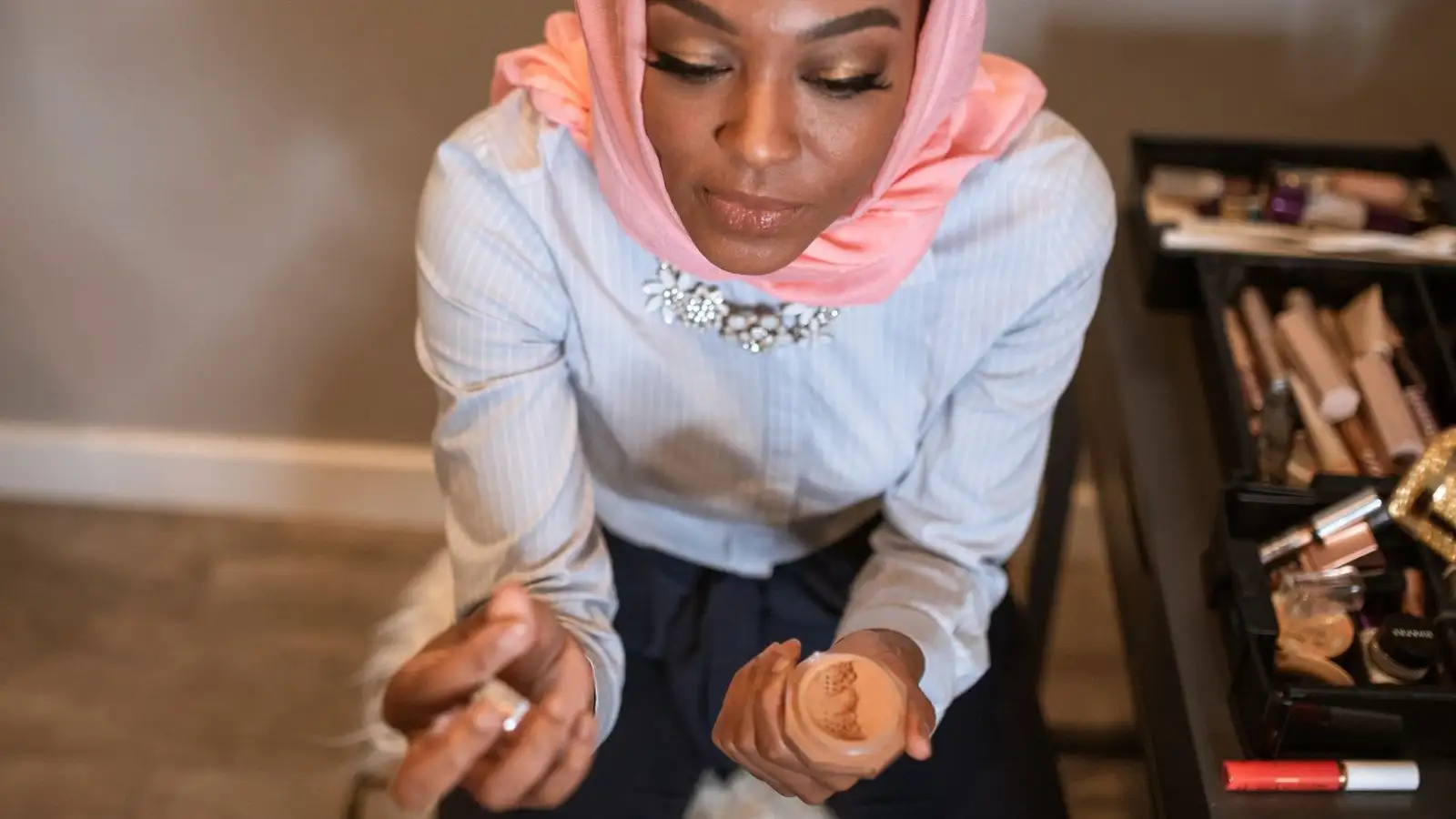
I do my face in a bathroom with one warm bulb over the sink, and warm light forgives everything. Powder goes on, skin looks even, I leave the house believing it. Then I pull the visor down in the car and it's there: a flat gray veil across my forehead, the bridge of my nose, the tops of my cheeks. Like someone dusted me with chalk and walked off. In the bathroom I looked finished. In the visor I looked coated.
That gap between the two lights is where the entire problem lives. A warm bulb hides a cast. Daylight reports it.
The powder isn't the enemy — the blanket is
The instinct is to dip the brush, tap it once, and sweep it over the whole face, because that's the move you see everywhere. On deep skin, that spreads a light-scattering layer over the largest possible area. Powder isn't wrong for you. A full-face blanket of it is wrong for anyone whose skin runs darker than the powder's base.
Most setting powders are built on silica, mica, or titanium dioxide. Those are the ingredients that make a powder look bright and blurred in the pan, and they're exactly what they sound like — white light-scattering fillers. On lighter skin, a thin scatter of that reads as soft focus. On deep skin, the same scatter is a lightening layer, and because the light it throws back is neutral-to-white, the result isn't a lighter brown. It's gray. That's the specific failure. Not "the powder is too light for me," but "the powder is bouncing white light off brown skin."
"Translucent" is not a color
This is the one that cost me the most time. Translucent means low coverage. It does not mean no color. A translucent powder built on a white base is still white on your face, and once you've applied enough of it, it still goes gray on deep skin. The word on the lid tells you nothing about how the powder reads on you.
Tap some onto the back of your hand and walk it to a window that doesn't get direct sun. If you can see a film sitting there, you will see it on your face, just bigger.
Particle size is the part nobody explains
Two powders can be the same shade and behave nothing alike, because of how finely they're milled. Fine powder sits close to the skin and mostly disappears into it. Coarse powder sits on top like dust and stays visible from across a room.
Rub a pinch between your fingertips. Fine-milled feels like silk and leaves almost nothing behind. Coarse feels grainy and leaves a haze. That haze, sitting on deep skin in daylight, is the gray you're trying to get rid of.
Pressed versus loose is not the real question here. I've owned both that behaved well and both that behaved badly. What matters is whether it sinks in or sits on top, and that's a fingertip test, not a category.
Set what moves, leave what doesn't
The T-zone is the whole job: between the brows, down the sides of the nose, and the center of the forehead. Maybe the chin if your foundation travels there. Cheeks, jawline, and the area around the mouth get nothing on a normal day unless they're genuinely sliding.
On mature skin this placement rule does double duty. Powder doesn't just go gray where it piles up — it also settles into fine lines and clings to any dry patch you didn't know you had. The cheeks and the lines running from the nose to the mouth are where that shows first. Setting only what moves keeps both problems off the table.
Press, don't sweep
A small brush or a puff folded in half, not a big fluffy one. A big fluffy brush holds a shocking amount of product and then releases it across your entire face in one pass. A small one puts powder where you aim it.
Press and roll. Sweeping drags powder onto areas you meant to leave bare and lifts the foundation underneath while it's at it.
The amount nobody believes
Tap the brush, then tap it again, and don't apply until the tap stops producing a visible cloud. If powder is falling through the air before it touches your face, you're carrying several times what you need. Aim for roughly half of what feels correct. You can always add more at lunch. You cannot take a blanket off.
Baking is the wrong direction for mature deep skin
Baking means piling powder on thick and letting it sit. It's the single fastest route to a gray cast in daylight, because you're stacking the exact light-scattering fillers that cause the problem, and you're stacking them in a thick layer. It also presses that layer into every fine line around the eyes and mouth. There are techniques worth borrowing from other routines. This isn't one of them.
Catch it before anyone else does: the window and the flash
Two checks, thirty seconds total, and they catch different problems.
Walk to a window that isn't getting direct sun, or step outside into shade. Direct sun flattens everything and lies to you. Indirect daylight is honest. Look at your jaw and the center of your forehead and ask whether the powder area reads the same tone as your neck.
Then take a phone photo with the rear camera, flash on, held at arm's length, in a normally lit room. If the center of your face comes back lighter than your neck, you have flashback — the powder is reflecting the flash straight back at the lens. Your face looks fine to the eye and wrong in every photo from that night.
White cast and flashback are not the same thing, and they don't always travel together. A cast is a daylight problem you can see in the mirror. Flashback is a camera problem you often can't. If the window check is clean and the flash check goes pale, the powder isn't necessarily the only culprit — a foundation with a high mineral sunscreen load or a heavy titanium dioxide content can bounce flash too. But powder on top of that foundation makes it worse, not better.
Give the powder a few minutes to settle before you run either test. Checking immediately gives you a slightly different picture than the one everyone else will be looking at an hour later.
Setting spray melts powder — it doesn't erase gray
A setting spray genuinely helps. It takes down the flat, powdery surface and lets the powder melt into the foundation so the finish reads more like skin. What it cannot do is neutralize a visible cast. If you can already see gray in daylight, spraying makes the gray sit more smoothly, which is not the same as making it go away. Spray is a finisher, not a correction.
If the cast is already on your face
Press a barely damp sponge over the areas that went gray — press, don't wipe. Wiping smears foundation and powder together into a streaky mess. Pressing lifts some of the excess without disturbing much else. Then re-set only the spots that actually need it, with less powder than the first time. On some days the honest fix is a little of the foundation you already own, pressed over the grayest patch, and no powder at all on top.
Where the tradeoff sits
This isn't a case for giving up powder. A long day, a humid room, a T-zone that shifts foundation by two in the afternoon — powder earns its place. The goal is the smallest area, the least product, and the finest texture that still stops the foundation from moving. On dry, mature deep skin, some days the correct amount is close to nothing, and blotting through the day beats adding another layer you'll have to reverse later.
I check at the window before I walk out now. The car visor is a terrible place to find out.

About the author
The Undertone
The Undertone is a byline for people who learned foundation on brown skin by swatching, mixing, and checking color in real light. They share a practical focus: if the depth and undertone are right, the formula will follow.
More about us