Chemical Peel for Dark Spots: Avoid This Depth Mistake
Dark spots and chemical peels: the decision that makes or breaks the outcome is depth, not ingredient brand or percentage alone. For melasma and skin that sits at Fitzpatrick IV or above, the playbook is clear — superficial peels are the only rational default, and a medium-depth TCA peel (15–35%) is a reliable trigger for post-inflammatory hyperpigmentation. That is not a caution; it is a contraindication backed by how melanocytes in melanin-rich skin respond to dermal injury. This article maps that depth-risk cutoff so you can fade pigment without creating more.
Match Your Starting Point: Dark Spot Type and Fitzpatrick Score
Until you pin down the combination you are treating, discussing peel protocols is noise. Choose the scenario closest to your own.
- Melasma on Fitzpatrick III–V skin — Your route: Absorb why medium peels are functionally off-limits, then execute the superficial-peel protocol that keeps melanocytes quiescent.
- Sun spots (lentigines) on Fitzpatrick I–III skin — Your route: Medium-depth TCA under clinical control may enter the conversation, but you will still learn when a superficial series is the sharper first move.
- Post-inflammatory hyperpigmentation on Fitzpatrick IV–VI skin — Your route: Superficial agents plus a pigment suppressor form the entire strategy; medium-depth peeling has no defendable place here.
- Uncertain about spot type or Fitzpatrick — Your route: Start with classification, then use the depth-mapping stage to build a plan that fits your actual risk profile.
Stage 1: Classify the Pigment So the Depth Decision Has a Base
What this stage is for — Peel depth without pigment biology is just acid on skin. The location of the excess melanin, the stability of the melanocyte, and the original trigger all dictate how far down you can safely go.
Actions to take
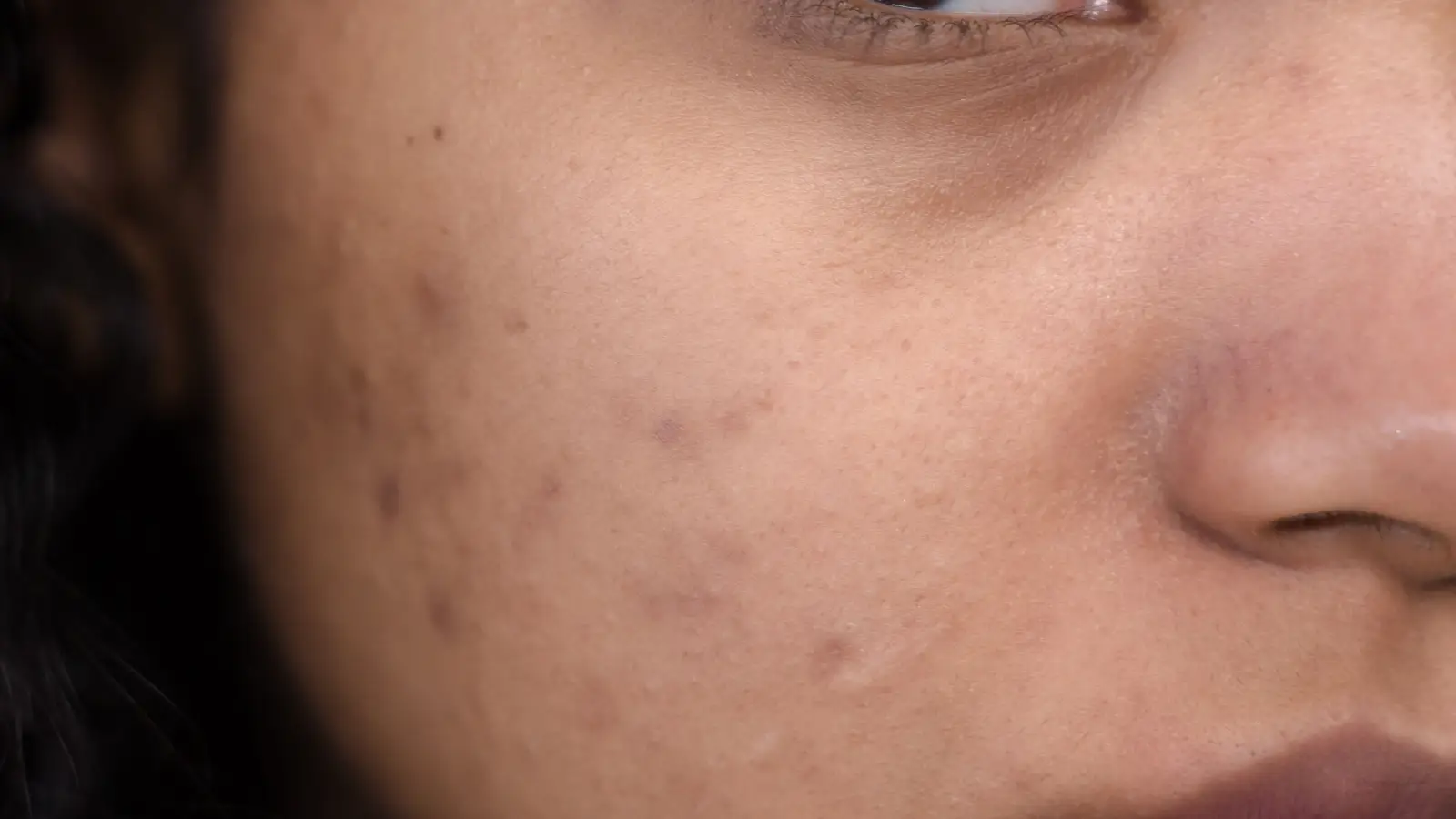
- Differentiate epidermal from dermal pigment: melasma typically appears as smudgy, grey-brown patches with indistinct borders; lentigines are flat, uniform brown spots with sharp edges; PIH mimics the shape of a former pimple or injury.
- Pin the trigger: hormonal shift, cumulative sun exposure, recent acne.
- Determine Fitzpatrick phototype (I–VI). If there is any doubt, assume the darker end — overestimating resilience is the dangerous mistake.
- A Wood’s lamp exam, when available, clarifies depth: epidermal pigment intensifies under the light, dermal pigment looks muted.
Sign you can advance — You state your primary dark-spot type, its probable depth layer, and your Fitzpatrick score without hedging.
Stage 2: Map Peel Depth to Spot Type and Fitzpatrick — The Cutoff That Decides Safety
What this stage is for — A hard internal rule: which peel depths are categorically unsuitable for your combination, and which superficial agent and concentration range you will stay within.
Actions to take
- Know the three depth tiers:
– Superficial (epidermis only): Glycolic acid 20–70%, lactic acid 20–50%, salicylic acid 20–30%, Jessner’s, and low-concentration TCA (10–15%) applied lightly. PIH risk is lowest because the inflammation stays above the melanocyte layer.
– Medium (papillary dermis): TCA 15–35% applied to a visible frost. This wound reaches the dermo-epidermal junction where melanocytes sit; in skin with reactive pigment cells, the repair process often deposits new melanin.
– Deep (reticular dermis): Phenol formulas. Reserved for extreme photodamage in Fitzpatrick I–II; for darker skin, the hypopigmentation and scarring risk is unacceptable.
- Apply the safety map:
– Melasma + any Fitzpatrick: Superficial only. Melasma is a melanocyte sensitivity disorder; breaching the dermo-epidermal junction almost guarantees rebound pigmentation.
– Lentigines + Fitzpatrick I–III: Superficial peels exfoliate shallow pigment. When the lesion sits deeper, a medium-depth TCA (15–25%) under physician control is an option with rigorous pre- and post-care.
– PIH + Fitzpatrick IV–VI: Superficial only. Adding a tyrosinase inhibitor (hydroquinone 4%, azelaic acid 15–20%, or tranexamic acid) for at least four weeks prior is not optional — it is the precondition for a safe peel.
– Fitzpatrick V–VI, any spot type: Medium and deep peels have no routine role. Even a superficial peel demands lower starting concentrations, shorter contact time, and a patch test behind the ear.
Sign you can advance — You can defend why a medium-depth peel is contraindicated for your situation, and you have chosen a specific superficial acid and concentration ceiling you will not exceed.
Stage 3: Run a Superficial Peel That Fades Pigment Without Igniting PIH
What this stage is for — A sequence of superficial peels that cumulatively lightens spots while the skin stays calm and even.
Actions to take
- Pre-treatment (minimum 4 weeks): Nightly tyrosinase inhibitor, and broad-spectrum SPF 50+ every morning. Stop any retinoid or exfoliant 5–7 days before the peel to preserve barrier integrity.
- Patch test: Apply the peel at the planned concentration behind one ear; observe for 72 hours. Erythema or stinging that persists or crusting signals that the skin needs more conditioning.
- Peel application:
– Cleanse with a non-stripping cleanser; degrease with acetone only if using salicylic acid.
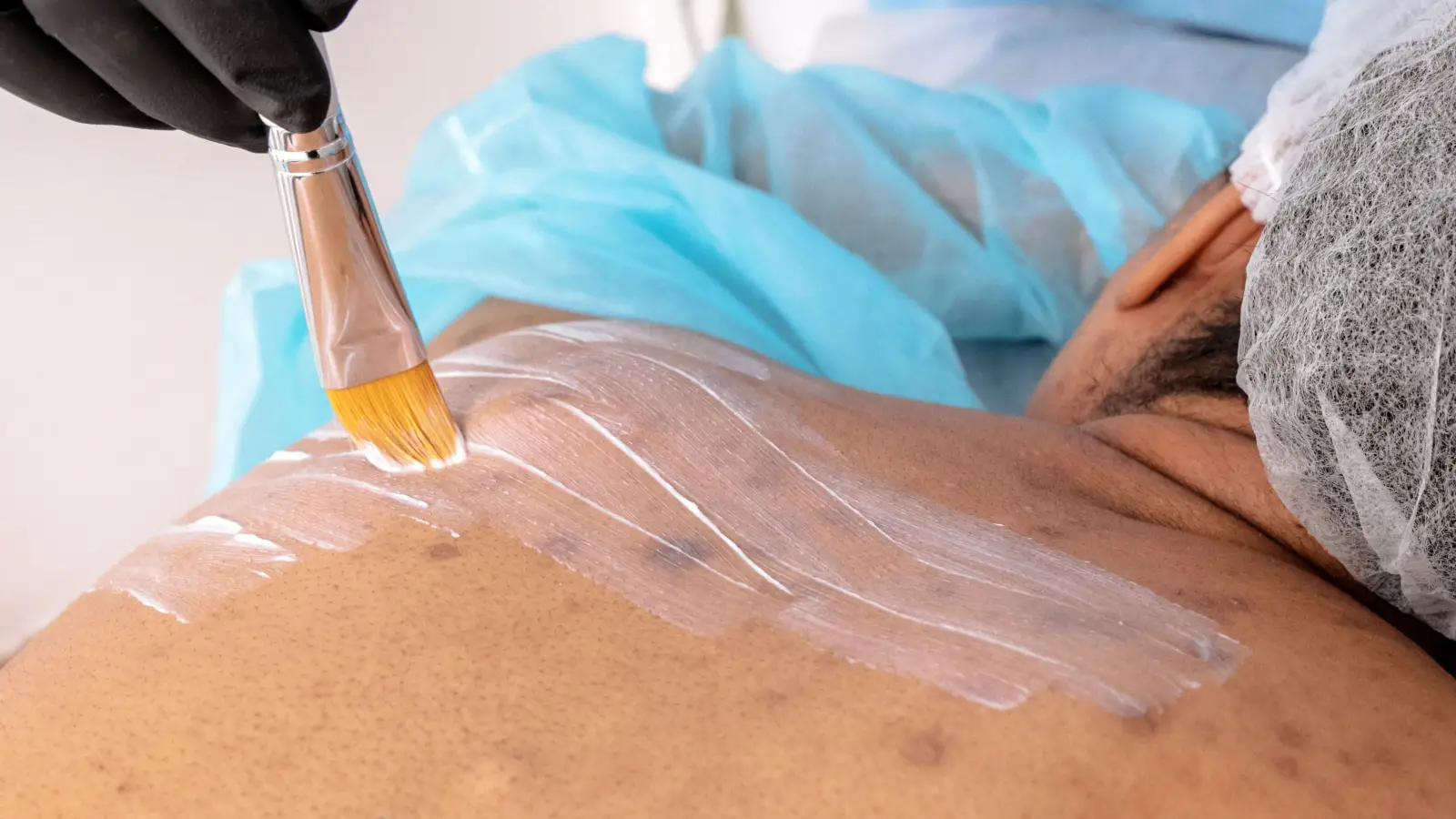
– Use a cotton-tipped applicator or gauze. One pass only on the first session — no layering.
– Endpoint guidance: glycolic and lactic acid produce a faint pink blush; salicylic acid creates a white crystalline pseudo-frost. True frost (plate-like coagulation) means you have entered the dermis — neutralise immediately.
- Neutralization and aftercare:
– Neutralize glycolic and lactic peels with cool water or dilute baking-soda solution at the endpoint.
– Salicylic acid can be rinsed after 3–5 minutes.
– Apply a bland moisturizer. No actives for 5–7 days. SPF 50+ is non-negotiable; a single UV exposure can reverse the gain.
- Series and spacing: Space peels 2–4 weeks apart. Pigment fades across multiple sessions; compressing the schedule raises inflammation and PIH probability.
Sign you can advance — Two or more peels completed; spots lightening visibly; no post-peel darkening; barrier recovery within 3–5 days.
Readiness Signs Recap
- You have identified your dark-spot type and its likely depth.
- You know your Fitzpatrick score with certainty.
- You can explain why medium-depth TCA (15–35%) is unsafe for melasma and for Fitzpatrick IV–VI.
- You have chosen a superficial acid and a concentration range that fits your risk boundary.
- You used a tyrosinase inhibitor for at least 4 weeks before the first peel.
- A patch test behind the ear showed no prolonged reaction.
- Your first superficial peel resulted in transient pinkness only, no crusting or darkening.
- You are spacing peels 2–4 weeks apart and using SPF 50+ daily.
Worry Later, Not Now: Deep Peels, At-Home TCA, and Laser Add-Ons
Some topics consume discussion but have no bearing on a safe, early-stage plan. File them here until a specific trigger elevates them.
- Phenol deep peels — These matter only for Fitzpatrick I–II skin with advanced photodamage and rhytides, performed under monitored sedation. Do not research phenol unless years of superficial treatment have been exhausted and a dermatologist raises it.
- At-home TCA kits — TCA above 15% is not a consumer product. A poorly controlled frost produces demarcation lines and persistent PIH. This worry should stay permanently deferred: if a medium peel fits, it belongs in a clinic.
- Laser-peel combinations — Combining a laser and a peel in one appointment is an escalation for resistant pigment in low-risk skin types. For melasma and darker skin, it multiplies inflammation. Hold combination planning until a standalone superficial series has reached its ceiling.
Common Questions About Chemical Peels and Dark Spot Safety
Can I use a 30% glycolic acid peel at home on brown skin?
Home-use 30% glycolic is common, but concentration is one lever among several—contact time and barrier health matter equally. For Fitzpatrick IV and above, an in-office peel at a conservative concentration is the surer start. If you proceed at home, make only one pass, time it precisely, and neutralise at the first sign of pinkness.
What TCA percentage is safe for hyperpigmentation on dark skin?
No TCA above 15% is a first-line treatment for Fitzpatrick IV–VI hyperpigmentation. Even a light 10–15% application can be used superficially, but salicylic acid or glycolic acid remains more predictable and safer because depth control is less delicate.
How many superficial peels does it take to see dark-spot fading?
A series of 4–6 sessions, spaced 2–4 weeks apart, usually produces visible lightening. Lentigines may respond after 3–4 peels; melasma and deep PIH often require a longer series with continued pigment suppression. Rushed intervals or concentration increases are a direct path to PIH.
Should I use hydroquinone before a chemical peel for melasma?
Yes — a bleaching primer is standard. Hydroquinone 4% (or azelaic acid 15–20%) for 4–6 weeks before peeling stabilises melanocyte activity and reduces the chance of a rebound. Continue through the series, with planned breaks every 3–4 months for hydroquinone.
Is a Jessner’s peel safe for melasma on Fitzpatrick IV skin?
Jessner’s is superficial and can be used, but its resorcinol component (a phenol derivative) can provoke irritation and secondary hyperpigmentation in some darker-skinned patients. A single-agent peel — salicylic acid 20–30% or lactic acid 40–50% — often gives clearer, more controllable feedback.
The End Result: Faded Spots, No New Marks
Reaching the endpoint means your hyperpigmented areas have lightened across a peel series and the treated skin shows no fresh dark patches. For the most common starting point — melasma on Fitzpatrick III–V — the first immediate action is to begin a tyrosinase inhibitor (hydroquinone 4%, azelaic acid, or tranexamic acid, as prescribed) and continue it for four weeks, then book your first in-clinic superficial peel at a conservative concentration.
Pigment Curious
We are people who want to better understand skin pigmentation, dark spots, and how different skin tones respond to skincare and professional treatments. We look beyond simple beauty claims, focusing on scientific evidence, clear explanations, and practical knowledge that helps people make more informed decisions about their skin.