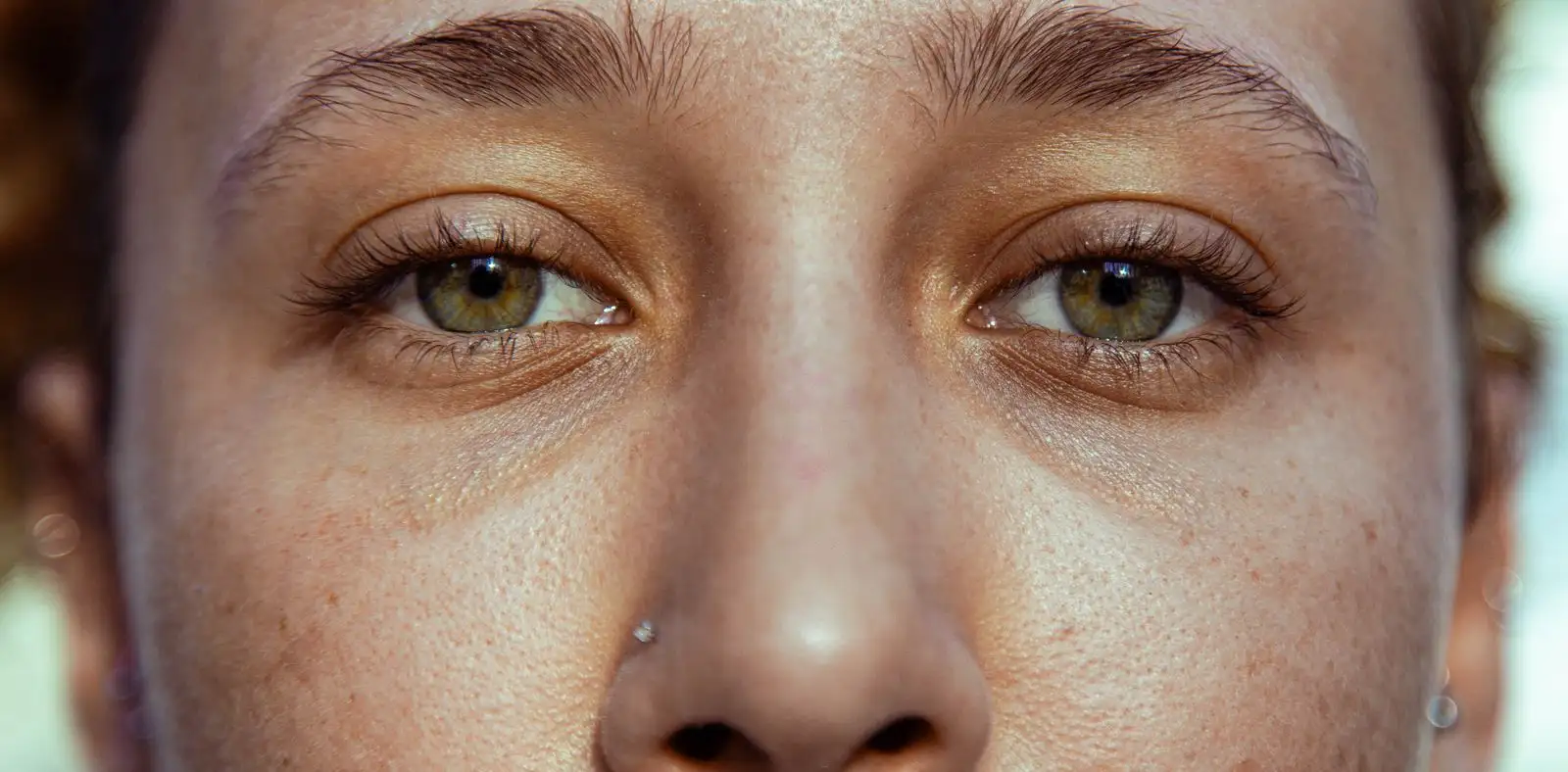
Your Foundation Formula May Be Causing Pore Settling
Pore settling is a base-system problem, not a skin problem: the film formers in your foundation can't hold against the amount and location of oil your face produces, so pigment migrates down into the pore openings and dries there. Water-based formulas separate first on an oily T-zone. Silicone-based formulas hold their film longer, but oil breaks the film and the pigment slips into the same pores that film was sitting on. Serum foundations carry fewer film formers, so they flash off and settle into texture within a couple of hours. Cream and stick formulas fill a pore when you press them in thin and crack when you layer them heavy. Powder grabs the pore rim the second a dense brush drives it down. Match the base of the formula to the base of your prep and your primer, control how much you put down, and most of the settling stops.

The mirror by the window, not the one over the sink
I do my check at two in the afternoon at a west-facing window. Not the bathroom mirror — that light is a liar, it flattens everything and makes the finish look better than it is. At the window I turn my chin down and toward the glass, and I look specifically at the strip of skin beside my nose and across the top of my cheeks.
That's where I see the pinpricks. Tiny dark dots sitting in the pores, each one the exact color of the foundation I put on that morning. An hour after application, that color was lying flat and even across the skin. By mid-afternoon it has drained into every opening it could find, and the rest of the face has gone patchy in a way that reads as "tired" rather than "separated."
The first ten minutes lie to you. Almost every formula looks fine at minute ten, because the film is still intact and the pigment hasn't moved yet. The information you need is at hour three, in daylight, on the side of your face that gets the most oil. What you're checking isn't "did it break down" — it's "where did the pigment go." If it's sitting in the pore openings, your formula and your oil are fighting, and your formula is losing.
One more thing before we get into formulas: pores don't open and close. There's no muscle around a pore opening. It's a fixed aperture, and its size is mostly genetic and influenced by how much oil is moving through it. So anything you've heard about a product "shrinking" them or a cold rinse "closing" them is describing a temporary visual effect, not the mechanism. What actually happens with foundation is mechanical: pigment and film get pushed into an opening, and whether it stays there depends on how the formula behaves once oil arrives.
What each base does once the oil shows up
Water-based formulas. These are the ones where water is the first thing on the ingredient panel and the texture is thin and fluid, almost like a tinted liquid. They feel light because they are — the pigment is suspended in water with gums and fairly light film formers holding it in place. On normal or dry skin, that's a pleasant, breathable wear. On an oily T-zone, the film loses early. The water flashes off, the gums can't hold against sebum coming up from underneath, and the pigment does the only thing left for it to do: it runs downhill into the nearest opening. That's the speckled, settled look that shows up around hour two or three, and it's usually worse right where your oil is worst.
Silicone-based formulas. Dimethicone and its relatives form a continuous film across the skin, which is exactly why these look so even an hour in. The film is the product. But sebum migrates up into that film, softens it, and breaks it in patches. Where it breaks, pigment goes down into the pore; where it holds, the surface still looks smooth. So you get an uneven pattern — settled in some zones, clean in others — which is confusing because it looks like a skin problem when it's really a film failure. On very dry skin, silicone films can fail the opposite way: they sit on top of flaky texture and lift at the edges, which reads as dry patchiness rather than settling.
Serum foundations. These are the ones with a watery-gel feel, often with a long list of skincare-sounding ingredients and a short list of film formers. They're lovely for the first hour. Then they settle into texture faster than almost anything else, because there's no real film to hold the pigment in place — nothing grips the skin, so gravity and normal facial movement do the work. If your pores show as dots rather than as oil-driven shine, and your skin is on the drier or more mature side, serum formulas are usually the worst offender in the drawer.
Cream and stick formulas. Waxes, oils, a heavy pigment load. These get a bad reputation they don't fully deserve. Pressed in thin with a small synthetic brush, a cream fills the pore opening — there's no hole left for pigment to fall into, so the surface stays level and even. That's the good version. The bad version is two or three layers, which cracks along expression lines and migrates sideways into everything adjacent. A stick swiped directly onto the face and buffed hard is the heaviest version of that mistake. Warm it on the back of your hand first, then pick up a very small amount.
Powder foundations. Talc, mica, silica, pigment. These settle instantly, and it's almost entirely about the tool. A dense, tightly packed brush drives powder down into the pore opening like grout into a tile joint. A fluffy brush, tapped off until almost nothing is left, pressed rather than buffed, leaves powder sitting on top of the skin where it blurs instead of fills. And powder applied over oil is a paste — that's the mid-afternoon touch-up that makes everything look worse.
The base has to match the layer underneath it
This is the part people skip, and it's where most of the settling is actually created.
If your primer is silicone-based and your foundation is water-based, the foundation has nothing to grip — it slides on top of the silicone film and settles fast. Reverse it, and a silicone foundation over a water or glycerin primer beads up and goes patchy in the first twenty minutes. Either combination can be fine on its own; together they fight.
Skin prep does the same thing in a subtler way. Moisturizer and sunscreen leave a film. If you go straight from moisturizer to foundation, you're painting on top of a slip layer, and everything you put down is only as stable as that layer. I give it a minute. On an oily day, I blot that film down before I start.
What I actually do now
I test one variable at a time, and I test it for three days before I decide anything, because a single bad skin day will lie to you. Same prep, same primer, same application method, one new formula.
I press instead of sweep. A damp sponge pressed into the pore-prone zones pushes less product into the openings than a brush dragged across them, and it takes off the excess that would otherwise settle later. I use a thin layer where my oil is worst — not because thinner coverage is more virtuous, but because a thin layer has less pigment available to fall into a pore in the first place. I never add powder over shine. I blot first, then decide whether I need anything at all.
And it depends. If your pores show because of oil, you want a formula with a film that holds and a base that matches what's under it. If your pores show because of texture — dry, flaky, uneven skin around the nose — a stronger film won't help; it'll grab onto the flakes and lift. That version wants a cream pressed in thin, or a powder applied with a much lighter hand.
The window at two in the afternoon is the only review that matters. Everything else is marketing.

About the author
The Undertone
The Undertone is a byline for people who learned foundation on brown skin by swatching, mixing, and checking color in real light. They share a practical focus: if the depth and undertone are right, the formula will follow.
More about us