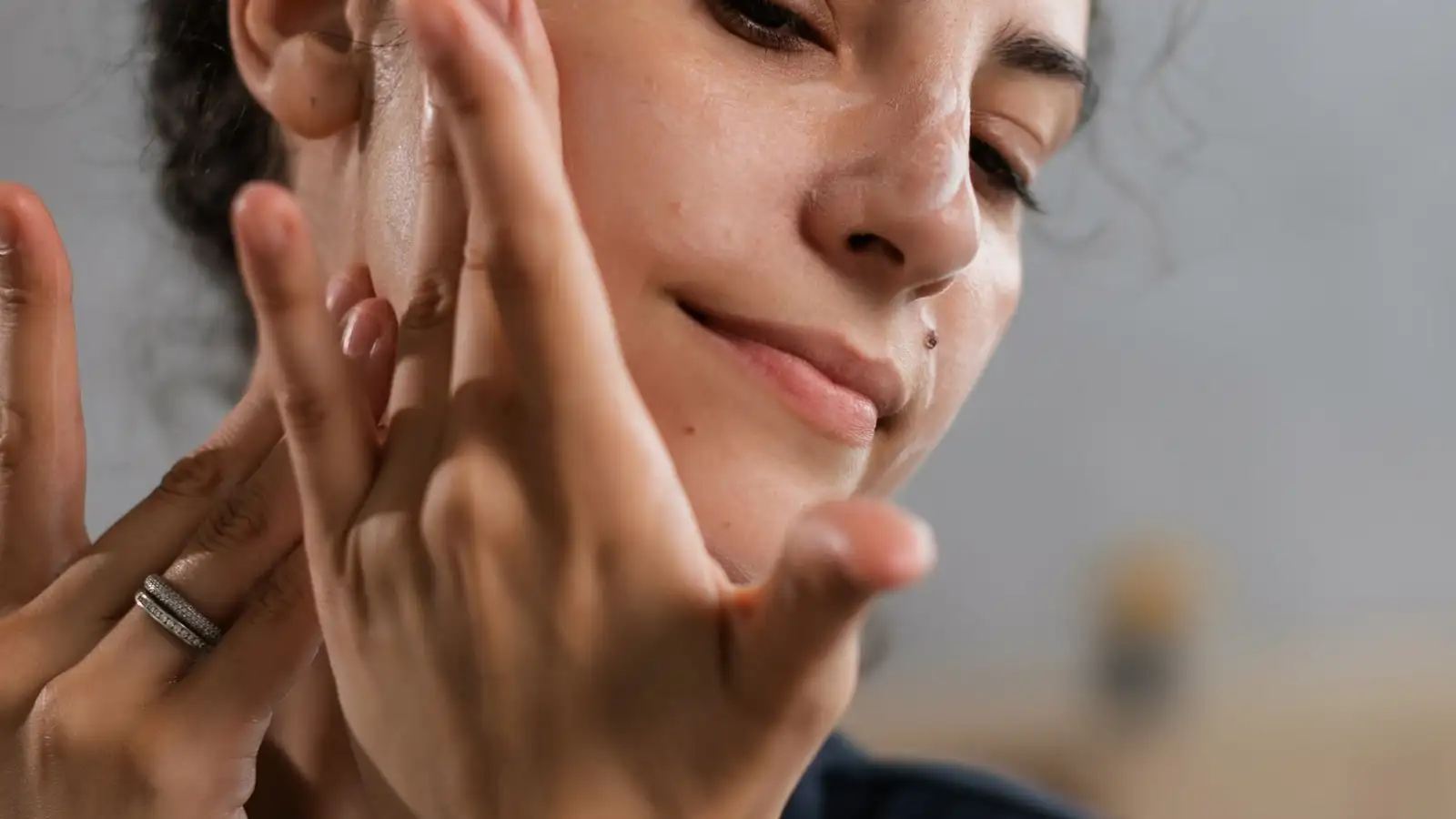
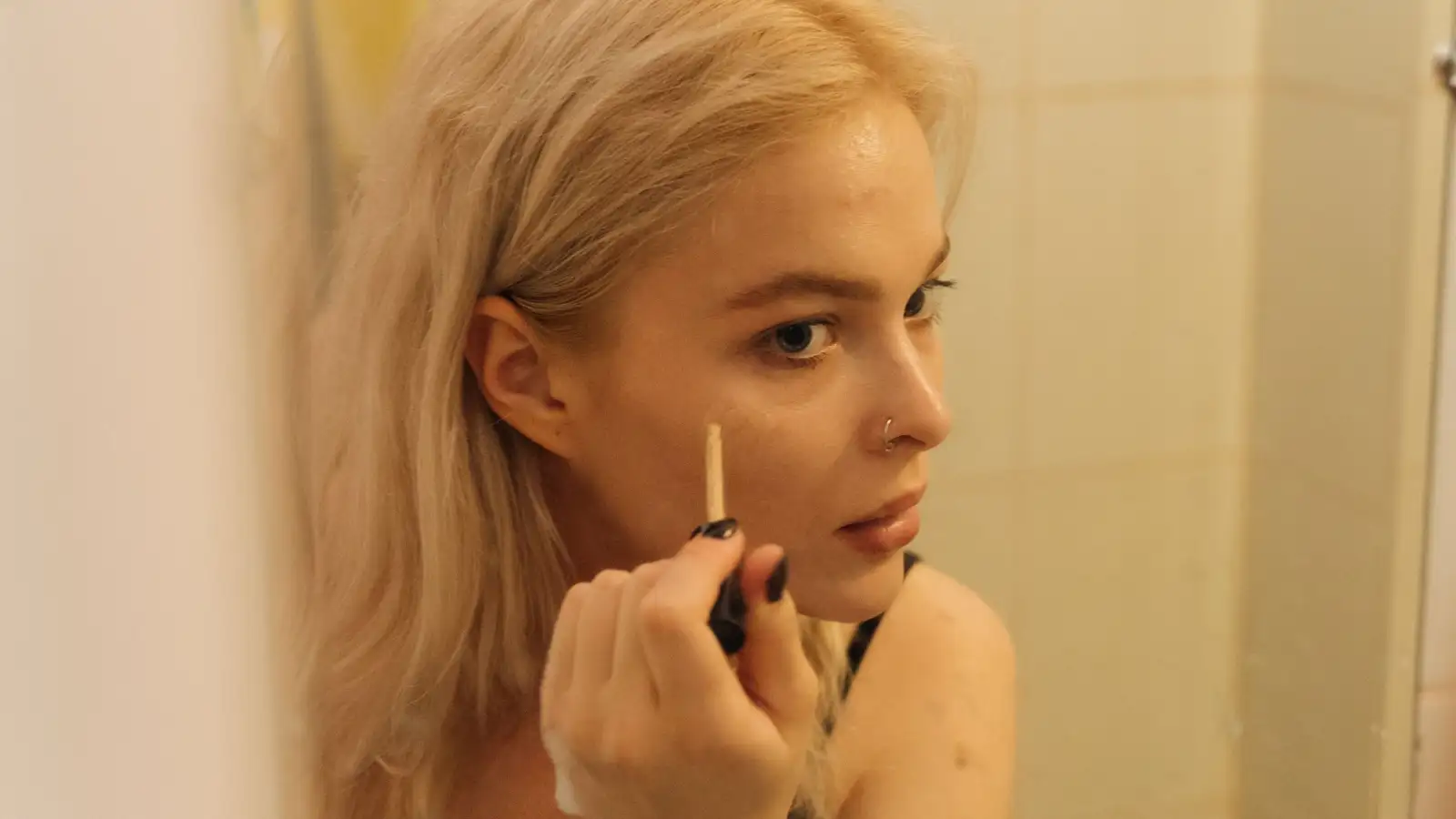
Is Your Setting Powder Making Your Pores Look Worse?
Probably — but not because powder makes pores bigger. It makes them read bigger. Press powder into the skin with a puff or a damp sponge and you drive product into the mouth of each pore; every filled pore now has a hard edge, and a hard edge catches light. A light dusting with a fluffy brush, a tap to shed the excess, and a setting spray that melts the powder down does the opposite — it softens the shadow inside the dip instead of outlining the rim. On deeper skin the powder itself matters as much as the motion, because silica and mica scatter light, and under a flash that scattering turns into a pale haze that reads as white cast sitting on top of your foundation.
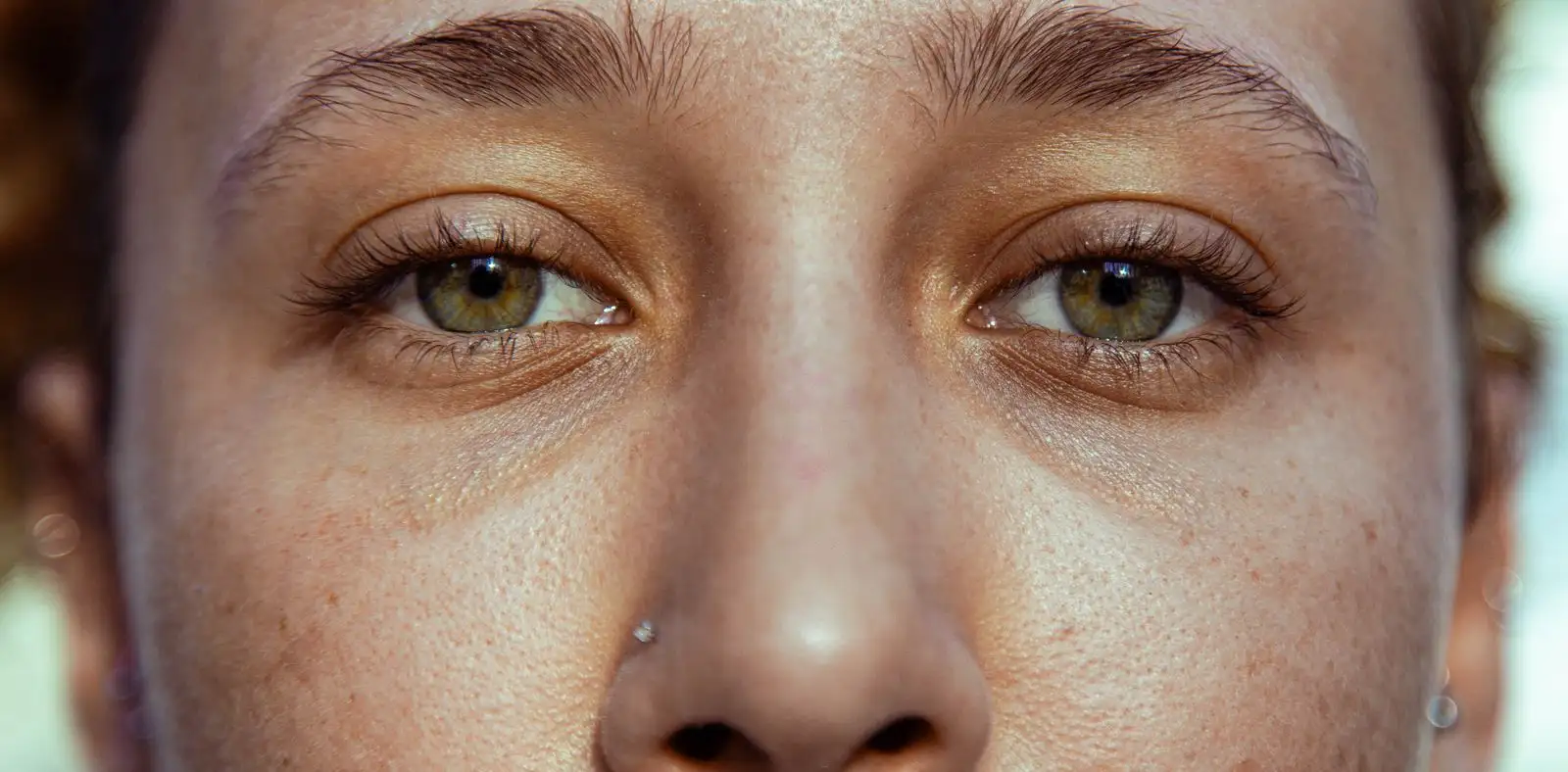
I found that out from a photo, not a mirror. It was a birthday dinner, and when the pictures came back I was the only person at the table whose face had gone flat and grey through the center while the skin near my hairline still looked like mine. Nobody had touched my face. Nothing had gone wrong. I had just been pressing powder under my eyes with a puff, hard, the way I'd been taught.
Putting the mirror in the wrong light
Now I do the check in my kitchen, at the window, around four in the afternoon, with the overhead light off. Phone at chest height, about three feet away, flash on. It's deliberately unflattering, which is the point — the bathroom mirror at seven in the morning with a ring light over it will forgive almost anything.
What I'm looking for in that photo isn't fine lines. It's the area right beside my nose and across the apples of my cheeks, where the pores are densest. In a good photo that area looks like a soft gradient, slightly darker inside the dips. In a bad one, every pore sits inside its own tiny ring of lighter powder, and the whole area looks stippled, like the skin of an orange held under a lamp.
That ring is the tell. Powder doesn't stretch a pore. It collects at the rim where the skin curves down, and it fills the dip where oil and foundation have already pooled. Now you have light powder at the rim and darker product in the hole, and that contrast is what your eye reads as big pores.
Dusting and pressing are not the same motion
Here is what I actually changed.
Dusting: I load a fluffy brush, then tap it against the side of my hand until almost nothing comes off. What's left is a faint haze. Then I go over the T-zone with the flat side of the brush, one direction, no swirling, no scrubbing. The brush lays powder on the surface of the skin and picks up oil; it doesn't push anything down into the dips. The finish is a soft blur, because the powder sits on the raised parts and skips the holes.
Pressing: a puff or a sponge, with pressure. I still press sometimes, under the eyes, right after concealer, because that's the only thing that stops creasing. But I press once, lightly, and I don't grind. Grinding is what fills the pores. A puff in a heavy hand works like a stamp — it forces powder into every dip it can find, and the dip is exactly where you don't want it.
The other half of pressing is the pause. Whatever I press, I let sit for two or three minutes and then brush off the excess with a clean, dry brush. Powder that is sitting on the skin doing nothing is still powder.
What's in the powder, and why it shows on deep skin
When I read an ingredient list now, I look for two names and where they sit in the order. Silica, especially the very fine kind, is the one that turns ghostly under a camera flash. Mica is the one that gives the satin sheen — lovely in daylight, ashy in flash. Both scatter light instead of absorbing it, and on a deep complexion that scattering reads as a pale film. It doesn't matter how good the foundation underneath is, because the film is on top of it.
There are two different problems here and they get mixed up constantly. Flashback is light bouncing back at the camera: you won't see it in the mirror, your face just looks grey or bluish in photos while it looks fine in person. A powder that's simply too light for you is visible in daylight too — that's not flashback, that's a color mismatch, and no application technique fixes it. If I can see the cast in window light, it's the second one and the powder has to go. If I only see it in the flash photo, it's flashback, and I can often keep the powder by changing how much I use and where I put it.
Baking is a timer, not a technique
Baking is a thick layer pressed under the eyes and along the T-zone, left to sit while the heat of your face sets it, then dusted away. Ten minutes under the eyes is fine, and it does stop creasing. Forty minutes on the T-zone because you got distracted is not fine. The powder mixes with oil, turns into a paste, and settles into every pore edge. When you finally brush it off, you brush off the surface and leave the paste behind.
Loose or pressed
Loose powder gives a softer result and less drag, but it's messy and it's easy to pick up too much. Pressed powder gives me more control, a cleaner edge around the nose, and it's the only thing that makes sense in a bag. The tradeoff is real: a pressed powder applied with pressure drags across the base, and if the foundation has already dried down, that drag lifts it in streaks. I use pressed powder with a small fluffy brush, light-handed, or with a velour puff barely touching the surface — never with the flat sponge that comes in the compact, which is essentially a tool for pressing powder into pores.
The spray step is where I overcorrected for a year
Setting spray melts the powder into the base and takes away the flat, dusty look. That's what it's for. It also has a limit.
What works for me: hold the bottle about ten inches away, close my eyes, two passes in an X across the face, nothing more. Then I press my palms flat against my cheeks and forehead for a second — the warmth and the slight pressure knit the powder down without pushing it into anything. That's it. No second round.
Too much spray is worse than no spray. It re-wets the foundation, and wet foundation slides into the same dips you just spent ten minutes keeping powder out of. If I mist three or four times and then go back in with a brush, I get patchiness, and by mid-afternoon the base has separated around my nose and settled into the pores, which is the exact thing I was trying to avoid.
The short version I actually use
- Powder only where I need it: under the eyes if I've concealed, down the center of the forehead, the sides of the nose, the chin. Not the cheeks. The cheeks almost never need powder and they always look worse with it.
- Dust, don't press. Tap the brush until it's nearly empty.
- If I do press, I press once, then brush off the excess after two or three minutes.
- Check in window light first, then take one flash photo in a dim room before I leave the house.
- One pass of spray, then press with my palms.
- If I've already overdone it, I spray once, wait thirty seconds, and press a clean tissue over the area to lift the excess instead of adding more powder on top.
One thing I've had to accept: I can't make texture disappear. Powder isn't a treatment, it doesn't shrink anything, and on a dry, flaky day it will find every flake and make it louder. On days like that I set less and let the foundation do the work. The goal isn't a poreless face. It's a face that still looks like mine at arm's length and in a photograph, which is a much lower bar and a much more achievable one.

About the author
The Undertone
The Undertone is a byline for people who learned foundation on brown skin by swatching, mixing, and checking color in real light. They share a practical focus: if the depth and undertone are right, the formula will follow.
More about us