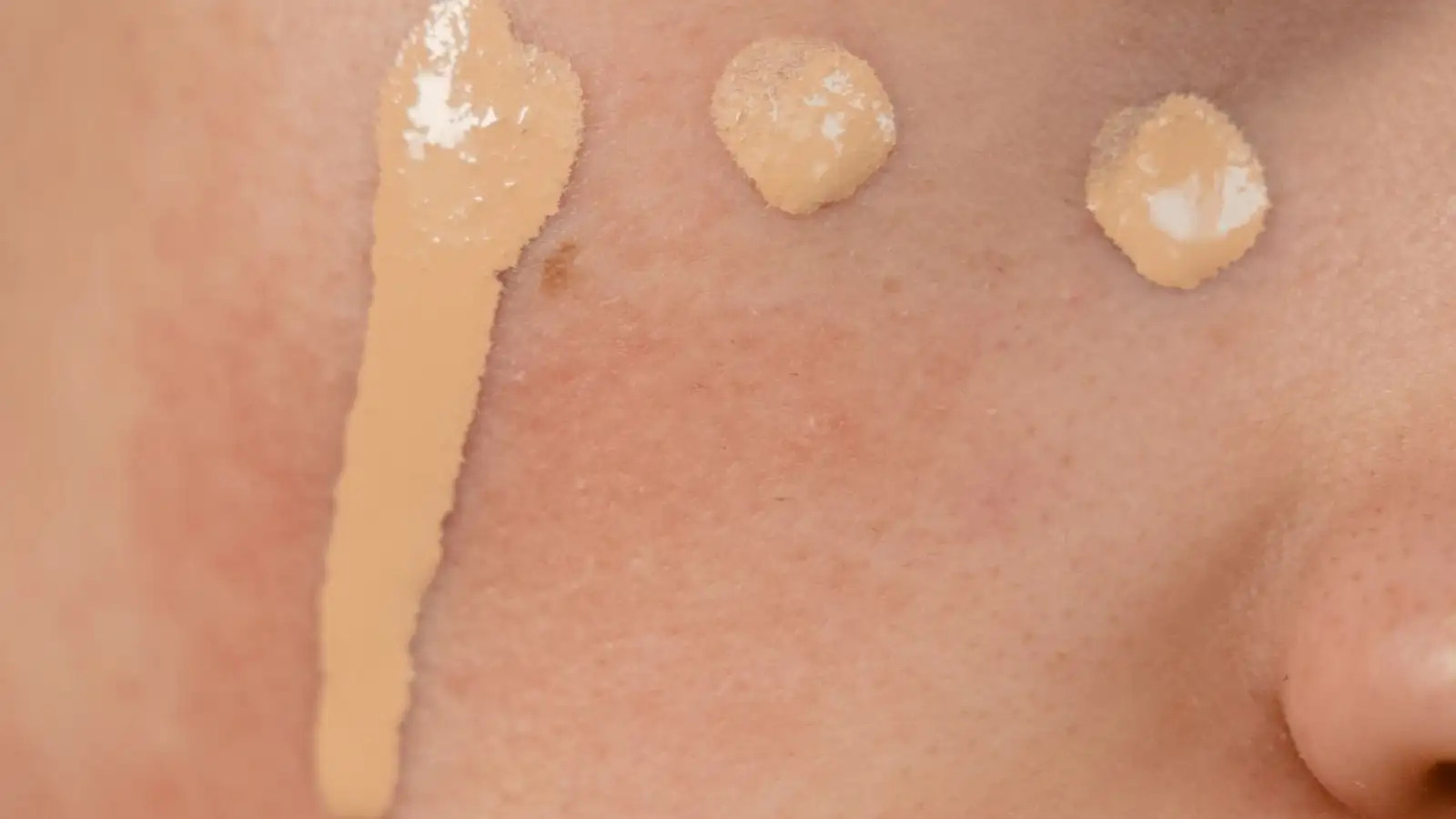
Foundation Settles Into Pores Because of Application Order
Foundation collects in pores and fine lines because too much product is sitting on the skin and each layer went down before the layer under it had set. It is a volume-and-timing problem, not a pore-size problem, and the correction is to reduce the total amount, let each layer settle, and powder only where shine actually appears.
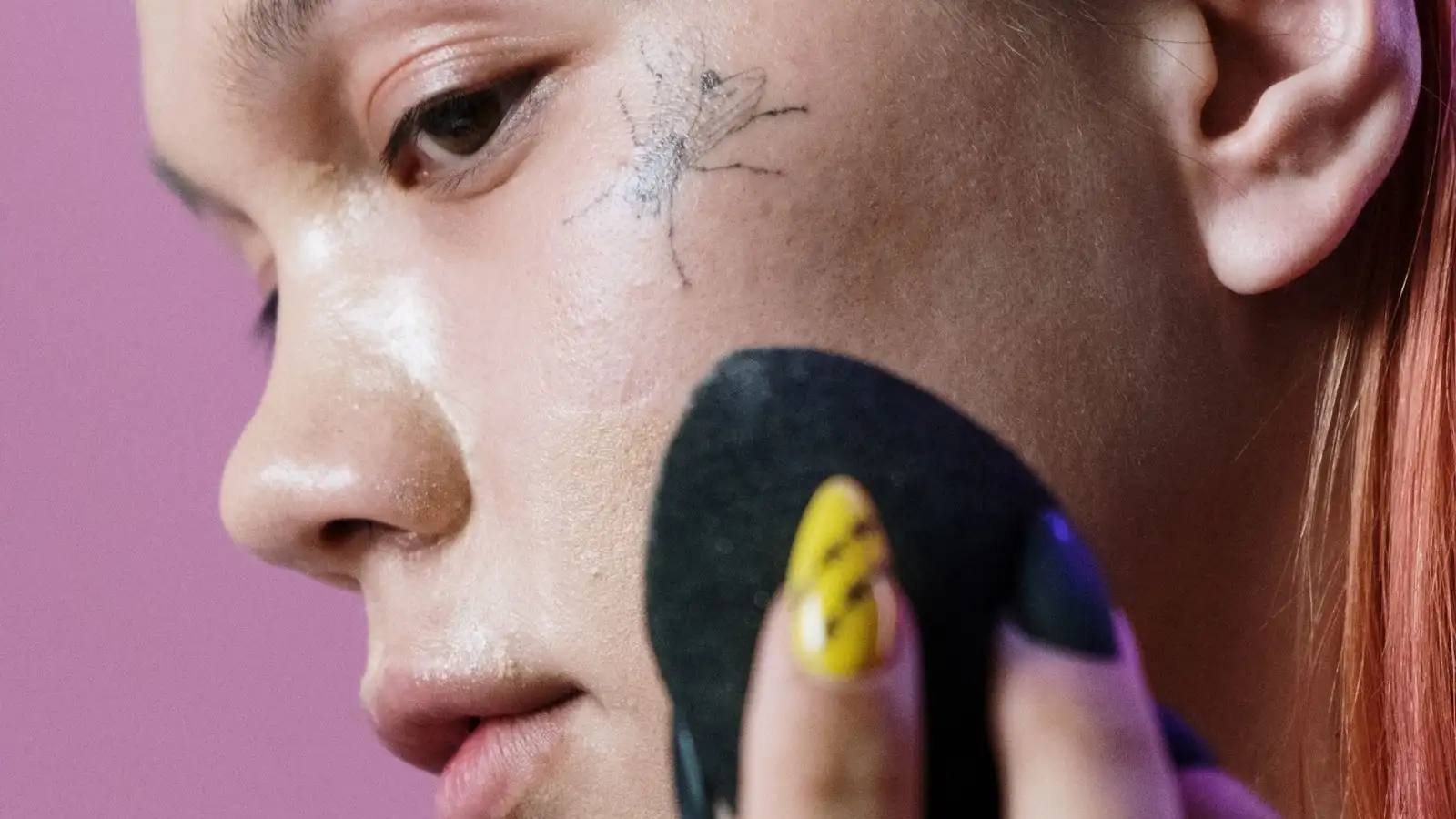
Stand at the window with me. Nine in the morning, flat gray daylight, a hand mirror tilted so I'm looking at my cheek from the side instead of straight on. Straight on, the base reads fine. From the side, it has broken into a scatter of tiny dots sitting in the texture beside my nose, and one shallow line near my mouth has a thin ridge of product along it. Same bottle I used yesterday. Same face.
What changed was the amount and the order, and I only found that out by counting.
I spent a couple of years convinced my pores were the problem. That framing is expensive, because it points you at products instead of at your own hands. Pores do not widen when foundation touches them. The foundation just has somewhere to sit. Every recess in the surface, including the ones you cannot see head-on, is a place where liquid pools once there is more of it than the skin will hold. Skin holds less than you think.
So the first diagnostic is not about your face. It is about the number of layers.
Count what is on your face before you blame the surface
I do this out loud sometimes, which looks ridiculous and works anyway. Primer. Color corrector on two spots. Foundation. Concealer under the eyes and on one old scar. Cream blush. Cream bronzer. Then powder. That is eight passes, and six of them are wet. Every one of them adds volume into the same set of recesses, and they do not stack like paint on a wall. They stack like water finding the low spots.
When I cut the count, the settling drops before I change anything else. Correctors get skipped unless the discoloration is genuinely there that day. Concealer goes where I am actually covering something, not in a sweep under the eye. Cream blush and cream bronzer do not both go on the same cheek.
Then the pump count. I used to load a full pump onto the back of my hand and use all of it because it was there. Now I start with half a pump, work it in with fingertips from the center of the face outward, and stop. If I think I need more, I stop and look first. Nine times out of ten, the thing I am about to cover is texture, not a gap in coverage, and more foundation will only make it more visible.
The waiting problem, which is the real one
Silicone-based primer is the layer people rush most. A thin layer does cosmetically blur the look of texture, and that is a real effect, not marketing. The keyword is thin. Thin also needs a minute or two to stop feeling slick, and that wait is where most of the settling in my own routine was coming from.
The test is a fingertip. Press it to your cheek. If it slides, the primer has not set, and whatever goes on top will move with it. I have watched foundation travel into the exact pores I was trying to conceal because I stacked it onto a primer that was still wet.
Mixing bases is where it goes wrong in a specific, recognizable way. A silicone primer under a water-based foundation can pill. You will see little rolls of product, like eraser crumbs, and those crumbs collect in texture and look exactly like settled foundation from a few feet away. If your foundation beads or rolls on contact, that is not your skin complaining. That is the two bases arguing. You either wait longer and use less primer, or you match the primer's base type to the foundation's base type.
And "wait" does not mean standing there with your hands in the air. It means the thirty seconds it takes to put the bottle away, answer a text, brush your teeth. It is not a ritual. It is just refusing to stack wet on wet.
Powder is where thin coverage turns into dots
Powder too soon and it grabs foundation while it is still mobile, dragging it down into the recesses you were trying to keep clear. Powder too heavily and you have built a matte surface that announces every bit of texture you have.
The fix is smaller than most routines make it. A small brush, a light tap into the powder, a tap off, and then press rather than sweep, only where shine is actually showing. For most people that is the center of the forehead, the sides of the nose, maybe the chin. Outer cheeks usually do not need powder at all, and powdering them is how a face starts reading dusty by noon.
Pressing matters more than the amount. Sweeping moves product around and lifts it off the surface. Pressing sets what is already there.
The twenty-minute check, at an angle, in daylight
Settling is almost never visible the second you finish, because the product is still moving and still drying down. That is why the mirror check at the vanity lies to you. Bathroom light tends to be too warm and too head-on, and looking straight at yourself hides exactly the recesses that show from the side.
I check at about twenty minutes, near a window, with the mirror angled and my cheek turned. Side light, not front light. If dots have appeared, I now know which of three things went wrong: too much product, a layer that had not set, or powder pressed in too early. Those three produce different patterns, and after a few weeks you can read them at a glance. Twenty minutes is generally long enough for the base to stop shifting, and the light has to be the light you will actually be seen in.
If it has already settled, do not add anything
The instinct is to fix dots with more product. That makes them worse, because you are adding volume to a place that is already overfilled.
What works is a damp sponge, wrung out until it is barely cool to the touch, pressed over the area. Pressed, not wiped. The residual water re-wets the surface just enough that excess product lifts onto the sponge instead of sitting in the recess, and the base that stays behind presses flat against the skin. Then leave it alone. Going back in immediately with a brush undoes the whole thing.
Same move for a line that has collected product. Press. Do not drag.
What this does not fix
Two honest limits.
Scarring and deep textural marks cannot be filled with foundation, and pretending otherwise leads to thick coverage that catches light on every edge and announces itself from across a room. Thin coverage that lets the surface show reads better than a thick layer trying to erase it. That is a finish decision more than a coverage decision, and it is the harder one to make.
Second, at hour twelve, some settling happens no matter what you do. Skin moves, it produces oil, it creases. The goal is not a face that never settles. It is a face that settles late enough that nobody watches it happen, plus a fifteen-second correction for when it does.
The bottle in my bathroom has not changed in a while. The count has.

About the author
The Undertone
The Undertone is a byline for people who learned foundation on brown skin by swatching, mixing, and checking color in real light. They share a practical focus: if the depth and undertone are right, the formula will follow.
More about us