Setting Powder Can Turn Textured Skin Ashy in Photos
Setting powder goes ashy on textured, melanin-rich skin in photos because light-reflecting particles - silica, mica, and titanium dioxide - are sitting on top of the skin instead of blending into it, and a camera flash bounces off them and straight back to the lens as a pale film. The powder is usually not the villain by itself; the amount, the placement, and the ingredient list are. The fix is to blot first, press a small amount of finely milled tinted powder into the oily zones only, skip the all-over translucent dusting and the heavy bake, and check the result with your own flash photo before you walk out the door.
I keep one photo on my phone for this. Birthday dinner, someone across the table lifting their phone, the flash popping, and there I am: forehead and the tops of my cheeks gone flat and pale, like someone pressed chalk into them, while my jaw and neck stayed the color I actually am. Nothing about that face was new. The powder was. I had dusted it on before work and touched up in the car around six, and both times I used the same loose translucent powder I had been using for years without thinking about it.
Before you read anything else, go find the last photo of yourself where a flash fired and something looked slightly wrong. Not a mirror selfie, not a front-camera shot in daylight. A real one, where the light came from the camera. Look at where the pale patches land. Mine are always the same three: the middle of my forehead, the top of my nose, the highest part of my cheekbone. If yours match, keep reading, because that pattern is a formula and application problem, not a foundation problem.
Read the first three ingredients
Go get the container. Turn it over and read the first five ingredients out loud. The answer is usually in the first three.
Silica is a tiny sphere. It gives powder that rolling, weightless slip, and it also reflects light back where it came from. Mica is a flat plate, the reason a powder looks luminous in the pan, and flat plates bounce light beautifully. Titanium dioxide is the white pigment, the same one that turns mineral sunscreen purple-gray on deeper skin, and it shows up in a lot of setting powders at a low percentage for opacity and sun protection claims.
None of those are bad ingredients. They are what makes powder blur and set. The problem is that they do not stop working in front of a lens. On lighter skin, the bounce off a white particle is roughly the same value as the skin, so nobody notices it. On deeper skin, a white particle sitting on the surface is a color event. Which is why the word translucent is the one I trust least on a powder label. Translucent does not mean invisible. It means there is no pigment in the formula, so there is nothing in it to cancel the pale film it just created. You get the blur and the ash in one step.
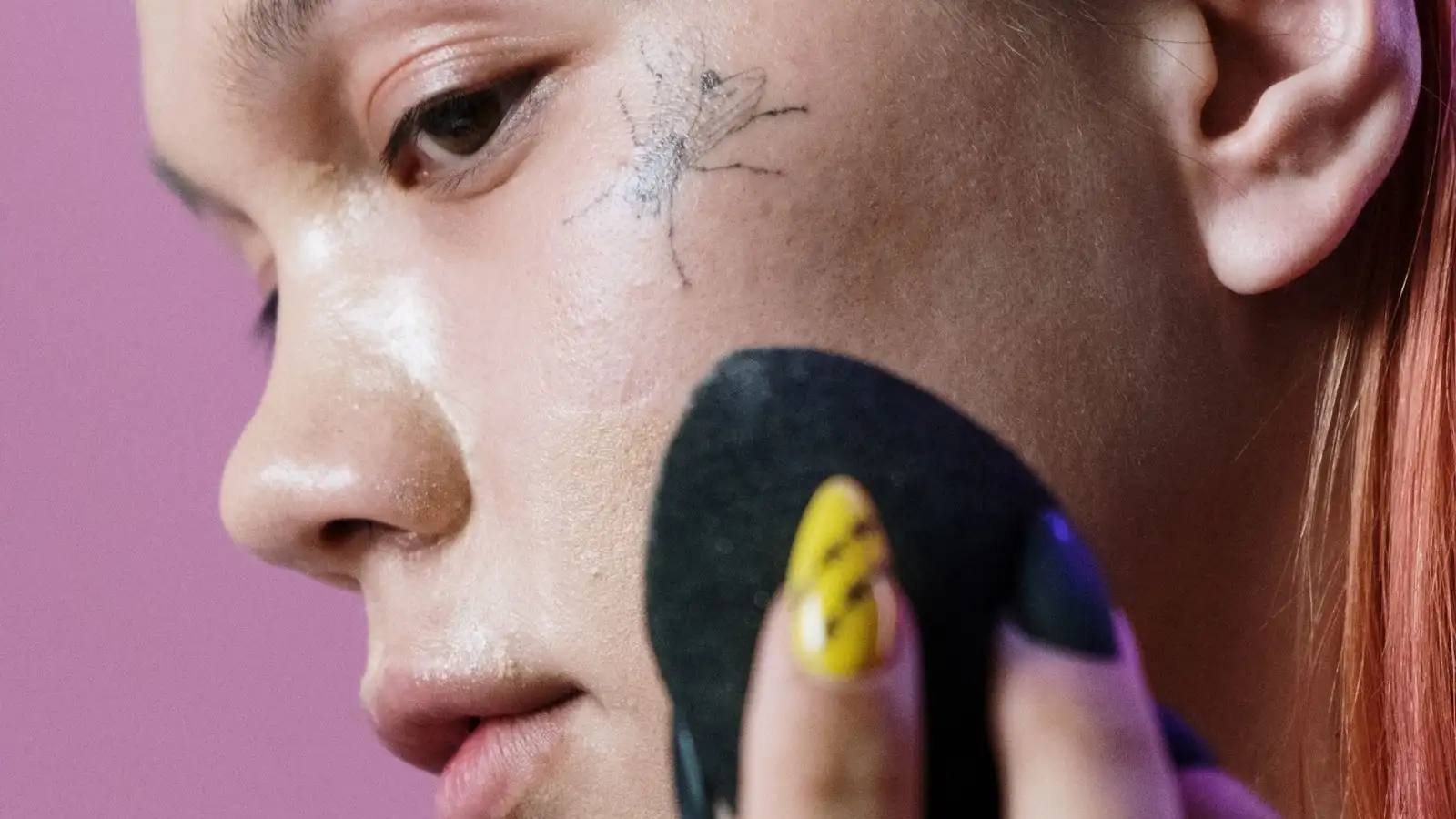
And powder does not spread itself evenly. It collects in whatever is not smooth: pores, old acne scars, the fine lines across the forehead. Every dip gets a slightly heavier dusting than the skin beside it, and then the flash lights up the ridge of it. Your texture did not get worse for the photo. A light-colored film is sitting in it, and the camera can see the film.
Why a bake makes it obvious
Baking means pressing a thick layer of powder into the skin and letting it sit there. If that powder is lighter than your face, and the ones traditionally used for it are, you are leaving a visible residue on deeper skin even in daylight. Under flash it goes chalky. On textured skin there is a second cost: powder packs into the crease under the eye and along the smile line, so a soft fold photographs as a hard, lit line. More powder is not more set. Past a certain point it is just more surface for light to hit.
The test I run before I leave the house
Bathroom, lights off, phone in hand. Flash on, back camera, arm's length, shoot your own face. Then take one more from across the room, propping the phone up or handing it to whoever is around, because distance changes what you see. The close one is the brutal one. A phone flash sits less than an inch from the lens and hits your face almost head-on, which is the most punishing angle that exists. A photographer bouncing a flash off a ceiling gives you a much softer, more spread-out light, so treat the close phone photo as a stress test rather than a preview of every picture you will ever be in. If your face still looks like your face at twelve inches, you are in good shape.
Now look at the shot and mark the pale zones. They usually sit right where you are oiliest, because that is where you are re-powdering all day, which is exactly what builds the film.
The small routine
Blot before you powder. Tissue or blotting paper, pressed in, not wiped across. Oil breaks down powder, so powdering over a shiny forehead means you will be back in two hours adding another layer on top of the first one. Blotting gets you down to one thin pass.
Use a small, dense brush or a velour puff. The big fluffy brush is what turns a touch-up into an all-over dusting. Tap the excess off hard, until it looks like there is nothing left on the bristles. There is still enough.
Press, do not sweep, and only where you shine. Center of the forehead, alongside the nose, the spot that is greasy by noon. Leave the outer cheeks, the jaw, and anywhere dry alone. Sweeping drags powder over real estate that did not need it.
Use a tinted powder and match the undertone, not just the depth. This is the part that matters most on deep textured skin. A powder that matches your depth but not your undertone leaves a gray cast on cool-leaning skin and an orange one on warm. Press a little along your jaw and step to a window, because daylight is the only place that comparison is honest.
Skip the bake, or shrink it. If you love it under the eyes, use a powder that reads as your skin, use half of what you are using, and do not let it sit for ten minutes before you brush it away.
Finish with a setting spray, knowing what it does and does not do. Two light passes of a fine mist, then press your face with clean hands to melt the powder down so it stops reading as a separate layer. It cuts the chalkiness. It does not control oil the way powder does. That is the trade: less pale film, more shine by mid-afternoon. Choose based on whether your day ends in front of a camera or in a hot room.
Where this still goes sideways
Reading ingredients narrows the field; it does not guarantee anything. Mica is in nearly every powder because it is what makes powder feel like powder. A formula can list silica fourth and look fine on you, or second and look terrible. Particle size and how the powder is pressed into the pan matter as much as the order on the label, and you cannot see either one from the outside. That is why the test photo beats the ingredient list when the two disagree.
Also worth knowing: sometimes the film in the photo is not the powder at all. A sunscreen with a high percentage of titanium dioxide or zinc oxide, a primer built on silica, a full-coverage foundation that sets matte - any of those can be the thing that is flashing back. If you swap the powder, run the flash test again, and the ash is still sitting in the same places, the problem is underneath.
And if your real goal is holding shine down through a fourteen-hour day, powder is still the tool that does it. Setting spray will not take that job. The point was never to stop setting your face. It is to stop setting all of it with something colorless and pale, and then finding out about it in someone else's photo.

About the author
The Undertone
The Undertone is a byline for people who learned foundation on brown skin by swatching, mixing, and checking color in real light. They share a practical focus: if the depth and undertone are right, the formula will follow.
More about us