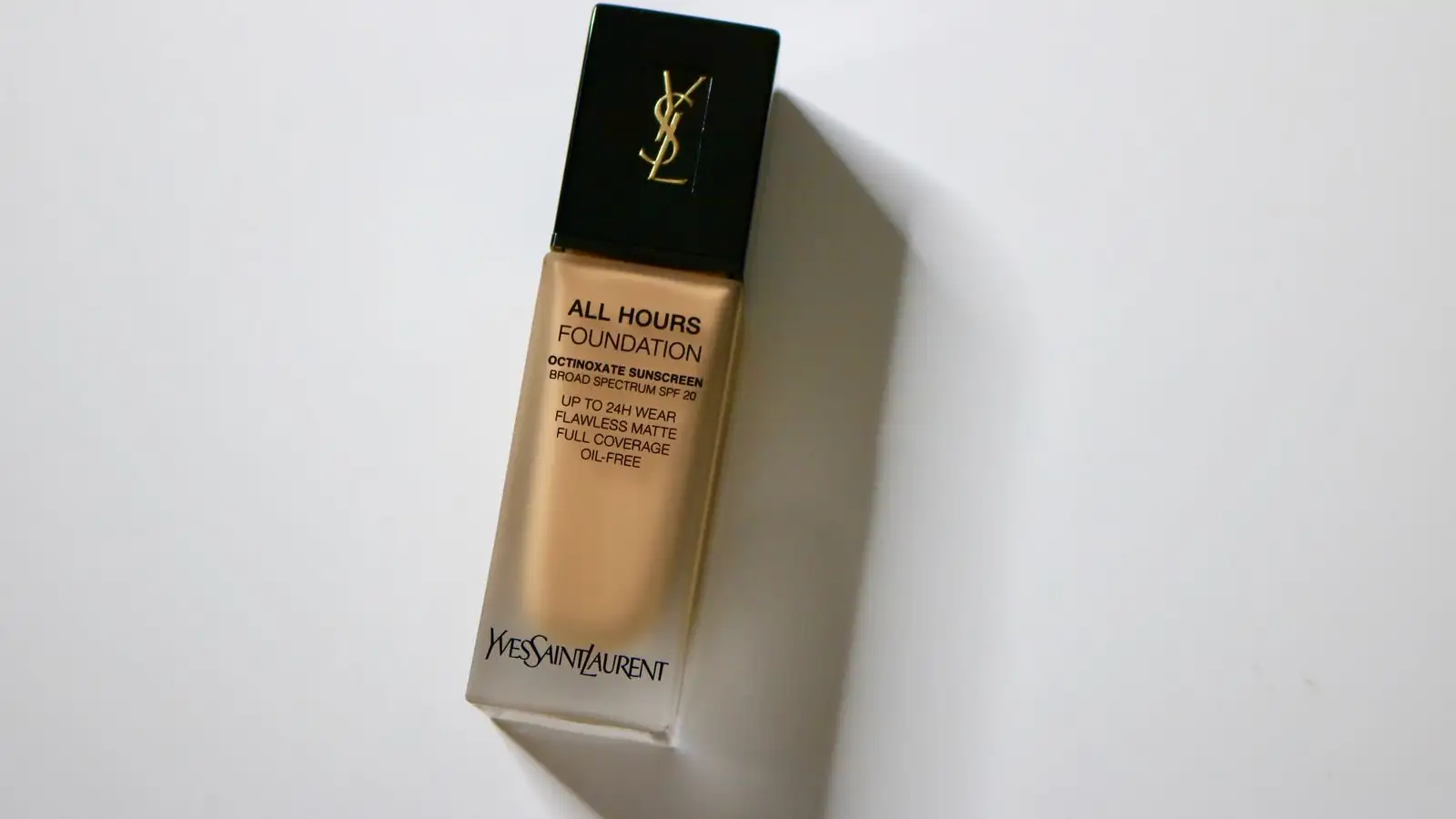
The ingredient that makes full coverage flash back
The ingredient behind most full-coverage flashback is titanium dioxide, a light-scattering mineral that throws a camera's flash straight back at the lens. Zinc oxide behaves the same way, and so do the silica and "HD" powders in a lot of finishing products. Coverage level is not the cause of flashback, but it is the multiplier: a formula built to hide everything generally carries a heavier load of those scattering powders than a sheer one does. Read the ingredient list instead of the coverage claim, and photograph your finished base with flash in a dim room before you leave the house.
I've stood in front of a mirror, decided a base looked seamless, then seen the pictures from that same night and watched a pale film hover over my jaw in every frame. The mirror is useless for this. A mirror gives you diffuse light coming from every direction, and it forgives almost anything. A flash does the opposite: one hard burst, fired from very close to the lens. Whatever in the film reflects light sends it right back.
What the flash is actually hitting
Think about the geometry for a second. The light source and the camera are essentially in the same place. So the brightest thing the sensor can record is whatever reflects light most directly back at that point. Titanium dioxide is extremely good at that. It is, functionally, a white pigment engineered to scatter light. Zinc oxide is close behind. Fine silica and the soft-focus powders sold as HD do a milder version of the same trick.
Skin doesn't work that way. Skin absorbs and scatters in a messier pattern, in many directions at once. So when a scattering powder sits on top of the skin or mixed into a base, the camera records a surface that is brighter and flatter than the skin around it. On a deep complexion the gap is wider, because there's more contrast available between the film and the skin underneath.
You can see this in the photo itself. The reflect-back is strongest when you shoot straight on, and it mostly falls apart when the light comes from the side or bounces off a ceiling. Which is the first clue about why event photos are so unpredictable. A photographer with an off-camera flash and a bounce is doing you an enormous favor. A phone held at arm's length in a dark room is doing the exact opposite.
Coverage raises the risk; the ingredient is the risk
Here's the part that gets muddled. People say "full coverage flashes back," then buy a medium-coverage formula and it still happens. Coverage describes how much pigment and filler lands on your skin. It does not tell you what's in it. High coverage usually means more iron oxides for color, yes, but also more of the powders that create opacity without weight, and those are frequently the light-scattering ones.
The two things move together most of the time, which is why the shorthand exists. But they can separate. A sheer base with a physical sunscreen in it can flash back hard, because titanium dioxide or zinc oxide is doing UV work at a meaningful percentage. A full-coverage base built mainly on iron oxide pigments, with no mineral sunscreen and no silica, can photograph clean at that same depth of coverage.
Iron oxides are your friend in this. They absorb light rather than bounce it, and they're the part of the formula giving you color instead of whiteness.
Most SPF foundations deserve flagging for exactly this reason. Not because the SPF is a problem in itself, but because the mineral filters show up in photographs. If titanium dioxide or zinc oxide sits high on the ingredient list, treat that product as a flashback candidate no matter what coverage level the label claims.
The gray you see in daylight is a different problem
This trips people up constantly, so I keep the two separate. Flashback is an optical event. It exists only in the photograph, it reads white or pale, and it's about light bouncing back. The ashy gray a deep complexion can show in plain daylight is a color problem: the depth is roughly right but the undertone isn't, or there's too much white in the mixture relative to the pigment in your skin. That one is visible to the naked eye, and it's about hue, not reflection — the fix is a mixer that shifts undertone without adding coverage.
The distinction matters practically because the fixes differ. Going a shade darker does nothing for flashback; the powder still reflects. Changing what's in the film, or what you set it with, does. And buying a formula that photographs clean won't rescue a base that's the wrong undertone in daylight.
The powder on top counts as much as the base
I've had a base photograph beautifully and then ruined it with a setting powder. Silica and HD finishing powders can add more bounce than the foundation ever did, because you're putting a nearly pure scattering agent on the surface, right where the light lands. A fine translucent powder without those ingredients is the safer top layer for an event with a photographer.
That's a tradeoff, not a rule. Silica blurs texture beautifully in person and on video, and it holds up in a room where nobody is using flash. If the whole night is available light, use it. If there's a speedlight in the room, that's the night to leave it in the bag.
The check I run before I leave
Ninety seconds, in the room where I'm getting ready.
Kill the overhead light. Leave a lamp on across the room or crack the door. Dim, not pitch black, because a camera in total darkness pushes the flash harder than it will at the event and exaggerates what you see. Turn the phone's flash on, turn off any beauty filter or auto-smoothing, and stand at the distance another person would stand from you. If there's a mirror, prop the phone against it and shoot into the reflection. Otherwise hand it to somebody.
Shoot one frame straight on, then turn your head about forty-five degrees and shoot again. Tap to focus on your cheek, not your forehead. Then push the screen brightness all the way up and look at the actual file instead of the little preview.
Read the result like a diagnosis. A pale veil covering the whole face evenly is the foundation. A veil brightest where you powdered, especially across the center of the face, is the powder. Brightness only under the eyes is the concealer. And a face that reads uniformly lighter than your neck and chest is probably the shade itself rather than reflection. That's the daylight problem showing up in a flash photo.
Two things to hold onto. Faint shine is not flashback. Sweat, setting spray residue, and a rich moisturizer under the base all catch light, and they look different in the frame: sharper, patchier, more localized. And failing the phone test doesn't guarantee failure at the event. Phone flash is the worst case, tiny and close to the lens and unmodified. A real photographer is usually kinder to you. But "usually" is carrying a lot of weight in that sentence, and I would rather find out at six in the evening than at eleven.

About the author
The Undertone
The Undertone is a byline for people who learned foundation on brown skin by swatching, mixing, and checking color in real light. They share a practical focus: if the depth and undertone are right, the formula will follow.
More about us