Why Long-Wear Foundation Fails on Melanin-Rich Skin
Long-wear foundation fails on melanin-rich skin because “long-wear” is a claim about one variable — how stubbornly a film holds pigment to skin — while what actually happens on a deep complexion over a day is decided by five things at once: how the shade was matched, what went underneath it, how thickly it was laid down, what was set on top, and how fast the pigment itself shifts once air, oil, and heat start working on it. On deeper skin, longevity is a color-stability problem before it is a wear-time problem, and color stability is the variable almost nobody is shopping for.

Two clocks are running at once
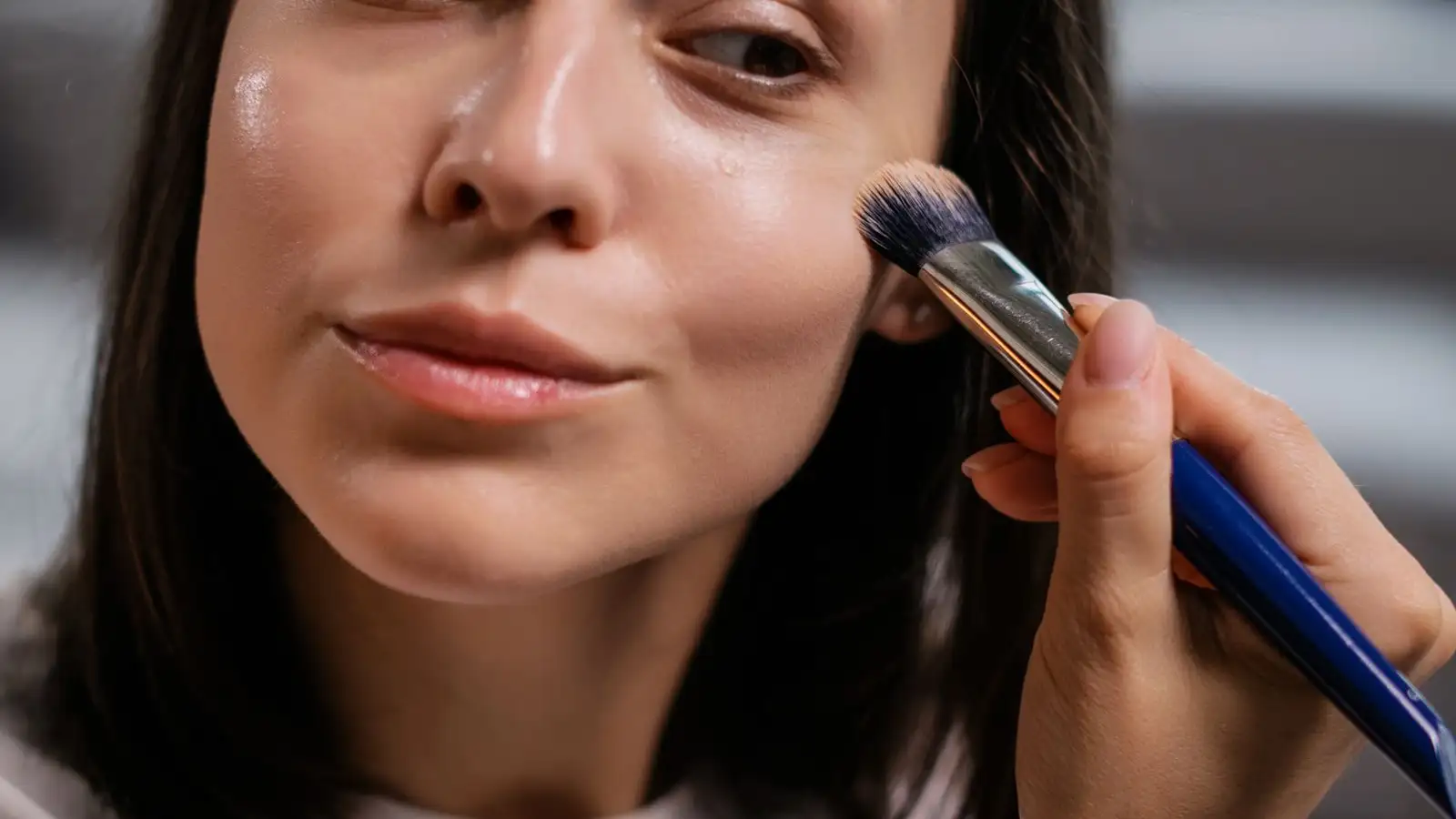
I want you standing where I stand most mornings. Bathroom mirror, door cracked so the hallway light doesn’t fight the vanity bulbs, damp sponge in one hand. You finished a few minutes ago. The jaw matches, the hairline is blended, that dip under the bottom lip is covered, and you walk out the door.
Mid-afternoon, stopped at a light, you flip the visor down out of habit. The jawline has gone half a step gray. The corners of your mouth have thinned into a haze. Where your cheek meets your ear there’s a patch reading faintly red against everything else. Nothing has slid off your face. No transfer on the phone screen. The color left first.
That is two clocks, not one. Physical wear is the film formers — the polymers holding pigment onto your skin — being worked on by sebum, sweat, and humidity. Those polymers are built to release with oil, which is exactly what makes them come off with a cleanser at night; the same chemistry is working on them at noon, just more slowly. You see it as patchiness, transfer onto a collar, product gathering in the creases beside your nose.
Color wear is the other clock, and it is the one that ruins the day. Pigment and the carrier oils around it are exposed to air and to your own skin from the second you blend. The base darkens and warms, or it desaturates and goes flat, and on a deep complexion both directions are obvious in a way they are not on a light one. A foundation can be perfectly intact and completely the wrong color. Most people read that as the product failing, go buy something with a bigger number on the bottle, and repeat the whole cycle.
The bottle is a sealed environment
The shade in the bottle is close to the shade on your skin early in the day, when it’s cold and nothing has touched it. It is not the shade you will be looking at in a car later. No air in a bottle, no oil, no heat, no phone pressed against your cheek.
Two directions of drift, and it helps to know which one you’re getting.
When it goes orange or red, the warm side of the base is reading hotter as the oils concentrate and react. It usually shows first around the mouth and in the creases, because that’s where the layer is thinnest and the pigment is most exposed.
When it goes gray or ashy, you’re seeing desaturation instead — the pigment flattening out, or the coverage thinning enough that your own depth starts coming through unevenly. Powder on top can push it the same way.
This is why the store swatch lies. Counter lighting is the least honest light in the building, and your hand is not your jawline. If you can, swatch, walk outside, and look again a few hours later before you commit. Depth being a half shade off is survivable. Undertone drifting the wrong way is what people actually notice.
Prep decides how long the top layer gets
Two jobs down there: give the foundation an even surface, and don’t fight its film.
The step that gets skipped is drying time. Skincare that’s still wet or still slippery is the most common reason a base separates by lunch — you can feel it while you blend, the foundation glides instead of grabbing. If you can slide a finger across your cheek and it leaves a shine trail, you’re not ready. Primer does the same job where skincare leaves off, and the useful ones dry down tacky rather than slick.
On deep skin, prep is also doing color work. Even out the deeper areas around the mouth and along the jawline before foundation goes on, and you won’t need as much product in exactly the places product goes wrong first.
Thin layers, and give them a minute
One thick application gives you a film that’s more brittle than the face it’s sitting on. Thin layers with a short wait between them build something more flexible, something that moves when you talk and smile instead of cracking at the corners of the mouth and separating along the jaw. Two thin passes also put less product down in the creases, where product collects and where your own pigment already runs darker.
Build where you need it, not everywhere. A full-coverage pass across the whole face is a lot of pigment sitting in places nobody asked about.
Setting is a trade, not a win
Powder works by absorbing oil that would otherwise be attacking the film formers, so yes, it extends wear.
It also carries reflective particles — titanium dioxide, zinc oxide, silica, mica — and those bounce light straight back. Under flash, that reads pale, and it reads pale on the wrong part of the face. Silica-heavy translucent powders can look ashy in ordinary daylight too, no camera required.
If a flash is coming, the move is a powder tinted close to your own depth, or one without a heavy reflective load, pressed only where you actually get oil: the T-zone, the creases. Leave the outer face alone. Setting spray is the other lever — it re-wets and re-forms the film — and most sprays aren’t loaded with reflective particles, but check, because some are.
Where it quits first
Jawline, neck, and around the mouth. Three different reasons.
The jawline is the highest-traffic edge on the face. It meets your collar, your phone, the heel of your hand, and it sits right where your face color and your neck color already disagree by a hair. A small shift there reads huge.
The neck gets either nothing or a lighter product, and then daylight finds it.
Around the mouth is movement, moisture, and your natural depth all in one zone, at the exact spot where the lip line and the chin crease meet. Product thins. Your pigment comes through. That’s the haze.
What you can’t fix
No routine keeps a match identical from morning to night. What you can do is slow the color shift, steer it so it lands somewhere you can live with, and keep the film flexible enough to move with your face.
The tradeoffs are real. Formulas built around oil control are doing their job by pulling oil into the film, and anything pulling oil into the film is also moving pigment and carrier around with it — the physical wear holds, the color wanders. Powder buys wear and spends flashback-safety. A sheerer layer is more flexible and more honest about where your own skin is.
So when you’re standing at that mirror tomorrow with the door cracked, you’re not really choosing a foundation. You’re setting five dials at once — shade, prep, thickness, set, and how much air and oil you let in — and the dial that decides whether the match survives the day is usually not the one on the label.

About the author
The Undertone
The Undertone is a byline for people who learned foundation on brown skin by swatching, mixing, and checking color in real light. They share a practical focus: if the depth and undertone are right, the formula will follow.
More about us