Set Foundation for All-Day Wear Without the White Cast
Set foundation for long wear on melanin-rich skin by pressing a finely milled, deep-toned powder into only the zones that move and produce oil — the sides of the nose, the mouth area, the forehead — and then melting that layer down with a setting spray. Sweeping powder across the whole face with a brush, or reaching for a pale "translucent" powder, is what leaves light-reflecting particles sitting on top of your own pigment. That is the white cast you see in daylight and the flashback you see in photos.
I learned it in a dark restaurant. A phone went up at the end of the table, the flash fired, and there I was on that little screen with a pale, grayish bloom sitting across the middle of my face. In the mirror over the bar ten minutes earlier, my base had looked even. Warm, even. The photo wasn't lying and the mirror wasn't lying either. They were just doing different things with the same layer of powder.
That's the whole thing, really. White cast and flashback aren't two problems. They're one problem seen under two light sources.
What those particles are doing up there
Hold a pinch of loose powder between your fingers and look at it under a lamp. It isn't a cream or a liquid. It's a cloud of tiny solid particles, and a lot of them were chosen for specific optical work. Titanium dioxide and zinc oxide are opaque white minerals. Silica is a clear microsphere that scatters light to blur texture. Mica is a flat, reflective platelet that gives a soft glow.
On light skin, those particles blend into the surface and vanish. On deep skin, they sit on top of a much darker background, and the difference in how they throw light back becomes visible all at once.
Under a camera flash it gets worse, because the light source is small, intense, and aimed straight at you. The particles send that burst back at the lens instead of absorbing it. The areas where you packed on the most product — usually the center of the face, which is exactly where a flash hits hardest — come back as a pale haze. That isn't your foundation oxidizing. Oxidation is a separate event happening underneath. Flashback is a surface-layer effect caused by what you put on top of the base.
"Translucent" is a relative word
Here's the part that took me the longest to accept: translucent doesn't mean invisible. It means invisible against a reference color.
Most powders carrying that word are formulated and tested against light skin, so against light skin they disappear. Against deep skin, the same product is a thin veil. You can't see it in the jar. You can't see it on the back of your hand in the car. Then four hours in, you catch yourself in a store window and your jawline looks dusty.
So the goal isn't colorless. The goal is a powder that sits close enough to your depth that when it settles into pores and expression lines, the residue reads as nothing. A finely milled, tinted or deep-toned powder does that and still handles oil — the tint has nothing to do with oil absorption.
Milled size matters as much as shade. Fine particles sink into texture and blur it. Coarse ones stack on top like a dusting of flour, and a stacked layer is a visible layer. Pinch a little between your fingers; if it feels gritty rather than soft, expect it to sit above your skin rather than in it.
Powder only where something is moving
Powder's job is not to cover your face. Powder's job is to interrupt the migration of a cream foundation, and it only needs to be in the places where that migration actually happens.
Slide a finger down the side of your nose and into the crease beside your mouth. That's movement. The forehead above your brows is oil. The eyelids are oil and they fold. Those are the places where setting genuinely buys you hours. Your cheeks, your jaw, the outer edges of your face — if they're normal or dry, powder there is doing almost nothing except building a film that will eventually catch light.
This is also the smartest way to handle a shiny T-zone, because an oily T-zone that's been heavily powdered is the worst possible combination: oil pushing up from below, a bright particle layer on top, and a flash hitting both. Keeping the center thin is not a compromise on longevity. It's the reason longevity doesn't turn into ash.
One more thing worth checking before you add anything: what's already in your foundation. Formulas with high sun protection or a heavy pigment load often carry their own titanium dioxide or zinc oxide. Layer a powder built on the same opacifiers over that and you've doubled the film. The answer isn't to stop setting. It's to go lighter and more targeted, and to lean toward a powder that carries less of the opaque white minerals.
The technique is the tool
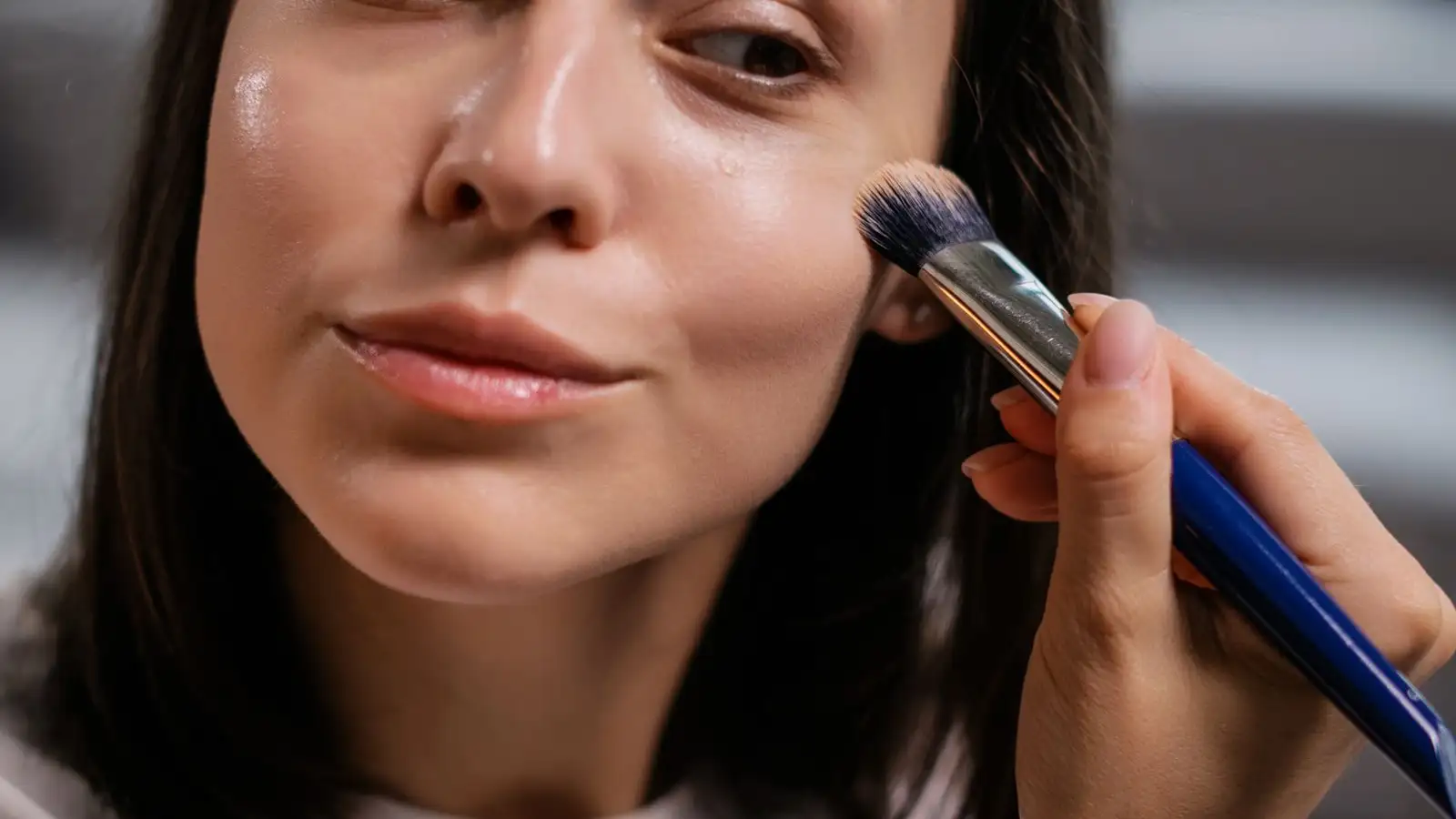
Press. Don't sweep. Brush versus puff isn't a matter of preference here — it changes what ends up on your skin.
A brush drags product across the surface. It also drags across the foundation you just applied, lifting pigment and pushing the lighter particles toward the top of that layer. That is the exact arrangement that flashes back. A puff, worked so the powder is folded into the fibers and then pressed into the skin, pushes powder down into the foundation instead of laying it on top, and it deposits far less product for the same amount of oil control.
Load it like this: press the puff into the powder, then knock it hard against the back of your hand or the rim of the lid until it looks like almost nothing is on there. Fold the puff and press and roll across the area — press, roll, lift, move. You're not wiping and you're not buffing.
Timing matters. You want the foundation to still have a whisper of tack when the powder lands. If the base has already dried down completely, the powder has nothing to grip and it just sits there waiting to be seen.
Under the eyes, use less than feels correct. Bake-style layering concentrates a wall of product in the one spot a flash is most likely to find, and the skin there is thin enough that powder settles into fine lines within the hour anyway.
Melting the layer down
A setting spray isn't a finishing touch you add for the smell. It's the step that dissolves the powdery look. The mist re-wets the layer slightly so the powder settles into the foundation rather than resting above it, which is what stops it reading as a separate surface on your face.
It adds no reflective particles. That's the point of using it instead of another dusting of powder. Mist from a real distance, let it settle instead of drenching one spot, then press your palms flat against your face for a few seconds to help everything merge.
Not every spray behaves the same way. Ones that are mostly water with very little film former will freshen the look and then let the base break down faster than it would have on its own. Ones with heavy film formers hold things in place but can feel tight and can read flat in photos. And nothing here is a permanent seal. A phone screen, a collar, a mask, a nap on a plane — all of it moves your base. Setting is a delay, not a force field, and it's worth deciding how much particle load you're willing to carry in exchange for how many extra hours.
Check it in the light you'll actually be standing in
The bathroom bulb is a liar. It's warm, it's diffuse, and it usually comes from above at an angle nothing else in your day matches.
Finish your face near a window when you can, and look at your jawline in daylight before you walk out. Then do the thing that costs nothing: stand somewhere dim, hold your phone at arm's length, and take one photo with the flash on. That's the test. If the center of your face blooms, you have powder sitting on top instead of pressed in, and you can take the puff back out and work it down before you leave.
Touch-ups aren't re-application
Around hour five, if the T-zone starts to shine, the instinct is to puff more powder on. Don't. Oil plus fresh powder is how you get cake, and cake catches a flash worse than bare skin does.
Press a tissue or blotting paper over the shine first and let it lift the oil. Then press a barely loaded puff over the same spot, or skip the powder entirely. Most of the time the blot alone is enough, because the powder from the morning is still there — it's just buried under oil.
Two minutes at the window, one flash photo, and a blot at five o'clock. That's the entire maintenance routine, and it's the difference between a base that reads true all day and one that only looks right in the mirror you got dressed in front of.

About the author
The Undertone
The Undertone is a byline for people who learned foundation on brown skin by swatching, mixing, and checking color in real light. They share a practical focus: if the depth and undertone are right, the formula will follow.
More about us