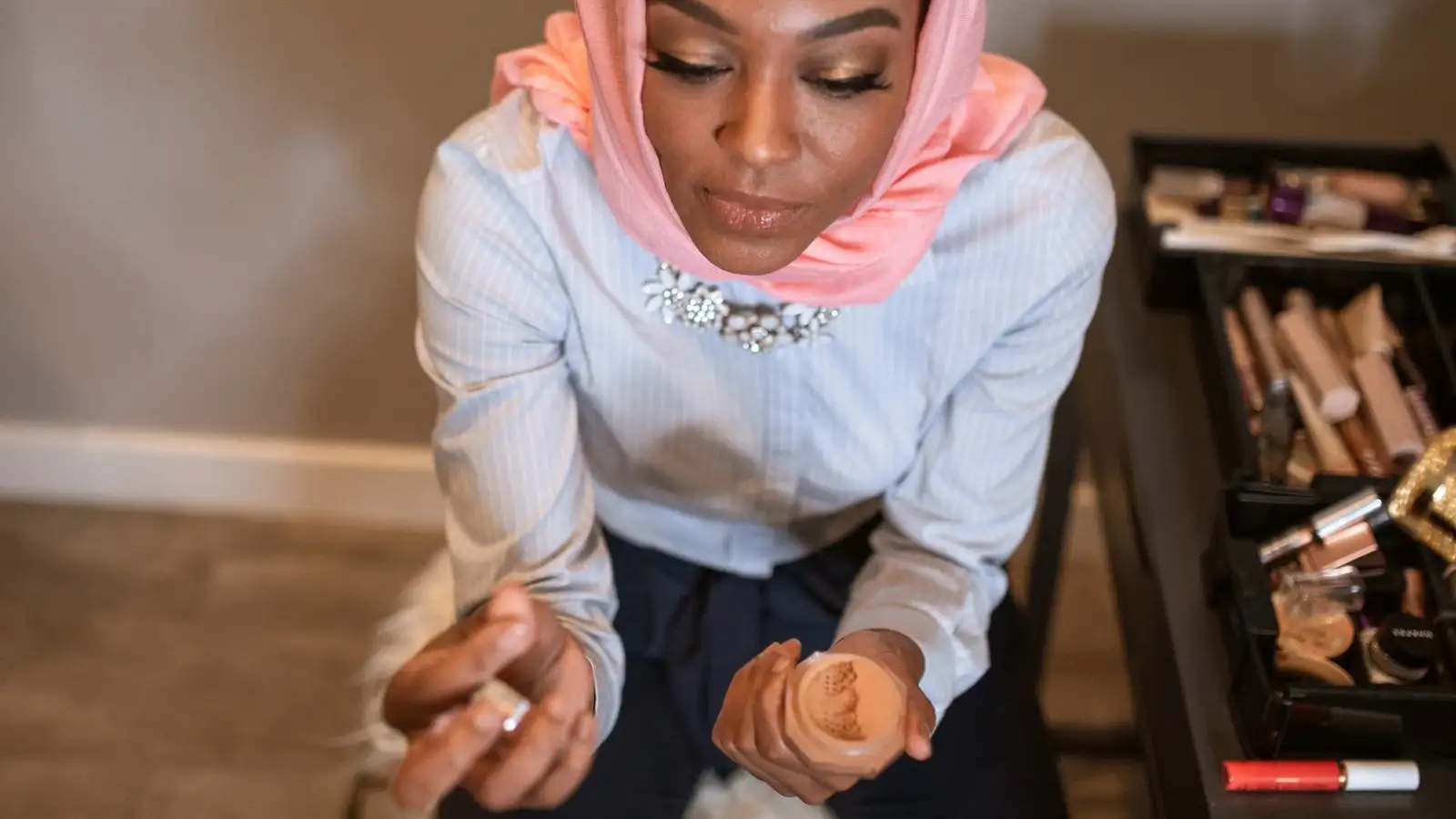
Why Matte Foundation Makes Mature Deep Skin Look Older
Matte foundation makes mature deep skin look older because it removes reflected light, and reflected light is what was softening the surface. Matte absorbs and scatters light instead of bouncing it back, so the eye goes straight to texture, pores, and the fine lines around the mouth. A satin or natural finish returns a moderate amount of light and keeps the same shade from reading dry. Changing the finish, or cutting the matte you already own with something more reflective, does more for the look of mature deep skin than adding another layer of anything.
Stand at a window. Not under the vanity bulbs, not at the counter in the store. A window, mid-morning, curtain pulled back so the light comes in from the side.
Hold a mirror at arm's length, then bring it in to about six inches. Look at the half of your face the window is hitting, then turn slowly so your cheek catches the light at an angle. There's a band of brightness that runs along the top of your cheekbone. That band is the whole conversation. It isn't oil and it isn't shine. It's the surface of the skin sending light back at you, and while it's there, the edges of everything underneath it go quiet.
Now think about what matte does to that band. It doesn't change your skin. It changes what happens to the light when the light lands. Matte pigment and matte powder scatter and absorb, and the band goes out. The brightness flattens. What's left is the actual topography: the place where the laugh line dips, the crosshatch above the lip, the patch on the cheek where the texture has gotten less even over the years.
On deep skin there's a second thing happening, and this is the part I almost never hear said out loud. Deep skin has natural depth built into it. That's not a flaw, that's the structure. Light moving across a deeper tone is what makes a face read as a face instead of a mask, because the high points stay warm and the planes fall back. Matte kills the high points along with the shine, and the face starts to read as one flat density, like a photograph with the contrast pulled down. Add a translucent powder on top and it can tip gray or dusty in the places the powder sits heaviest. Watch under the eyes and around the mouth first. That's where it shows.
Deep skin isn't one thing, either. The deepest espresso tones and the medium-deep tones with warm olive in them behave differently under the same finish, and the flatter one goes, the less of that difference survives. So the fix isn't a rule about deep skin. It's a rule about light.
Matte isn't wrong, it's just doing a job you may not want
Matte is a control tool. It holds oil down and it keeps product in place in heat and humidity, and on a long day that matters. The mistake is applying it to the whole face when only part of the face asked for it.
Here's how I handle it. Matte through the center panel, the T-zone down to the sides of the nose, and a satin or natural finish on the cheeks and along the jaw. The center is where oil actually comes from. The cheeks are where light needs to keep moving. Same bottle of shade, two finishes, and the face stops reading flat.
If you're going to powder, press it in with a small brush instead of sweeping it across, and only where you've already seen shine in the mirror. At midday, blot before you powder. Powder over oil is what turns into that dusty cast, and once it's there you can't brush it off without taking the base with it.
Dewy, satin, and the daylight test
Dewy reflects the most. On mature deep skin it can look fresh and awake, and it can also read wet by two in the afternoon if nothing is holding the center of the face. If dewy is the look you want, set the T-zone lightly and leave the cheeks alone. That's the whole adjustment.
One thing to be clear about: a dewy finish is a light behavior, not moisture. It won't make dry skin less dry. It changes what the light does, and that's all it does. If the skin underneath is tight and flaking, the finish will show you the flakes more clearly, not less.
Satin sits in the middle. It returns a moderate amount of light, enough to keep the surface from going dusty, not so much that it looks wet. For most mature deep skin I've looked at in daylight, that's the finish that reads true.
And daylight is the point. A finish that looks too shiny under artificial light very often reads balanced in a window. Store lighting and vanity bulbs both push reflection harder than the sun does, so the mirror in the shop is the worst place to make this call. Swatch it, walk to the door, look at your jaw outside. If you can't get outside, get as close to a window as the store allows and turn your face side to side. The band of brightness along the cheekbone should be there. It just shouldn't be the first thing anyone sees.
Fix the finish before you replace the bottle
Most people I know with a matte foundation they've fallen out of love with don't need a new foundation. They need a different ratio.
Put a pump of the matte on the back of your hand or a small palette and add a drop of something more satin. Mix it with a finger, then apply. You're changing how the film reflects, not how deep the shade is, so the match you already worked out stays intact. A satin is the safer blend than a dewy, because a dewy formula added to matte can loosen the wear you bought the matte for in the first place.
Two things to keep straight, though. Mixing on the back of your hand is fine; mixing in the bottle is not, because you can't undo it and you'll lose the matte where you actually wanted it. And none of this rescues a wrong shade.
Shade first, finish second, every time
Finish should be chosen after the shade match, not before. If the undertone is off, no finish hides it. Matte will make a half-step-too-light shade look chalky. Satin will make the same mismatch look glowy and still wrong. You'll spend money on the finish problem when the shade was the problem.
Get the depth right, get the undertone right in daylight, and then decide how much light you want coming back at you. That order saves more money than any other habit I've picked up.
So the short version, if you're standing in front of a mirror right now: look at your texture, look at where you actually get shiny, and look at where the light falls. Matte on the center if you need it there. Satin or natural everywhere else. Then check it in a window before you decide anything. The finish isn't a personality. It's a setting, and it should match the day you're having.

About the author
The Undertone
The Undertone is a byline for people who learned foundation on brown skin by swatching, mixing, and checking color in real light. They share a practical focus: if the depth and undertone are right, the formula will follow.
More about us