Is Titanium Dioxide the Reason Your Powder Flashes White?
Titanium dioxide is the pigment behind most powder flashback, but it is not the only one, and it is not interchangeable with the other. Titanium dioxide — CI 77891 on an ingredient panel — has a refractive index around 2.7 in its rutile form, scatters a camera flash harder for the same amount of pigment, and produces a bright, cool, slightly blue-white that sits on top of the face instead of in it. Zinc oxide — CI 77947 — sits closer to 2.0, scatters less at the same load, and usually reads as a thinner, softer pale veil. What actually decides how bad the cast looks is how much pigment is present, how finely it was milled, and how much air is trapped in the powder around it. None of those three things are printed anywhere on the label.
The test I run with the light off
I test every powder that comes into this apartment the same way, and I do it with the bathroom light off.
Phone at arm's length. Front camera. Flash forced on. One shot straight at my face, then a second shot into the mirror. The first frame tells me whether the powder flashes. The mirror frame tells me where.
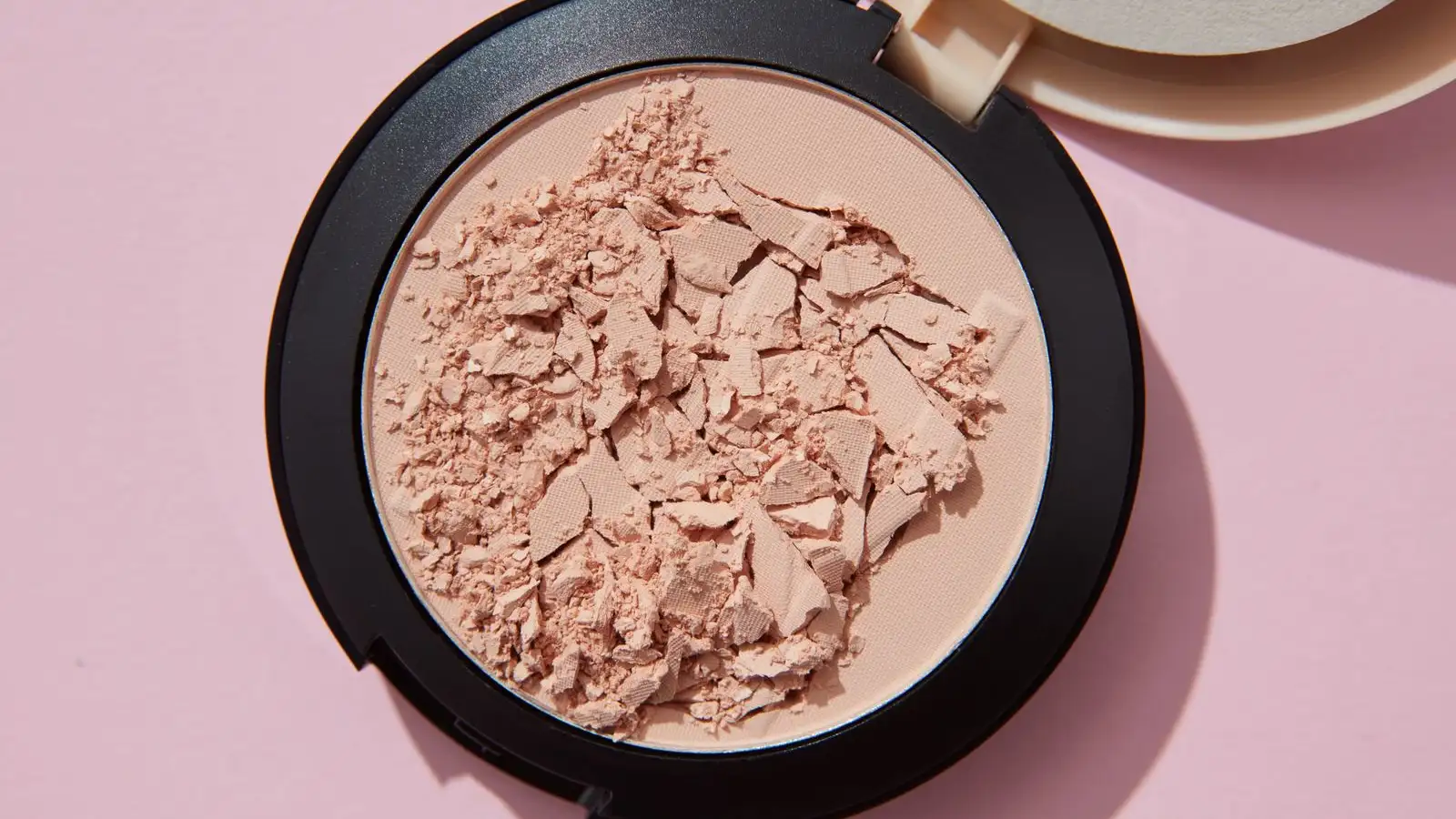
On a bad one, the photo isn't a face. It's a pale rectangle with a jaw somewhere inside it, brightest across the cheeks and the bridge of the nose, exactly where I set the powder heaviest. The edges, where my hand ran out of product, look like normal skin. That gradient is the entire diagnosis.
Flashback isn't the powder being the wrong shade. It's a layer at the surface bouncing the flash back into the lens before the light ever reaches the skin beneath it. You've seen the same thing in group photos — the one person whose forehead is a white smudge while everyone else looks fine — and if you've ever been that person, you know the specific sinking feeling when the photo gets passed around.
Why a flash finds this and daylight doesn't
Pigments don't glow. They scatter.
Light hits a particle, its speed changes, it bends, and it re-radiates in every direction, including straight back toward whoever is holding the camera. The bigger the gap between the particle's refractive index and the refractive index of whatever surrounds it, the more light comes back.
Titanium dioxide's rutile form runs around 2.7. Zinc oxide is around 2.0. Air is 1.0. The oils and esters in a powder binder sit somewhere near 1.45. Those gaps are the whole story.
The other half of the story is geometry. A flash is not the sun. It's a small, close, direct source sitting roughly one arm's length from your face, firing nearly straight on. That sends light down into the powder layer and straight back out again. Daylight arrives from everywhere, mostly from above, and a lot of what returns to the eye is diffuse light that has already been through the skin and picked up its color. The flash is a spotlight aimed at a mirror. The powder is the mirror.
The two whites do not fail the same way
Titanium dioxide's higher index means less of it does the same scattering job, which is exactly why it's the workhorse for opacity in pressed and loose powders. It's also why it's the usual suspect.
Zinc oxide at an equal load scatters less. The cast tends to come in weaker, and it comes in flatter and grayer rather than blue. I've had zinc-oxide-forward powders photograph as a faint haze across the cheek rather than a plate of white — visible, annoying, but not the same category of problem as a titanium dioxide powder at a real concentration.
The important word there is less, not none. A zinc oxide powder applied heavily enough over a large enough area still hits the same ceiling, just later and with more product. Swap one for the other and you've changed the slope, not the destination.
There's a color quality difference too. Titanium dioxide doesn't scatter every wavelength equally — it's a touch more efficient toward the blue end. Skin returns light that's warm. That combination is why a heavy flashback doesn't just look bright, it looks cold and slightly dead, like a separate surface parked on the face.
Particle size, and the reason the label can't help you
Scattering peaks when the particle is somewhere in the range of a few hundred nanometers — the general size of a visible light wave. Grind the pigment much finer than that and it stops scattering visible light efficiently and starts throwing the shorter wavelengths around instead. The practical upshot: a very finely milled white pigment can look sheerer in visible light than a coarser one at the exact same percentage.
Here's the catch. The INCI name does not change. Titanium Dioxide is Titanium Dioxide whether it was micronized or left coarse, and CI 77891 doesn't carry a particle size either. Coatings — the silane and methicone surface treatments you sometimes see listed as separate ingredients — change how the pigment disperses in the binder and how the particle interfaces behave, but the pigment's own name on the panel stays identical. So a label can tell you the pigment is in there. It cannot tell you how big the particles are, and particle size is half the outcome.
Clumping matters too. Agglomerated pigment behaves like large particles with air caught between them, which pushes scattering the wrong direction.
Air is the quiet variable
Air has the lowest refractive index of anything in that layer, right around 1.0. Every air pocket inside a powder is a hard boundary that light bounces off. A loose, fluffy powder holding a lot of air scatters more per gram than a dense pressed one. Same pigments, same percentages, different result — which is why two powders can behave nothing alike even when the first six ingredients match.
Wet application collapses the air. Pressing powder into a damp base with a sponge, or just sweating through it, fills those voids with water and oil, both of which sit much closer to the pigment's index than air does. That's part of why a powder can read at its absolute worst in the first twenty minutes and calm down later, once it's melted into the base.
Reading the panel when the panel doesn't want to be read
This is where most people give up, and it's not their fault. Both pigments are allowed to appear on a US ingredient panel under their common names or under their colorant names — CI 77891 for titanium dioxide, CI 77947 for zinc oxide. Titanium dioxide in particular can legitimately sit in two places on the same label: once in the main ingredient list where it's working as an opacifier, and again in a "may contain" colorant list where it's working as a color. Scan for the word and you'll miss the number. Scan for the number and you'll miss the word.
Order is the only real clue, and it's a blunt one. In the main list, ingredients run in descending order of concentration down to roughly one percent, after which the order is whatever the formulator prefers. So titanium dioxide sitting high in the main list means it's there in a meaningful amount, doing meaningful work, and you should expect it under flash.
If it shows up below the other colorants, near the tail of the panel, the amount is probably small — a tint adjuster rather than an opacifier — and the flashback will be softened rather than solved. Softened is not solved. A small quantity of a high-index pigment still sits on the surface, and the surface is where the flash lands first.
One thing no label can show you
The same scattering layer is always read against whatever is underneath it. On deeper skin, the step from skin to powder layer is a larger jump in value, so the identical veil reads more strongly — not because the powder got stronger, but because the contrast got bigger. A powder that looks like a soft sheen on light skin can look like a mask on deep skin. Same formula, same percentage, different outcome. If you've ever swatched something on your wrist, liked it, and then hated it on your face under a camera, that gap is part of what happened.
What I actually do about it
Most of this is fixable tonight, with what's already in the drawer.
Test in the condition that matters. Not daylight, not the store mirror. Dark room, forced flash, arm's length. Then shoot the mirror. If the mirror frame shows a bright patch, you know which zone to keep the powder off — usually the high points of the cheek, the bridge of the nose, the center of the forehead.
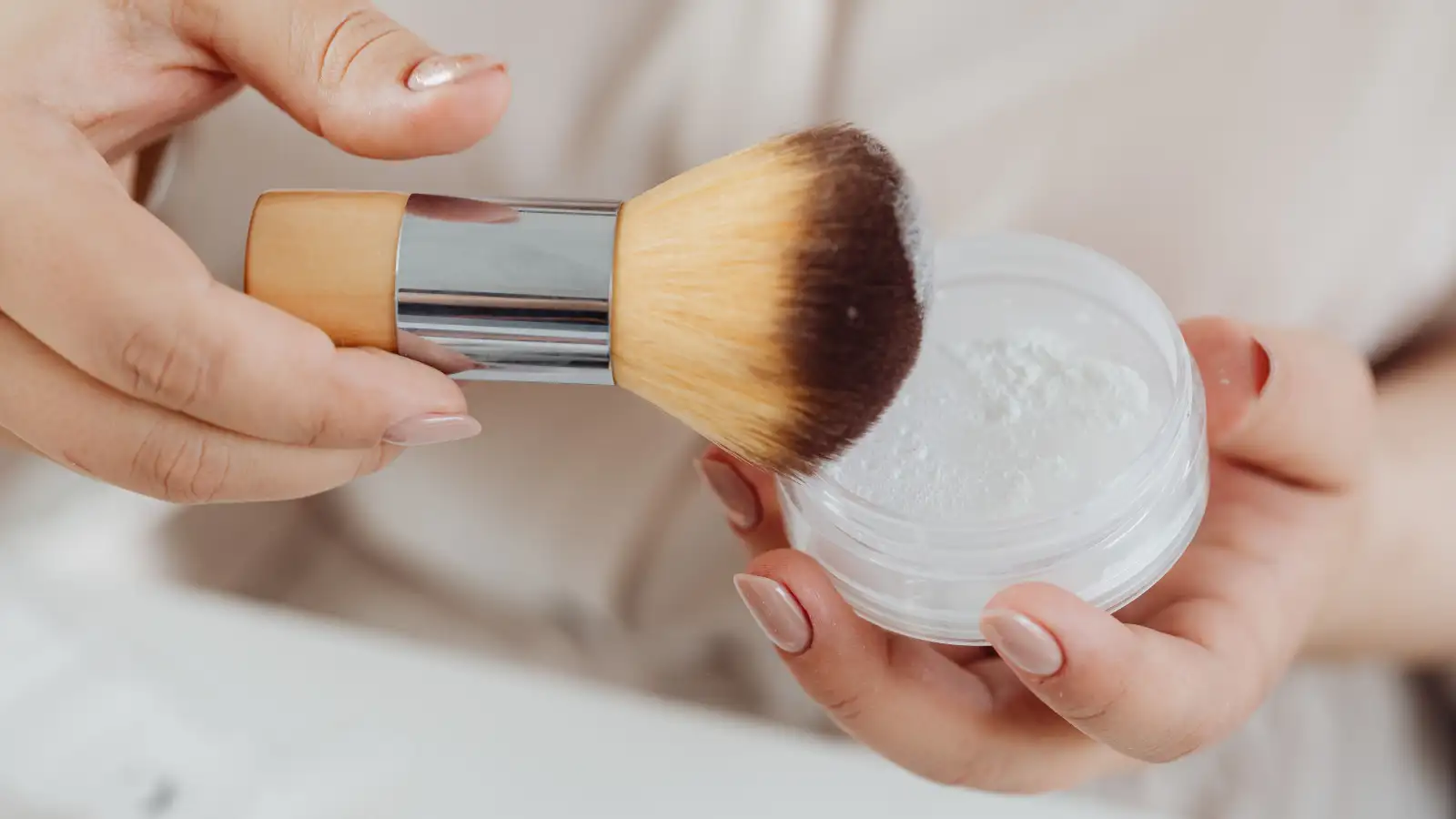
Use less, and press instead of dust. A puff pressed into the skin compacts the layer and pushes air out of it. A fluffy brush flicks powder into the air and lands it uneven. The heavy-handed zone is almost always the flashing zone.
Reconsider which powder goes where. A brightening powder under the eyes is asking for flashback by design — that's what it's for. Keep it off the cheekbones the flash will find.
Think about refractive index before you buy anything. Fillers with an index close to the binder's — amorphous silica sits around 1.46 — scatter far less than titanium dioxide does at the same visual effect. That's the physics reason some blurring powders photograph clean while a brightening powder at half the amount doesn't.
Blot instead of re-powdering. Every touch-up adds another scattering layer on top of the last one.
And when it really matters, change the light, not the face. A bounced flash, a bigger source, or simply standing a few feet further back does more than any product swap. It isn't always in your control at a wedding or a work event, but when it is, that's the lever with the most travel.
None of this maps onto a clean shopping decision, and I'd rather say that than pretend otherwise. Two powders with near-identical panels can behave differently because of air and particle size, and the same powder can flash badly on you tonight and photograph fine next month because you used a third of the amount and the flash was bounced off a ceiling. The variable you can actually control is how much pigment sits on the surface when the shutter fires.
So yes, titanium dioxide is usually the reason. But "is it titanium dioxide" is the wrong question to stop on. The better one is how much of it, how coarse, how much air, and how heavy your hand is — because you can change two of those four before you leave the house, without buying a thing.

About the author
The Undertone
The Undertone is a byline for people who learned foundation on brown skin by swatching, mixing, and checking color in real light. They share a practical focus: if the depth and undertone are right, the formula will follow.
More about us