You Can Still Wear Powder to Events With Flash Photography
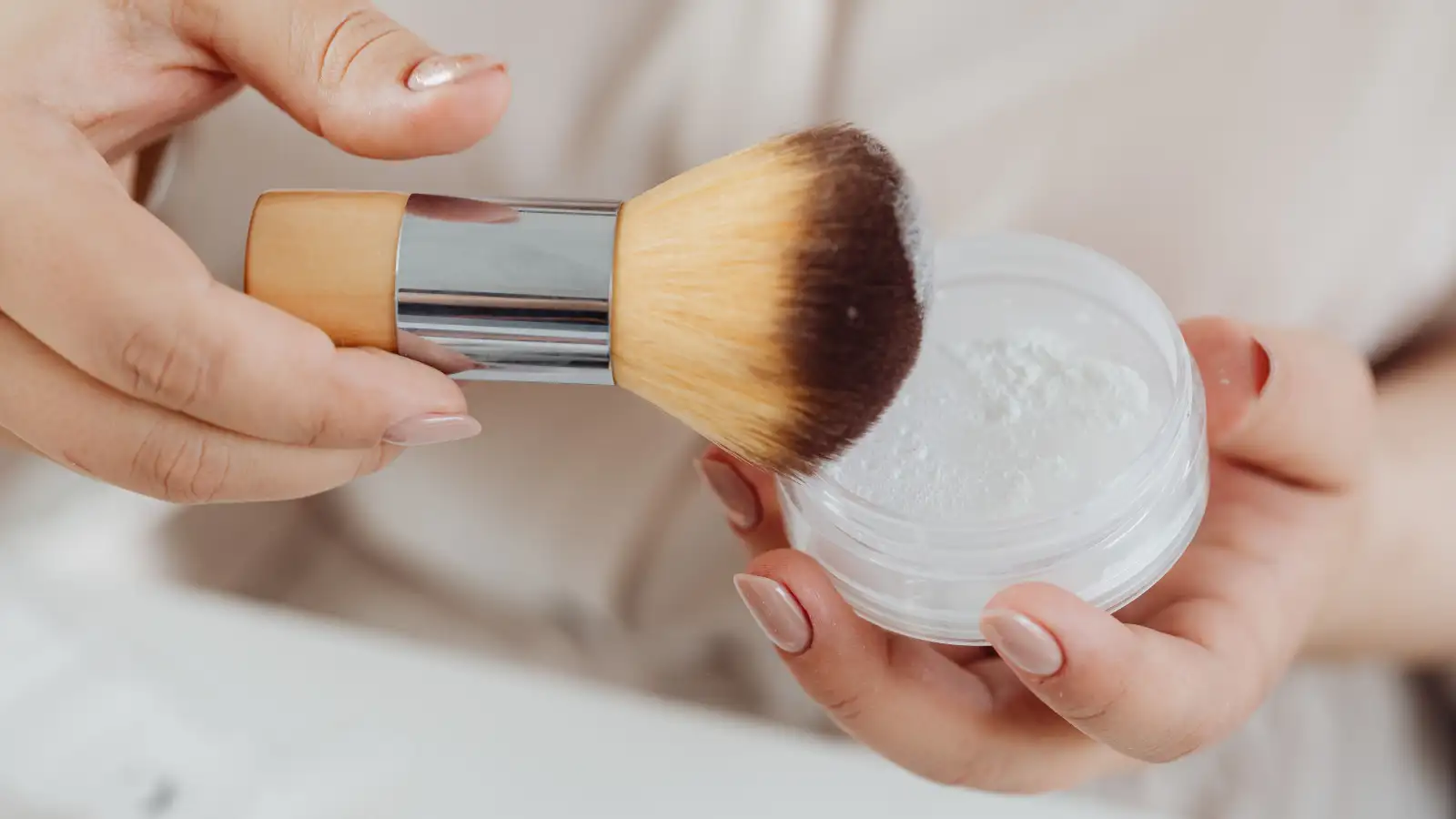
Yes, you can keep powder in your routine for an event with flash photography, but only if you stop treating it as a final all-over step and start treating it as a placement and timing decision. Powder goes on after the base has settled, in the smallest amount that will hold, worked down into the brush and pressed into the zones that actually move, with the thinnest film through the center of the face. Then it gets checked with a phone flash in a dim room before you walk out the door. The powder is usually not the problem. The film of it is.
The two-photo test
The bathroom light is off. The only light is what leaks under the door from the hall, and I am standing at arm's length from my own reflection with the phone held out and the flash forced on, not auto, forced, tilting my chin down the way a photographer's lens will be looking up at it. I tap to focus. The pre-flash fires, I blink, the real flash goes, and then I look at the picture.
Across my forehead, the bridge of my nose, and the tops of my cheeks there is a band of near-white that does not exist in the mirror. My jaw reads darker than my neck. That is the whole problem in one frame: light-scattering particles in the powder bouncing the flash straight back into the lens, and a film thick enough to be visible while it does it.
Here is the part most advice skips. Take one photo before you powder and one after. Same spot, same distance, same tilt. Now you are not guessing about the powder, you are reading a difference. If the first photo is already pale, the powder was never the culprit and no placement trick will rescue it. If the first photo is clean and the second one is not, you have just earned permission to change how you powder instead of abandoning it.
That distinction is the entire point. Most people take one photo, see white, and throw out a powder they otherwise like. Two photos tell you which layer is lying to you.
Let the base sit first
I do my base, then my brows and eyes, then come back to the face. That gap is not a ritual, it is the mechanism. Powder pressed into foundation that is still wet grabs more of itself than you intended. The damp surface holds more particles, they clump against each other, and you end up with a thicker, paler layer than the amount you actually picked up on the brush. A wet base also shifts shade as it settles. Powder over a shade that has not finished moving locks in the wrong one, and oxidation is easier to spot under flash than in a mirror. Five minutes of eye work is enough of a pause.
Loading the brush is most of the job
A small amount of product worked into a fluffy brush lays down a measurably thinner film than a puff pressed across the whole face. That is not a subtle difference. It is the difference between a photo I keep and a photo I delete.
What I do: shake a little into the lid, dip just the tips of the bristles, then tap the handle against the counter a couple of times so the powder settles down into the brush instead of sitting on top of it. The first tap is for the powder you can see. The second tap is for the powder you cannot.
Then I press. Pressing or rolling the brush into the skin moves far less powder off the bristles than sweeping does. Sweeping launches powder into the air and then drags whatever is left across the surface in a second, even layer that sits on top of the base rather than in it. You can feel the difference with your own hand. Sweeping feels like a breeze. Pressing feels like nothing at all. The nothing is correct.
Where it goes and how little
The center of the face is where a flash reflects most directly: forehead, nose bridge, the high points of the cheeks, chin. That is the zone where I want the least product, not the most. One press through the middle and stop. If the base moves somewhere specific, that spot gets a second pass, not a second layer.
Which is the awkward part, because the center is also the T-zone, and the T-zone is usually where your hand reaches first. Both things are true at once. The T-zone needs powder where the base actually moves; it does not need a full film of it. A thin press through the center does the job and barely registers on a flash. Three passes through the center is where white cast comes from, and no powder choice saves you once that has been built up.
The perimeter is more forgiving. Flash hits the outer face at an angle, so it reflects less. I take whatever is left on the brush and run it along the jaw and down the sides, which also keeps the powder edge from ending in a visible line where the light changes.
Under the eyes and in the creases beside the nose are the one place a puff earns its keep, because you want a dense, small, targeted press rather than a dusting. But it is a press, on one spot, not a sweep across the whole face. A puff dragged everywhere is the fastest route to a pale film.
The touch-up is where it comes apart
You powder at seven. You are in photos at eight and they look right. Then at ten, in a bathroom with bad light, you powder again, over the top of everything, without taking anything off first. That is layer two, and layer two is the one that shows up in the group shot. If you touch up, press the surface off with a tissue first, then add back as little as you can get away with, in the same places. Or do not add back at all.
What the test cannot tell you
The phone flash is a hard, close point source. Real event flash usually bounces off a ceiling or a wall, or goes through a diffuser, which spreads it and softens the reflection considerably. So the test you run at home in a dim room is a worst case, not a preview. If a powder survives that, it will almost certainly survive the venue. If it fails, that does not automatically mean it fails at the event, but you have learned that the powder is the variable, and you still have time to choose differently.
Some formulas are built on ingredients that reflect too much of a direct flash for placement to matter. If a powder is one of those, the two-photo test will tell you the same day, and the answer is to set it aside for photo days rather than use less of it. There is no trick that turns a reflective formula into a non-reflective one.
One more limit: the test is your phone, your distance, your angle. A photographer with a longer lens and different flash exposure will render things their own way, so a clean test is a strong signal, not a guarantee. Your clothing, your collar, the venue walls, and the ambient light in the room all change what bounces back at the lens too.
Which is why the goal is not a matte face. The goal is a face that reads as your face when someone points a flash at it. Powder can absolutely be part of that. Decide where it goes, decide how little, wait until the base has settled, and check it with one photo before and one after. Then put the phone down and go.

About the author
The Undertone
The Undertone is a byline for people who learned foundation on brown skin by swatching, mixing, and checking color in real light. They share a practical focus: if the depth and undertone are right, the formula will follow.
More about us