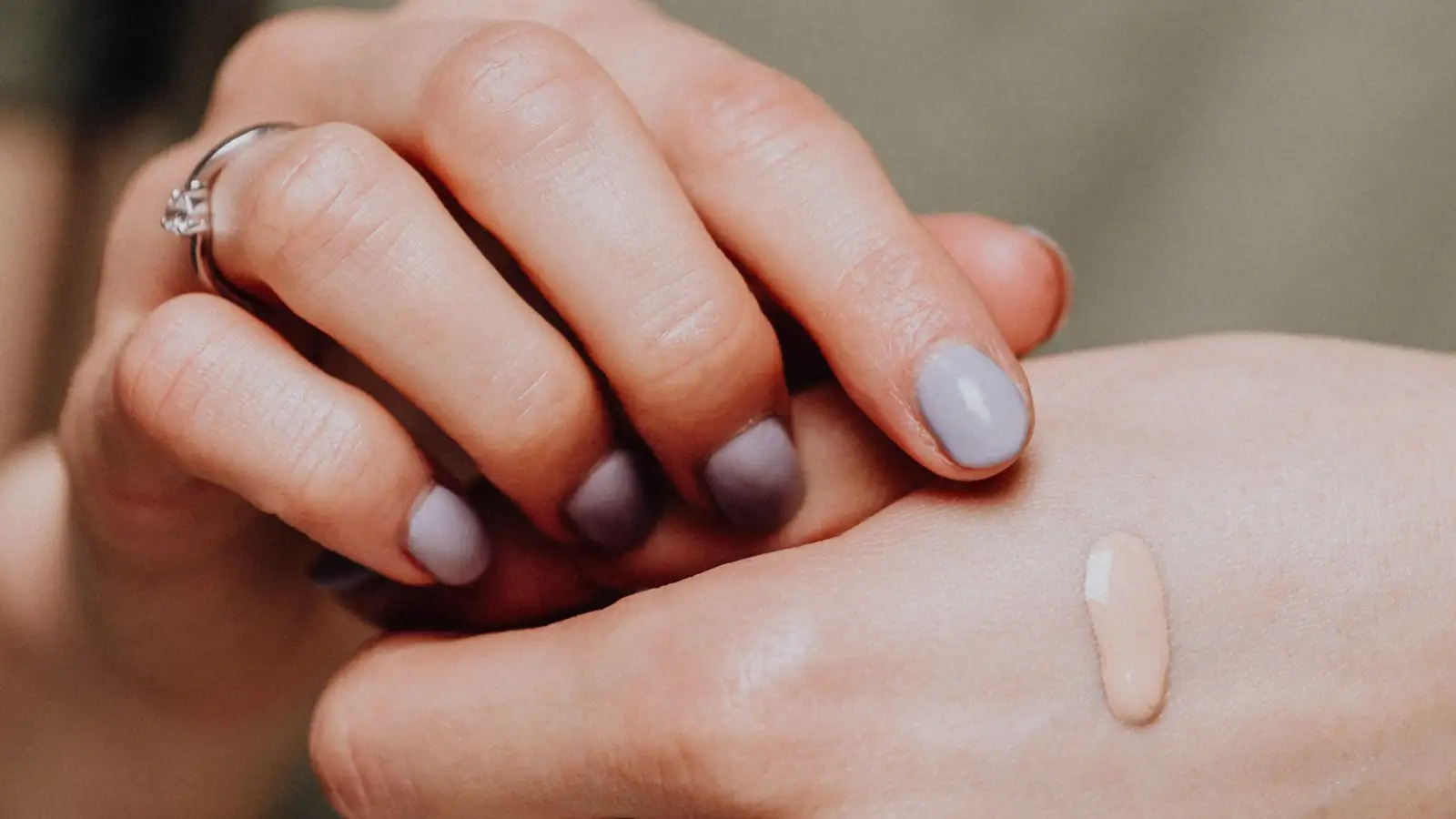
Which Light Lies About Your Foundation Swatch?
The light that lies about a foundation swatch is almost always the warm track lighting overhead, the small yellowish bulbs angled down at the shelf that make every bottle look expensive and push every swatch a half step warmer and a half step lighter than it actually is. The light that tells the truth is indirect daylight at a window or an open doorway. The test is to carry the swatch there before you commit, because the swatch was never one single color to begin with. It is a recipe of pigments that answers differently to different lights, and the aisle is the worst place on earth to find out how.
I keep a white index card folded in my wallet for exactly this. Stand at the end of the aisle with me for a minute and look up. What you will usually find is a row of track heads, each one hot and small, tilted toward the shelf so the row of bottles glows from above like a jewelry case. Now look down at the shelf edge, the white plastic strip with the price printed on it. Does it look white? In most of the stores I have stood in, it looks cream. Slightly buttery, slightly aged. That is not the plastic. That is the light landing on the plastic, and it is landing on your skin the same way.
Hold the card up next to your hand. If the card turns yellow, everything you are looking at is being pushed warm, and every swatch on your skin is being told the same lie in the same direction. If the card goes faintly blue or grey, you are under a cooler bulb, and the swatches are being pulled toward ash. Either way, you now have a reference point that does not have an opinion: white paper, in your hand, under the actual light.
Two swatches, one aisle, two different answers
Here is what I want you to notice while you are still standing there. Swatch three stripes on your jaw and blend the bottom edge down toward your neck. Two of them will look nearly identical under those bulbs. Same depth, same warmth, both plausible.
That is the part that fools people. It does not feel like a coin flip. It feels like a decision you can make, because the light has narrowed the difference to nothing.
The word for what is happening is metamerism. Two samples can match under one light source and split apart under another, not because either one changed, but because each is built from a different set of pigments that reflect light in a different shape. Foundation is not a color. It is a formula: iron oxides, titanium dioxide, sometimes mica, suspended in something that dries down on your skin. Two formulas can land on the same apparent shade under a warm bulb using completely different recipes, and only one of them survives daylight.
This is why the swatch that looked perfect in the aisle goes peach in your car mirror, or goes grey by the time you get to your desk. Nothing about your face changed. The spectrum hitting it changed. Warm bulbs emit a narrow, yellow-heavy band, and under that band, a slightly too-warm, slightly too-light shade reads neutral. Take the yellow away and the warmth you were compensating for is suddenly visible.
The phone flashlight is a second opinion, not a verdict
If a window is far and you want a fast read, pull out your phone and put the flashlight on. Shine it at a slight angle across the swatch and the index card, not straight down, and watch the color of the paper. It will look cooler than the shelf light, always, because a phone LED runs closer to a neutral white than a track head does.
I want to be honest about the limits here. Phone flashlights are not calibrated. Some run noticeably cool, some lean warm, and you cannot treat one as a precision instrument. That is not what you are using it for. You are using it to make the swatch show you its other face. If a shade looks seamless under the store bulbs and then looks wrong under the flashlight, you have not found the right foundation, you have found a metameric match, and daylight is going to side with the flashlight far more often than it sides with the ceiling.
One more thing about the card: keep it in the same pocket as your phone and replace it when it gets grimy. A foundation-stained white card is a useless white card.
Then walk it to the window
This is the step people skip because it takes a minute. Pick up the two contenders, walk to the front of the store, and stand at the edge of the daylight rather than in the middle of it. Overcast light at a doorway is the cleanest read you will get. Hard direct sun is not, because it blows out depth and makes everything look like a different product.
Hold your hand so the daylight falls across the jawline. Your eye should be hunting for one specific thing: a seam. Not a color that looks nice, not a shade that reads smooth on your hand. A seam where the swatch stops and your neck starts. That boundary is where the mismatch lives, and it is almost invisible under track heads because the warm cast softens the transition, especially at the jaw where the bone line already creates a shadow.
I check the neck rather than the face. The face is where color lives anyway, and it is the neck that gets compared against it every time you look in a mirror. If the swatch disappears into the neck in indirect daylight, it is a candidate.
What the ceiling does to deeper skin
Track lighting is bright and it bounces, and that bounce does two things that hit melanin-rich skin harder than anything else in the room — which is why reading undertone on deep skin calls for a daylight comparison, not a warmer bulb. It adds luminosity, so a shade that is genuinely too light for you reads as coverage. And the yellow cast fills in grey, so ash does not show up. A foundation that is too ashy or too pink on deep skin can read almost neutral under those bulbs, because the light is supplying the warmth the formula lacks.
Then you step outside and the grey comes up like a mask around the perimeter of your face.
If you are matching deep, the daylight walk matters more, not less, because the error is bigger and it is hiding in exactly the direction the aisle light pushes it. Warm light forgives a wrong undertone on lighter skin more readily. On deep skin it tends to bury it until you are already outside.
Ten minutes, and look at the edges
Swatch it, walk it, then give it ten minutes before you decide. Formulas dry down, and some of them shift as they do. This is the part most people never check because they have already paid and walked out.
Do not stare at the middle of the swatch. Watch the edges, because the edges dry first and they are where the shift announces itself. If the perimeter starts going peach or dusty grey while the center still looks right, you are watching a formula dry down, not a lighting problem, and no amount of window light is going to fix it.
Not every foundation oxidizes. Plenty sit exactly where they land and stay there. And a small shift is not automatically a disqualifier, because some formulas settle a hair and then hold. What you are checking is whether the shift is one you can live with at 3 p.m. in a car with the sun coming in, not whether the swatch is perfectly static.
What I actually do now
Four checks, in this order. The card tells me what the light is doing. The swatch on the jaw tells me what the formula does at my depth. The phone flashlight tells me whether a match is real or borrowed. The window and the ten minutes tell me the truth.
If two shades survive all four, I take the one that matches the neck, and I take it home and wear it for a day before I trust it.
Stand under those track heads one more time before you pay. Look at the bulbs, then look at your card, then look at your hand. The light is the one guessing. You are the one who gets to check.

About the author
The Undertone
The Undertone is a byline for people who learned foundation on brown skin by swatching, mixing, and checking color in real light. They share a practical focus: if the depth and undertone are right, the formula will follow.
More about us