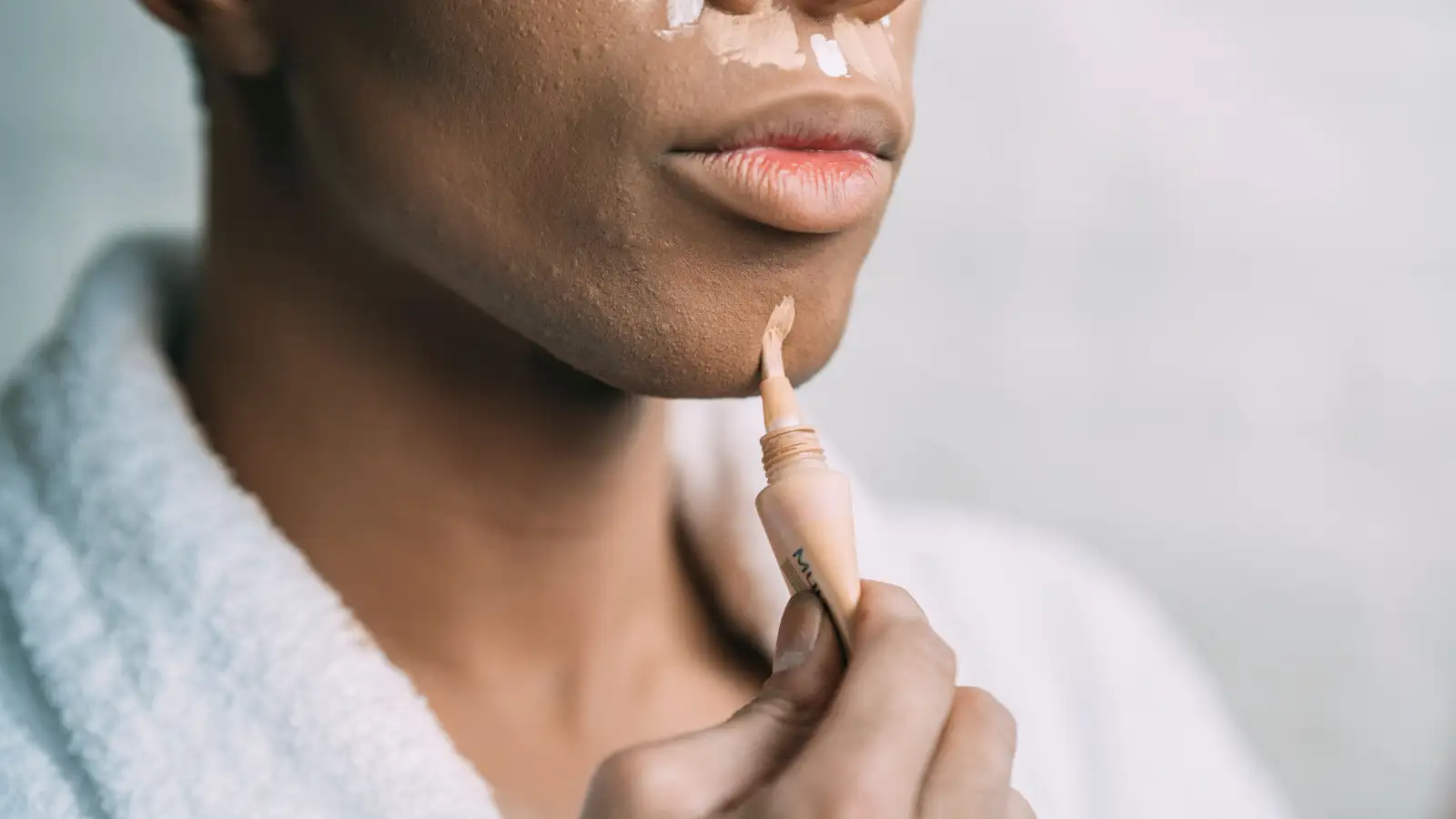
Dry Skin Can Hold Deep Foundation, but Prep Comes First
Dry skin can hold a deep foundation shade, but not by adding more cream. The reliable approach is to split prep into two jobs: put a light hydrating layer where dehydration lines around the mouth and eyes grab color, and keep heavy occlusive layers off the center of the face where they make foundation break down within a few hours. Then wait a short beat, apply the foundation thin, and use a hydrating primer only on the outer face so the jaw, cheeks, and neck read even while the center stays intact.
Stand at the bathroom window with me. It is early, the light is coming in low and flat, and I have a bottle of deep foundation on the counter next to a hand mirror. When I smile, the lines at the corners of my mouth catch the light. If I go straight in with foundation, those lines hold a thin dark line of product. By the afternoon, the same bottle has separated across my chin because I put a rich cream underneath it. That was the mistake I made for years: I treated dry skin prep as one big layer of moisture and then blamed the foundation.
Two problems, two different fixes
Dryness under foundation is not one problem. The first is dehydration lines: shallow creases that grab color because the surface is dry and slightly rough. The second is weight: a heavy occlusive layer sits on the skin, the foundation mixes with it, and the whole thing moves. One needs slip. The other needs less weight in the wrong place. I separate them before I open the bottle.
The layer that adds slip
I use a light humectant layer, something that feels like water on the back of my hand, not a balm. I press it around my mouth, over the cheekbones, and along the orbital bone where the skin is thin. Then I wait. Two or three minutes. The surface should feel tacky, not wet. If I apply foundation while it is still wet, the foundation floats; if I wait too long and it dries down completely, the lines come back. That short wait is the step I used to skip, and it is the one that changes how the foundation sits in the creases.
The layer that adds weight
A thick occlusive cream has a place, just not under foundation in the center of the face. When I put it on my nose, between my brows, and on my chin, the foundation emulsifies with it. A deep shade shows that fast: the color goes patchy around the nostrils, the chin looks lighter where the product has broken, and no powder fixes it. I keep the heavy layer for the outer cheeks and jaw if I use it at all, and I keep the center light.
What I do at the sink
I do not scrub my face right before a deep foundation. I learned that one in daylight: scrubbing leaves the surface uneven, and a deep shade reads every patch. The foundation looks lighter where I scrubbed too hard and darker where I did not. It is not smoother; it is striped. If I scrub, it is not on the same morning as a full face of foundation.
My neck is often drier and paler than my face. If I prep only my face, the jawline gets a hard line where the foundation stops. I take the light hydrating layer down the sides of my neck and under the jaw, then I press a small amount of foundation there with a damp sponge. I do not try to make the neck match by piling on foundation. I make the transition smaller: a little moisture, a little color, and a blur at the edge.
Flaking or settling?
Not every rough patch is dry flaking. I look at it in the window light. A flake lifts at one edge and moves when I run a sponge over it. Settling is different: the foundation has collected in the same line, usually the smile lines or under the eyes, and the skin underneath is smooth. If it is a flake, a little more of the light hydrating layer before makeup helps. If it is settling into mature texture, more moisture makes it worse. That is when I go thinner: less foundation, a smaller sponge, and no hydrating primer on that spot.
Where the primer goes
I put hydrating primer on the outer face: the cheeks, around the mouth, the outer jaw. I keep it off the nose, the center of the forehead, and the chin. If I put it all over, the center turns slippery. The foundation does not set; it slides off the high points and collects around the nose. The outer face still needs it because that is where the dry patches are. So I treat primer like a spot prep for the makeup surface, not a base.
The check I trust
I judge prep by what I see at four hours, not by how it looks when I finish. If the center has separated, there was too much weight. If the smile lines are dark, I needed more slip and a longer wait. If the jawline is a different color from the neck, I did not carry prep down far enough. On my deeper skin, a patchy prep shows as color unevenness before it shows as texture, so I look for that first. That is the whole method: add slip where the face grips, take weight away where the foundation dissolves, and keep the primer on the outside.

About the author
The Undertone
The Undertone is a byline for people who learned foundation on brown skin by swatching, mixing, and checking color in real light. They share a practical focus: if the depth and undertone are right, the formula will follow.
More about usRelated posts