Why Prep, Not the Shade, Decides Deep Foundation Wear
Prep decides the color. On deeper skin, every layer under the foundation — the film a moisturizer leaves, the residue a toner leaves, the silicone in a primer — sits between your pigment and the light, and it keeps shifting after you leave the house. The shade is a decision you make once; prep is the thing that keeps moving it, which is why the same bottle reads correct at eight in the morning and a half step warm and flat by mid-afternoon. Get the surface right and a decent match holds. Get it wrong and a perfect match goes orange, or grey, before lunch.
I want you at the sink with me, at the window, not under the vanity bulb. It's quarter to eight, the light coming in is flat and white and honest, and there's a cotton pad in my hand that I've just swept down my jaw. Hold yours up. If it comes away with a pale, powdery film on it — almost chalky, lighter than your skin by two or three steps — that's not dirt and it isn't dead skin. That's the tail end of last night's moisturizer and whatever was in it, and it's sitting on your face right now, before you've opened the foundation.
Now look at your jaw in that same window light and compare it to your neck. If the jaw reads a shade lighter and slightly grey, that grey is not your undertone failing you. That's residue. This is the thing I keep trying to get across: on light skin a pale film is invisible, so people talk about prep as a texture problem — bumps, slip, grip. On brown and deep skin the same film is a color problem. It desaturates. It pulls the warmth out of the surface so that a foundation matched to your actual skin has to fight through a veil of something else to get there.
The residue is the first layer of color
Everything you put on before foundation is, functionally, a tinted layer even when it has no tint. A cream with a high load of mineral filters or pearlizers leaves a whitening cast that is fine on fair skin and ashy on ours. A primer with a white or pink base does the same. That cast is not a texture issue that a good foundation will cover — foundation is not opaque paint, it's a translucent film, and translucency means whatever is underneath contributes to the final color. You are not applying one color. You are applying two, stacked, and reading the average.
So when I hear someone say their foundation looked fine in the store and grey at their desk, I don't start with the foundation. I start with what they put under it, and how much, and how long they waited.
The emollient is the engine, not the villain
Here's where prep stops being neutral. A rich emollient cream applied a minute before foundation doesn't just sit there. It keeps the film soft and mobile. The oils migrate up through the pigment layer over the course of a day, mixing with sebum, softening the resin that holds the film together. The foundation doesn't oxidize in the dramatic chemical sense people imagine — iron oxide pigments are stubborn and stable. What changes is the film: it plasticizes, it mixes with oil, it reflects light differently. And the way that reads on deep skin is almost always warmer, deeper, more orange, because you're now seeing pigment plus oil plus a softer surface.
That's the honest version. Not a chemical reaction, a physical one. Which also means it's controllable.
If your correctly matched shade goes warm by hour six, the first thing I'd change is not the shade. It's how much cream went underneath it and how wet that cream still was when the foundation landed.
Testing on the jaw, not the hand
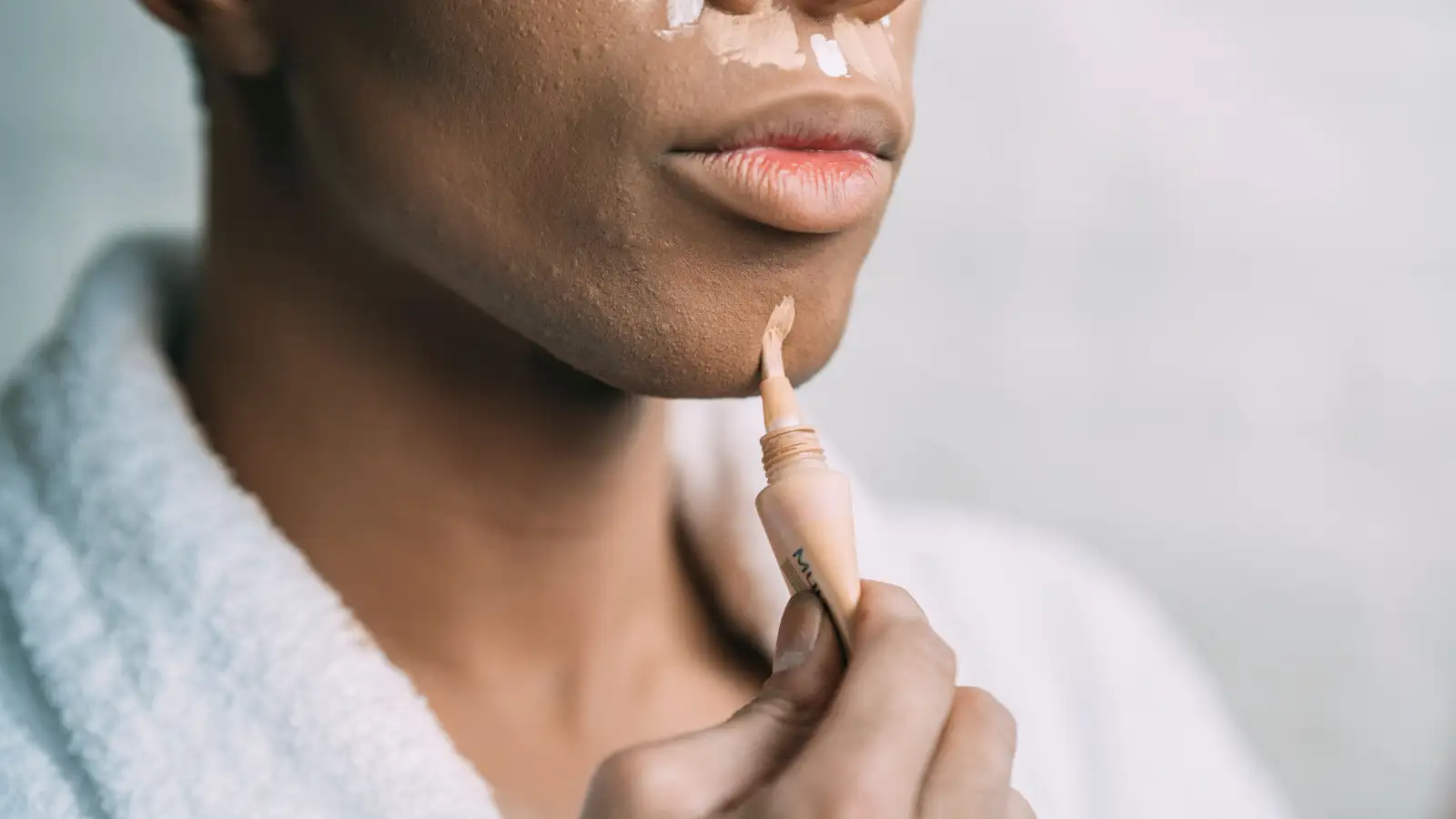
The back of the hand is the wrong instrument. Different tone, different oil, more sun, and it never matches the neck. I test on the jawline and down onto the neck, in daylight, next to a window, and I test the prep and the foundation together as a pair — a stripe of prepped skin, then foundation over it, then look at it against the neck, not against the cheek. Cheeks flush and run warmer than the truth. The neck doesn't lie.
Give it ten minutes before you judge. Fresh foundation reads lighter and cooler than settled foundation; that first impression is a trap. Ten minutes is enough for the film to start doing what it's going to do. Then walk to a different window. If the stripe still disappears into the neck in two kinds of daylight, the prep and the shade are compatible.
How much of each layer
The instinct when a foundation isn't behaving is to add more underneath. That's backwards. Thin foundation grips best on thin prep.
Cleanse until the water runs clear, and stop before the skin feels squeaky. Squeaky means you've taken the surface film off entirely, and the next thing you apply will sit on top of the skin rather than settling into it, which is exactly how you get slip — and on oily skin, stripping the skin can trigger a rebound that lifts pigment by midday.
Toner is optional and I'd skip it in dry weather under foundation. If you use a hydrating one, press it in and let it dry completely; a wet humectant layer under foundation is a recipe for the film breaking down early.
Moisturizer: a pea to a dime for the whole face, not a finger-length squirt. More on the dry perimeter, barely anything through the center if that's where you get shine. Then wait. Not thirty seconds — wait until it stops feeling like a layer, when your palm dragged across the cheek doesn't slide. That's usually a minute or two for a lotion and closer to five for a heavy cream, longer in humid air. This wait is the single most useful thing in this article, and the back of your hand tells you when it's over better than the clock.
Primer: one pea, pressed rather than rubbed, and only where you need it — pores, not pits or raised bumps. Most people need it in the center panel and nowhere else. Priming the whole face including the perimeter is how the edges of the foundation start sliding by noon.
The jaw and the neck get the same prep as the face, in the same amounts. If you prep to the jaw and stop, the boundary shows as a line of different color, and no one will read that as a prep issue. They'll read it as the wrong shade.
When it pills, find the layer that's rolling
Pilling is the most misdiagnosed thing in this whole routine. People blame the foundation, replace the foundation, and it happens again, because the fight was between the skincare and the primer.
The general rule: a silicone-heavy primer over water-based skincare with a lot of gums and humectants can ball up, and so can the reverse — heavy silicone skincare under a water-based primer. It's not about which family is better. It's about two films that don't want to merge.
To find the culprit, test in stages on the jaw. Moisturizer alone, wait, then rub gently. Then add primer, wait, then rub gently. If it rolls before any foundation exists, you've found the pair. Look at the color of the roll-up: pale and slightly white means it's the primer or the cream lifting, not the foundation. And press instead of rubbing when you apply — friction is what turns a marginal incompatibility into visible crumbs.
Winter air and summer air are two different routines
Same products, same amounts, different season, different result. This trips people up constantly.
In dry winter air, water leaves the film fast. The foundation sets quickly, which sounds good and isn't — it sets before it's fully settled, and it reads paler and chalkier than it did in July. The shift you'll be fighting is toward ash. Change one step: give the moisturizer more time and a little more product, and pull back the powder. Don't change the primer and the cream and the powder at once or you'll never learn which one worked.
In humid summer air, the film stays soft and mixes with sebum. Now you're fighting warmth and depth instead. Change one step: lighten the moisturizer layer and put a thin grip primer in the center only. Leave everything else alone.
The hour-six check
At some point mid-afternoon, go back to the window you used that morning. Press a tissue against the cheek and look at it. If it comes away tinted and warm, the film is moving and your prep was too rich. If the jaw now reads grey rather than warm, the residue under the foundation is winning. Either way, the answer is a change to the layer underneath, not another shade.
Once you start reading prep as color instead of texture, the search for the perfect shade gets a lot shorter. Most people don't have a shade problem. They have a surface problem wearing a shade problem's clothes.

About the author
The Undertone
The Undertone is a byline for people who learned foundation on brown skin by swatching, mixing, and checking color in real light. They share a practical focus: if the depth and undertone are right, the formula will follow.
More about usRelated posts