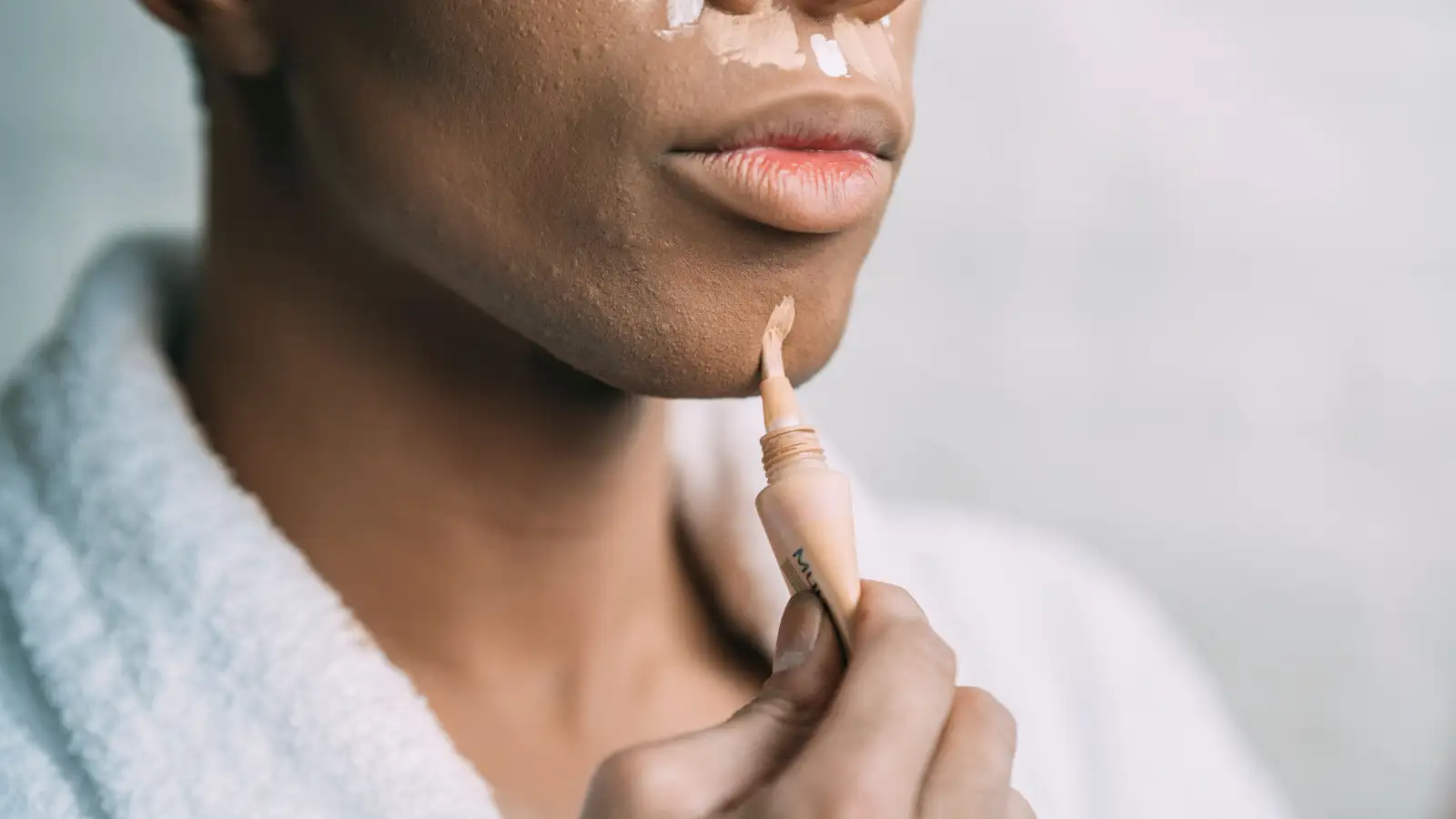
The Prep Habit That Hands Your Foundation to Oil by Noon
The prep habit that hands your foundation to oil by noon is prepping for drought instead of balance: a stripping cleanse, an astringent toner, and no moisturizer because oily skin already feels moist enough. That combination takes the surface down a notch, and by mid-morning the skin answers with more oil than it started with. The oil is what lifts pigment off the nose and brow and pushes the shade ruddy before lunch. What fixes it isn't more mattifying product. It's a thinner, more targeted prep that controls shine on the T-zone without drying the rest of the face.
I keep a compact mirror in the console of my car, and for about a year it was the most honest critic I owned. At 7:10 in the bathroom, under the warm bulb over the sink, my foundation looked matched. At 11:40, driver's seat, visor down, the same foundation had separated across my T-zone. Shine I could see from arm's length. A ruddy ring around each nostril. A patch between my brows where the color had gone grayish and slightly darker, as if the pigment had oxidized in place.
For months I blamed the bottle. I bought deeper, I bought warmer, I bought "oil-free." Every one matched at 7 and betrayed me at noon. It took me an embarrassingly long time to look at what I did before the foundation instead of what was in it.
The rebound is the whole mechanism
Here's the part I wish someone had drawn for me on a napkin. Oily skin doesn't stay oily at a steady rate all day. When you strip it in the morning — a gel cleanser that leaves your face tight, a toner that smells like alcohol, no moisturizer because "oily skin doesn't need it" — the surface loses the thin film it uses to keep itself comfortable. Within an hour or two, the skin pushes oil back out to replace what was taken. It usually overshoots. So you start the day with a clean, slightly tight face, and by late morning you have more oil than you would have had if you'd left it alone.
That rebound oil is thin and mobile. It travels. It gets under the edges of foundation around the nostrils and over the brow, and it lifts pigment in a way that plain shine doesn't. And because the oil is sitting on top of the pigment, it changes how the color reads — the shade goes warmer and slightly darker, the way a wet ring on fabric looks deeper than the dry fabric around it. On deeper skin, that shift is easier to see, not because the pigment behaves differently but because the contrast between your skin and the foundation is sharper. A half-shade shift on a fair face is a whisper. On a deeper face it's a headline.
So the goal of morning prep isn't to remove every trace of oil. It's to leave the skin calm enough that it doesn't feel the need to overproduce. That's the balancing act. You're not drying the face out. You're giving the T-zone just enough control to get through the morning without a rebound.
Mattifying primer is a pigment trap in the T-zone
The mattifying primers I've used over the years tend to lean on silica, a starch, or a clay — something that physically absorbs oil. They do what they say on the oily zones. But those same ingredients are powders, and powders grab pigment. On the nose and between the brows, where pores are larger and the skin has more texture, a mattifying primer can sit in the little dips and leave a surface that isn't perfectly even — and on an indented mark it makes the pit sharper. Foundation goes over it, skips the dips, and settles on the peaks. That's the patchiness — not the foundation separating, but the foundation never fully adhering in the first place.
I notice it most across the T-zone, where the primer is heaviest. The cheeks look fine. The center of the face looks like a map. And because the patchy spots are slightly lighter (less pigment) and the oily spots are slightly darker (more oxidized pigment), the whole center of the face reads uneven even when the shade is technically right.
The fix isn't to skip primer. It's to use less of it, and to press it only where the oil actually starts. A thin layer, warmed between fingertips, pressed into the forehead, the sides of the nose, and the chin. Not rubbed. Rubbing lifts the primer back up and moves it around.
The order that keeps the layers from fighting
I learned this order the hard way, by watching my foundation pill and roll into little gray crumbs along my jaw.
Moisturizer first, and thin
A thin moisturizer, applied everywhere, including the oily zones. This is the step that makes the rebound less likely. Let it set for a minute or two — actually set, not just feel dry to the touch. If you put primer on top of moisturizer that's still wet, the two layers slide against each other and the primer balls up. That's the pilling. It's not a bad primer. It's a wet layer underneath.
Primer pressed, not rubbed
Once the moisturizer has set, press a small amount of primer onto the oily zones only. Forehead, nose, chin. The cheeks, if they're drier, get nothing or a trace. Use your fingers, not a brush — a brush puts down more product than you think and drags at the surface.
Foundation last, and not on top of powder
Here's where I have to push back on a piece of advice I see everywhere: blotting and powdering before foundation. The idea is that you powder the oily zones first so the foundation has something to grip. On brown and deep skin, that powder sits as a chalky film between your skin and the pigment. The foundation goes on top and immediately looks duller than it did in the bottle. The depth reads flat, the undertone goes gray, and the shade you matched in daylight suddenly looks ashy. You haven't controlled oil. You've put a gray veil over your own color.
If you want to powder, powder after foundation, and use less than you think. Blot midday, not before.
The same face needs two different routines
The mistake I made for years was treating my whole face like one zone. The cheeks on my face are not dry, exactly, but they're nowhere near as oily as my forehead. When I primed everywhere, the cheeks went flat and slightly powdery, and the T-zone still broke through by noon anyway. Two problems from one routine.
What works for me is to split the face in the moment. Moisturizer everywhere. Primer pressed only on the forehead, nose, and chin. On the cheeks, foundation goes straight onto the moisturized skin. If the cheeks are feeling dry that day, I'll tap a tiny amount of moisturizer over the foundation at the end, just on the cheekbones, rather than adding primer I don't need.
It feels fussy the first few times. After a week it's just the routine. And it means the two zones aren't undermining each other — the oily zone gets control, the drier zone gets to keep its finish.
What actually needs redoing at midday
The instinct when you see shine is to powder over it. I did that for years, and all it did was turn a shiny patch into a cakey patch, then a patchy patch. Powder on top of breaking foundation doesn't fix the break. It makes a paste.
What needs redoing at midday is the oil, not the whole face. Blot first — a tissue pressed, not rubbed. Then look at what's underneath. If the foundation has held, a light dust of powder on the T-zone is enough. If the foundation has actually broken — lifted around the nostrils, gone patchy between the brows — then powder is the wrong tool. Take a tiny bit of moisturizer or a dab of primer on a fingertip, press it into the broken spot, tap a small amount of foundation over it, and only then powder.
The parts of the prep that need redoing are the oil-control layer on the T-zone and the foundation on the spots where it lifted. The cheeks usually don't need anything. The mistake is treating the whole face as one repair job.
The part that took me longest
The thing I resisted for the longest time was the idea that oily skin needs moisture. It sounds backwards. It sounds like something a moisturizer company would say. But the car mirror kept telling me the same story: the days I prepped gently, my foundation held. The days I stripped my face clean and skipped moisturizer, I was shiny and ruddy by 11:30.
Prep for balance, not for drought. Control the T-zone, leave the cheeks alone, put down a thin layer of moisture before anything else, and save the powder for after the foundation — and only where you actually need it. The shade you matched in daylight will stay closer to the shade you matched.

About the author
The Undertone
The Undertone is a byline for people who learned foundation on brown skin by swatching, mixing, and checking color in real light. They share a practical focus: if the depth and undertone are right, the formula will follow.
More about usRelated posts