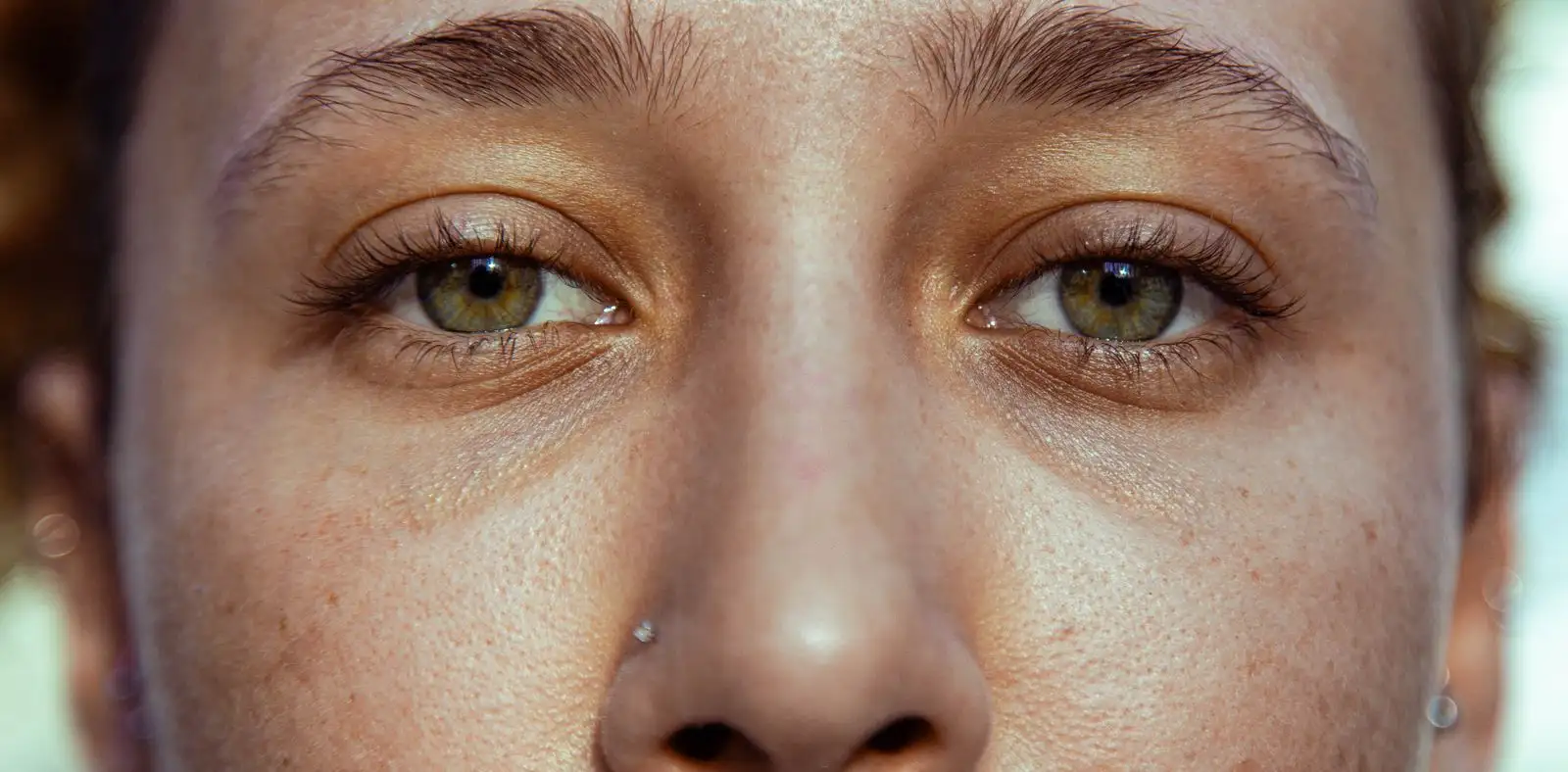
Why Your Foundation Turns Orange in Pores by Midday
The orange that shows up in your pores by midday is not your foundation wearing off. It is a color shift happening inside the pore openings, where sebum pools over the film, breaks it down, and leaves the iron oxide pigments sitting in oil, darker and more saturated than they were when you applied them. That is also why the pores themselves seem to deepen at the same time: darkened pigment sitting in each opening reads as shadow. There are two levers here, and neither of them is a new bottle. Slow the breakdown of the film in the oily zones, and choose prep or a shade direction that sends the shift toward your undertone instead of away from it.
I caught mine in the visor mirror of a parked car, engine off, sun coming in flat from the side. The bridge of my nose had become a grid of small dark dots. Not the whole face, just the nose and a strip across my forehead where I shine first. Each dot sat half a shade darker and noticeably more orange than the foundation around it. I pressed one with a fingertip and it did not move.
That last part mattered more than I expected it to.
The tell is where the color changes, not how much is left
Fading and shifting look similar in a photo and nothing alike on a face. Fading means the film thins out and your own skin starts showing through. Coverage drops, color drifts toward bare skin. Shifting means the coverage is all still there, opaque, doing its job, and the color has moved somewhere you did not pick. The pigment is still on your face. It is just not the color you applied.
Here is the test I use now. Where things look wrong, press a clean tissue against the skin and hold it a second. If the tissue comes away tinted and the patch underneath is lighter but still orange, that is not transfer and it is not fading. That is pigment that changed color on your face. Fading would have taken the color toward your own skin. This took it in a different direction entirely.
Why the film breaks over a pore first
Foundation does not sit on skin as a solid sheet. It sits as a thin film with pigment suspended in it, and a pore is a well. Over a well, the film stretches thinner and dips down into the opening. Two things happen at once: there is less binder shielding the pigment, and that is exactly where the oil arrives first.
Sebum is produced inside the pore and moves up through it, so the highest concentration of oil reaches the thinnest, most exposed part of the film, and it gets there early. Once oil works into that spot, the binder stops holding the pigments evenly apart. Pigment that was dispersed becomes pigment that is clumped, and clumped pigment scatters less light and shows more of its own color. Darker and more saturated is what you see. The air matters too, but the oil gets there first and opens the door.
None of this is about how much coverage you used. A sheer formula does it and a full-coverage one does it. What varies is how oil-resistant the formula's film is, which is why one foundation goes orange on you by noon and another one on the same face holds all day. Some of this is your skin. Some of it is the bottle, and it is worth knowing which one you are blaming before you throw anything out.
Nose and forehead go first
Not because they are hotter or more textured. Because that is where sebum output is highest and where the pores are largest, which means the most oil reaching the thinnest film. My forehead strip and the sides of my nose light up first every time, and my cheeks stay clean until evening. Once I started thinking of it as an oil delivery problem instead of a texture problem, the fix stopped being about covering pores and started being about where the oil goes.
On deeper skin, the same shift reads gray
This is the part that made me stop trusting the way oxidation gets described. On deep skin, the same breakdown over a pigmented pore often does not go orange at all. It goes dull and ashy. The warmth drops out of the foundation right at the pore while the skin around it stays warm, and you end up with gray dots on brown skin.
Same mechanism, different read, because the pore opening itself holds melanin, and a broken film over it lets you see the darker content instead of a clean, warm film. If your foundation is turning gray on you and everything you have read is about orange, you are not doing anything wrong. You are on the other side of the same problem.
Oxidation does not create pores, it shadows them
Nothing about a pore opening changed between morning and afternoon. What changed is contrast.
A foundation that matches your skin blends into the surrounding tone and the pore effectively disappears, because there is no edge for your eye to catch. The moment the pigment inside that opening darkens, every pore becomes a tiny dark dot against lighter surroundings, with a soft shadow under it because it is sitting in a well. Your eye reads the contrast, not the diameter, and contrast is what makes texture look deep. So the same pores look deeper at three in the afternoon than they did at eight in the morning without a single one of them having moved.
This is also why mattifying powder can backfire when you overdo it. Pack the pore with powder and the powder takes on oil and darkens, and now you have the same dark dot with a chalkier texture around it; pressing powder into the pore rim can outline it in lighter powder. More coverage over a shifted base does not fix texture. It just gives the contrast a cleaner edge to sit against.
Prep that gives the shift less to work with
I treat my T-zone and my cheeks as two different faces now, because they behave like two different faces. Cleanse, then go light on moisturizer through the nose and forehead. A heavy cream sits in the pores and gives the foundation something to float on, and trapped moisture under the film makes that film break earlier than it would on drier skin. If your cheeks need the cream, give the cheeks the cream. Gel or a thin lotion only in the middle. Then wait. Not five seconds. A minute or so. Going straight from moisturizer to foundation traps water under the base, and that water wants out.
If you use a blurring primer, keep it to the oily zones, keep it thin, and tap it into the depressions instead of sweeping it across them. Those primers fill the well so the film does not dip into it, which is exactly what you want across the nose. Two things to watch. They can pill under a water-based foundation, and they can flatten the finish enough that your skin stops reading as skin where you used them. T-zone only, pressed in, no more than that.
Press powder, do not sweep it
A fine loose powder pressed into the T-zone with a puff absorbs some of the surface oil before it can work into the film. Pressed, not swept. Sweeping moves the foundation around and leaves powder sitting on top of the pores instead of settled against them. Then a light pass over the rest of the face. A thin layer buys you time. A thick layer becomes its own problem by mid-afternoon, because powder loaded with oil darkens too, and now it is darkening in the same wells you were trying to protect.
Blotting papers midday reset the oil without disturbing the pigment. That beats re-powdering twice, which stacks layers into the pores and makes the texture read worse than it did before lunch.
Steering the color with a corrector or a shade direction
There are two things you can do to the color itself, and which one you reach for depends on the direction your shift is going.
If your foundation is going gray or ashy, the deep-skin version, a color-correcting primer with peach or orange tones underneath gives the base something warm to fall back on. When the film breaks down at the pores, it dulls toward your actual undertone instead of away from it. On deep skin, where the shift often arrives gray first and orange later, that warmth underneath is what keeps the middle of the day from going ashy on the way there. Keep it thin and keep it where you actually go gray. If you lay peach under the whole face on a skin tone that is already warm, you are just relocating the problem.
If your shift runs orange and you are neutral or cool, a peach corrector will make that worse, so do not reach for one. The move there is shade direction. Pick a foundation a touch less warm than your exact match, a half step and not a full one. You are choosing the shade that will be right at two in the afternoon rather than the one that was right at eight in the morning. There is a real cost to that. For the first hour or two the base may read slightly cool on you. If that bothers you more than the afternoon does, do not do it. I would rather be right for the six hours people actually see me than for the twenty minutes I spend getting ready.
What prep can and cannot buy you
Prep can slow the shift by hours. It cannot make an oil-sensitive formula oil-proof. If a foundation goes hard on you by lunchtime, the honest answer is that you can stretch it into the late afternoon and steer the color, but primer and powder are not going to defeat it. Wear that one when you need four hours, not when you need twelve. And if you want to know before you commit, the back of your hand and your jawline will not tell you anything, because pore-level oxidation happens where the oil is. Put a stripe on your nose and your forehead, wear it through a full day, and look at it in daylight. Not in a store, not under your bathroom bulb. Daylight on a face with real oil in it is the only honest test, and it takes a full day, not a swatch.
One more thing, because it gets confused with this constantly. If your face goes pale and ghostly in photos but looks fine in the mirror, that is flashback, not oxidation. That is light-reflecting particles bouncing a flash straight back at the camera. Different problem, different fix, and no amount of powder is going to solve it.

About the author
The Undertone
The Undertone is a byline for people who learned foundation on brown skin by swatching, mixing, and checking color in real light. They share a practical focus: if the depth and undertone are right, the formula will follow.
More about usRelated posts