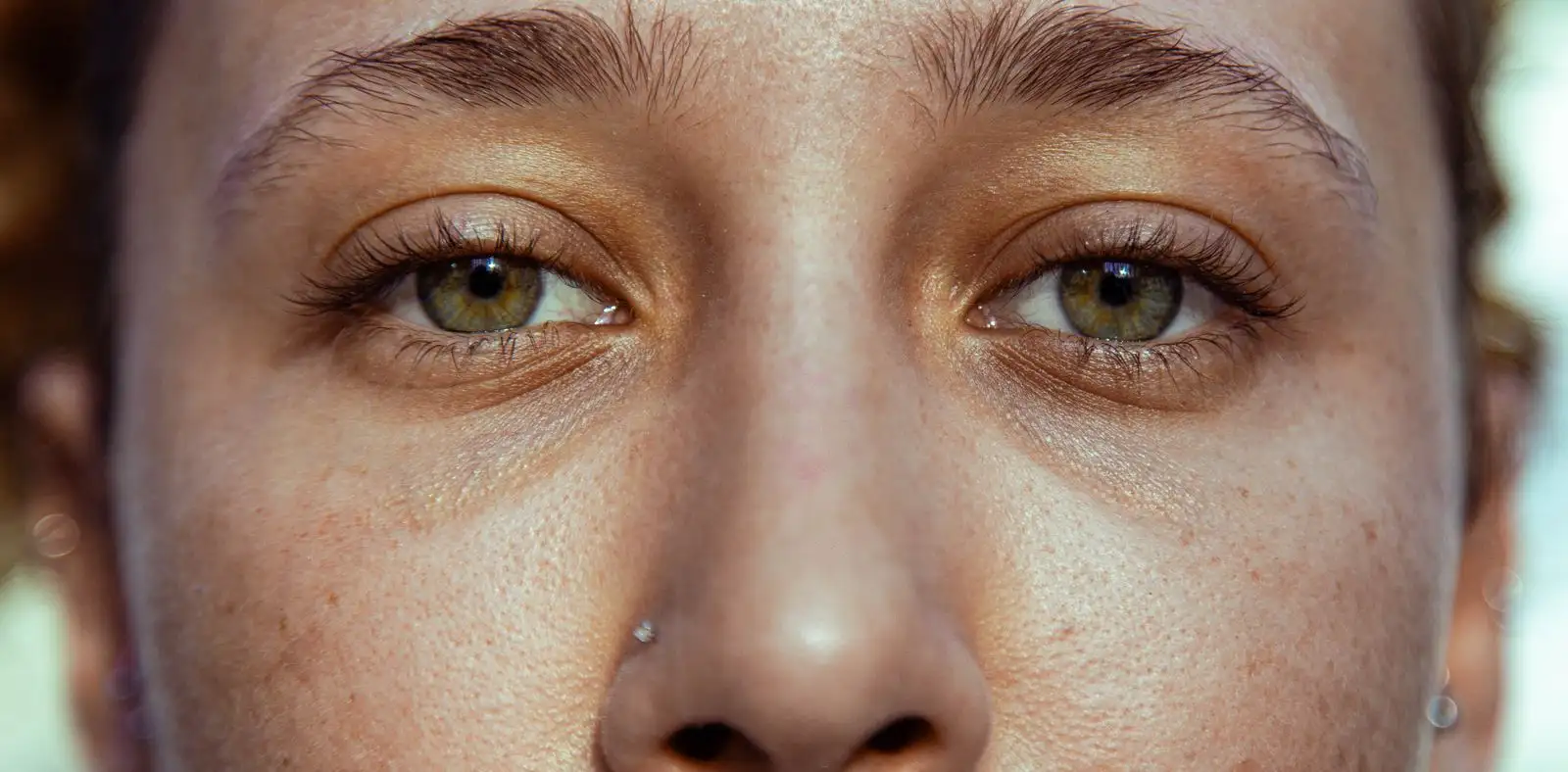
Prep Skin Right and Foundation Won't Settle in Pores
The fix for foundation settling into pores is a short prep sequence whose last layer matches the first: cleanse with something gentle enough that your skin does not feel tight when it dries, let moisturizer absorb until your face feels dry to a light touch, then press a pore-filling primer into the depressions instead of rubbing it across them. Match the primer's base to your foundation's base — silicone with silicone, water or glycerin with water — or the two will separate and the foundation will find every pore. On deep skin, tap a thin layer of peach or orange color-correcting primer only where settled foundation turns gray, because that ashiness reads as texture even when the pore is small.
I keep a small mirror on the windowsill, not the bathroom bulb. At 7:40 on a workday the light through that window is flat and white, and it shows me what the overhead light hides: the two pores beside my nose that look like pinpricks of gray, the dry patch at the corner of my mouth, the shine on my forehead that is actually moisturizer I did not wait long enough to absorb. You can see the same thing if you stand at your own window with your face turned toward it. That is where I start, before any product.
The cleanse I trust is the boring one
The first thing I do is wash my hands, then wash my face with lukewarm water and a cleanser that does not foam into a stiff pile. I used to think squeaky was clean. Squeaky is stripped. When my skin dries tight, primer does not glide over it; it catches on the dry edges around my nose, and foundation piles there by lunch. So I rinse longer than feels necessary, pat with a towel instead of dragging, and leave my skin slightly damp. Not wet. Damp.
A cleanser that leaves a film is just as bad. If my face feels slippery after I rinse, I rinse again. A gentle one keeps the surface barrier calm enough that primer sits evenly instead of catching on dry patches. Primer needs a clean surface to grip, but it also needs a surface that is not angry. That balance is the whole point of the first step.
Moisturizer has to disappear before primer goes on
While the skin is still damp, I press in a thin layer of moisturizer — thinner than I want to — and then I leave it alone. This is the part I used to rush. Primer over tacky moisturizer is how you get those little rolled-up pills along the jaw, and pills mean the primer is no longer sitting in the pore; it is sitting on top of lotion, and foundation will slide off it in patches.
I brush my teeth, fill my water bottle, do something else for five minutes. Then I touch my cheek. If my finger comes away shiny, I wait. If it drags, I wait. When my skin feels like skin and not like a product, I move on. The back of my hand is not the test. My cheek is.
Primer goes into the pore, not across it
Pore-filling primer is not a lotion. It is a surface filler. I ignore the word "minimizing" on the label. A primer cannot shrink a pore. It can fill the dip so light crosses it evenly, and that is enough.
I put a pea-sized amount on the back of my hand, then tap it into the areas where I actually see depressions — the inner cheeks, the sides of the nose, the chin — with the pad of my ring finger. Tap, lift, tap, lift. I do not sweep it sideways. Sweeping pushes the product across the surface, and it balls up at the edges of the pore instead of filling the middle. You can feel the difference: under a tapping finger the primer sinks in and the surface goes from slippery to slightly grippy. Under a rubbing finger it skates and leaves ridges. I let it set for about a minute before foundation. If I am in a hurry, I fan my hand over my face, but I do not blow on it.
The base has to match the base
This is the part that took me longest to learn because the labels do not say it plainly. A silicone-based primer under a water-based foundation is a fight. The primer is hydrophobic; the foundation is mostly water and glycerin; they do not blend, they separate. On my face that looks like foundation breaking up over my nose by 10 a.m. and collecting in the pores it was supposed to cover. Reverse it — water-based primer under silicone foundation — and the foundation can grab and patch.
So I read the first five ingredients. If the primer lists dimethicone, cyclopentasiloxane, or another silicone near the top, I use it with a silicone foundation. If the foundation's first ingredient is water and there is no silicone high in the list, I use a water-based or glycerin-rich primer. I test them together on the back of my hand first: a small dot of each, rubbed together. If they turn into little rubbery bits or a watery ring, they will do that on my face. If they blend into an even film, they are compatible.
The gray in the pore is not always texture
On deep skin, a settled foundation can turn gray rather than dark, because the same breakdown that reads orange on lighter skin can read ashy here. The pore is not bigger than it was; the contrast is wrong. The foundation sits in the depression, the light hits it differently, and the ashiness in the product or in the skin around it makes a small pore look like a shadow. I have spent money on texture products for a problem that was actually a color problem.
Now I keep a peach or orange color-correcting primer for the spots where I see that gray — usually the inner cheeks and the sides of my nose. I tap the tiniest amount into the pore, not across the whole face, and let it set before foundation. Too much orange turns the area muddy and shifts my foundation shade. A thin tap neutralizes the gray so the pore reads the same depth as the skin around it. That is the difference between "my foundation is settling" and "my foundation is settling and the color is wrong." The gray cast exaggerates texture because the eye reads contrast as depth. Kill the contrast and the pore stops announcing itself.
Exfoliation is a short-term fix with a long tail
I exfoliate, but not the day I need a flawless base. A chemical exfoliant can smooth the surface for a day or two, and a physical scrub can do the same for an hour. The problem is overdoing it. When I exfoliate too often, my skin gets tight and flaky, and foundation clings to the flakes around my nose and mouth. That looks more textured than the pores did.
So I keep exfoliation to once or twice a week, and I skip it before an event. If my skin is already stinging or tight, I do not exfoliate at all. I moisturize and wait. Primer over flaky skin is not going to fill anything; it is going to sit on top of the flakes and make them more visible.
What I do when it still goes wrong
Some days it still goes wrong. If the foundation starts to separate, I do not add more primer. I blot, then press a tiny amount of foundation back in with a damp sponge, and set only the areas that move. If I see pilling, I remove it with a tissue and start that section over with less moisturizer. If the gray is still showing, I add another thin tap of corrector, not more foundation. More foundation in a pore makes the pore look deeper.
That is the counterintuitive part: the instinct is to cover, but covering adds contrast. The fix is almost always less product, pressed more precisely. The order I actually use is cleanse, pat, moisturize thin, wait five minutes, press primer into the pores, wait one minute, tap corrector only where the gray shows, then foundation. If I skip the waiting, I might as well skip the primer.

About the author
The Undertone
The Undertone is a byline for people who learned foundation on brown skin by swatching, mixing, and checking color in real light. They share a practical focus: if the depth and undertone are right, the formula will follow.
More about usRelated posts