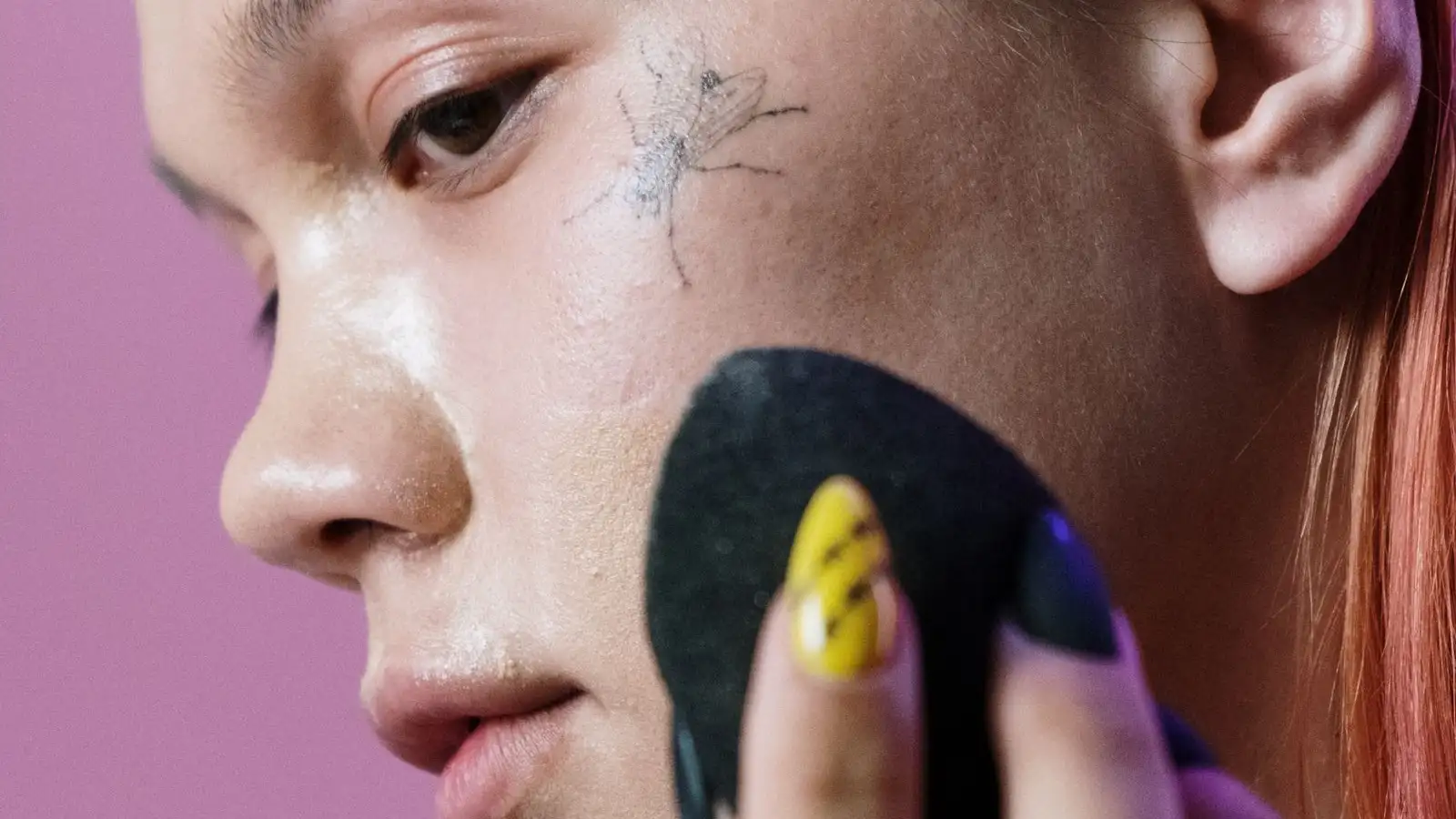
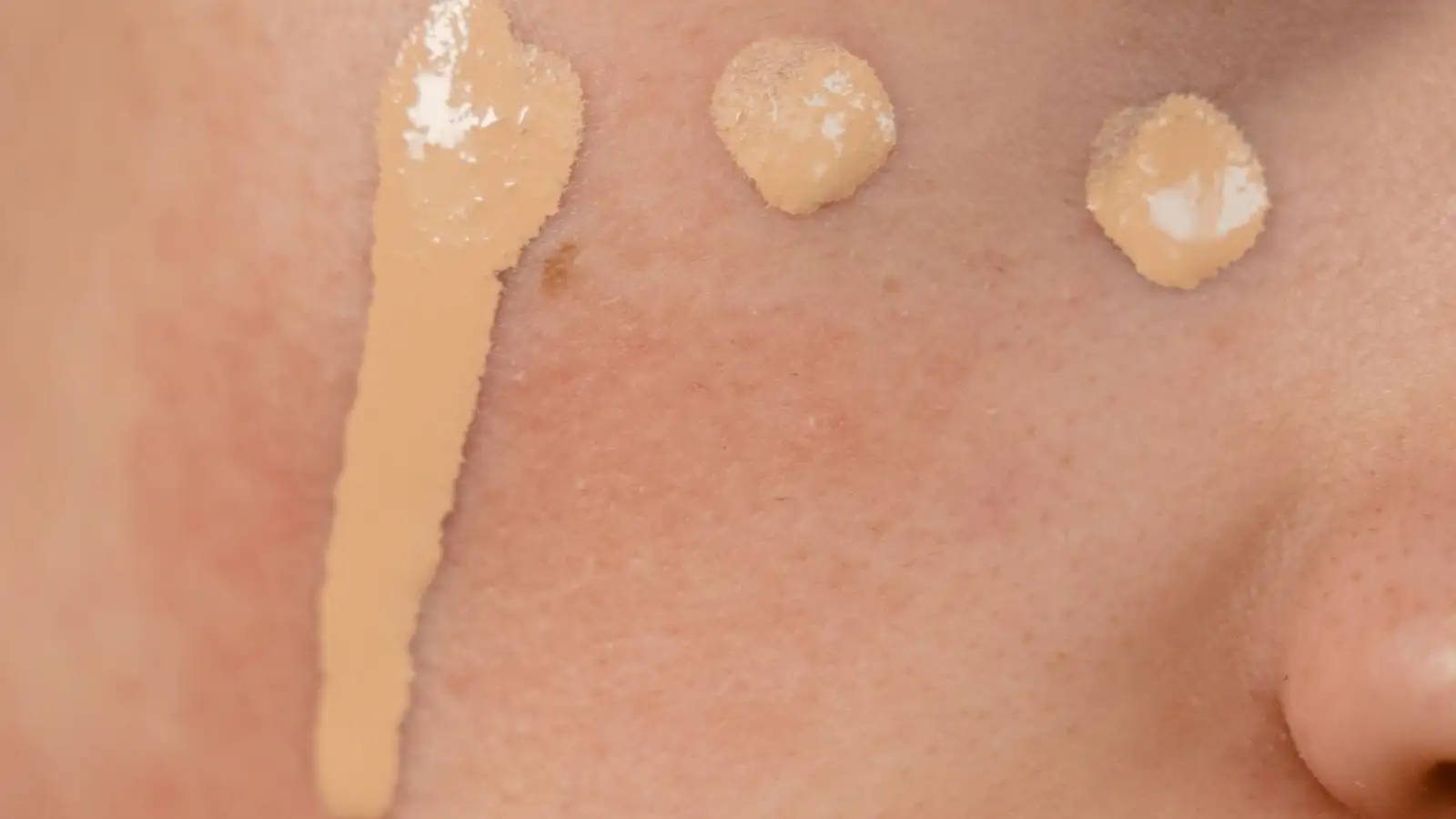
Matte or Dewy Finish on Textured Skin, and Why It Matters
Choose the finish by zone, not by trend. Satin across the cheek and jaw where texture sits on a curve, matte pressed only where shine actually breaks through, and any dew placed deliberately instead of sprayed over everything. On textured deeper skin, matte and dewy are not two moods — they are two directions of reflected light. A matte surface scatters light away and flattens whatever sits underneath it. A dewy surface sends light back at the eye and lifts every raised edge into a highlight. The same skin reads smooth in one and uneven in the other with nothing changed but the topcoat.
I learned that standing at my east window at 7:40 in the morning with a mug in one hand and a compact in the other, and I have not fully trusted a bathroom bulb since.
The bathroom in my apartment has one light, dead center in the ceiling, and everything under it looks like a finished photo. Smooth nose, even cheek, no story. Then I walk four steps into the living room, sit on the arm of the couch, and the sun comes in sideways at a low angle and rakes across my face. That is when the bump near my jawline shows up. Not because it appeared at 7:41. Because something finally caught its edge.
That is the whole topic, really. Texture is not the enemy. Uncontrolled light on texture is.
What each finish does to light
Matte absorbs and scatters. The pigment load is high, the shine is knocked down with silica, clay, talc, or a powder-finish polymer, and the surface stops sending much of anything back at you. That flattens pores and bumps and lines, which is why it photographs so clean. It also flattens the face itself. Melanin-rich skin has a natural depth gradient running across the cheek, a soft shift from the high point down into the hollow, and a full matte face kills it. In photos you get a smooth, correct, two-dimensional mask.
And in person, a matte finish on deeper skin without enough underneath it goes gray before it goes smooth. I mean the dry patch at the corner of my nose, the little crease beside the chin. Matte finds them and drains the color out of them. That ashy read is not a coverage problem. More foundation will not fix it; it will just make a bigger gray patch.
Dewy is the opposite error. It reflects, sometimes with emollients, sometimes with a film former, sometimes with pearl. On a high point like the top of a cheekbone, that reflection is exactly what you want. On a bump, it does something specific and unkind: the bump gains a bright ring at its top edge and a shadow underneath, so it reads rounder and more textured than it actually is. Under a strong dewy finish, my skin looks more textured than it does bare.
Pearl makes that worse. A pearl particle is a tiny mirror on a hard angle. It will catch the light dead on and hold it, and if it lands on a raised area, you have effectively put a small lamp on it.
Satin sits in the middle and does both jobs partly. Some diffuse scatter, some soft reflect. Not a compromise, a different tool. It is the finish I trust over texture because it never fully commits in either direction.
The zone map I actually use
Finish is a placement decision. I stopped treating my face as one surface years ago.
- Center forehead and the shine triangle between the brows: thin matte, pressed, not swept. This is where oil shows up first and where there is usually the least raised texture.
- Nose ridge: a whisper of matte. The sides of the nose, where pores and texture actually live, get satin or nothing. Powdering the sides is how people create the texture they are trying to hide.
- Under the eye and the upper cheek: satin, applied light. Never a heavy matte, which creases and dries, and never a high dewy, which pulls the eye straight to fine texture.
- Jaw and chin: satin, pressed in with a damp sponge rather than brushed on. This is my bump zone and the one place I test everything.
- Top of the cheekbone: dew is fine here, because that is a genuine high point where light is supposed to collect. It is the one place shine reads as shine and not as surface.
Same foundation, different placement, and it reads as two different products.
Finish is not coverage, and prep rewrites both
A sheer dewy foundation applied thin can look smoother than a full matte one, because thin product follows the surface instead of sitting on top of it. Coverage is pigment density. Finish is what the top layer does to light. People buy full matte hoping to hide texture and end up with a heavier, drier, flatter version of the same texture.
Prep and powder change the finish you paid for. A hydrating layer underneath pushes any foundation toward satin. A mattifying primer pulls it toward matte before you have set anything. A damp sponge presses product into the surface and leaves more of the original sheen; a buffing brush lifts it and leaves more of a velvet. And powder is the biggest lever of all. A silica powder pressed in with a puff will turn a satin foundation into flat matte in about four seconds, and it will do it hardest exactly where the texture is—the same powder can flash back ashy in photos.
That last part is the trade I make every morning. I want the shine knocked down in the center of my face and I want the surface left alone on my jaw. So I use a small brush and place powder only where I mean it, instead of dusting the whole face and wondering why the finish looks nothing like the bottle.
Test it in daylight, and test half a face
Bathroom light is overhead and fairly flat, and it lies to you. So does store lighting, which is engineered to sell. Take the mirror to a window and turn your head slowly, side to side, letting the light travel across the cheek at a low angle. That is the light you will be seen in at a lunch table, in a car, on a video call with a window behind you.
When I am deciding between two finishes, I do half a face. Matte on one side, satin or dewy on the other, no other change, and then I go live my morning near a window. By ten o'clock the answer is obvious and it is not the answer I expected about half the time.
The other test I use is my phone flashlight, held at arm's length and tilted slowly across my cheek at roughly forty-five degrees. It is harsh and slightly unfair, but it shows me exactly where light is landing. If the bumps light up like a topographical map, that finish is going to be a problem in any bright room.
Where this gets messy
Nothing stays where you put it. A matte T-zone at eight in the morning is a satin T-zone by one, because oil comes through and sits on top of the finish. That is not the product failing; that is the day happening. I blot and re-place rather than repowder the whole face, because a second full pass of powder on top of texture is worse than the shine was.
Humidity flips everything, and so does a long day under a mask. Some formulas separate over textured areas by afternoon, and the only fix is a thinner first layer, not a thicker second one.
And I will say plainly what a lot of finish advice skips: the finish on the label is a starting point, not a guarantee; the full routine from prep to powder is what actually changes the result. What you wear is the product plus your prep plus your powder plus the light in the room. I keep one satin base and one matte powder on the shelf and treat everything else as placement. That has done more for how my skin reads than any single bottle ever did.

About the author
The Undertone
The Undertone is a byline for people who learned foundation on brown skin by swatching, mixing, and checking color in real light. They share a practical focus: if the depth and undertone are right, the formula will follow.
More about us