Why the Same Powder Flashes White on Deep Skin Only
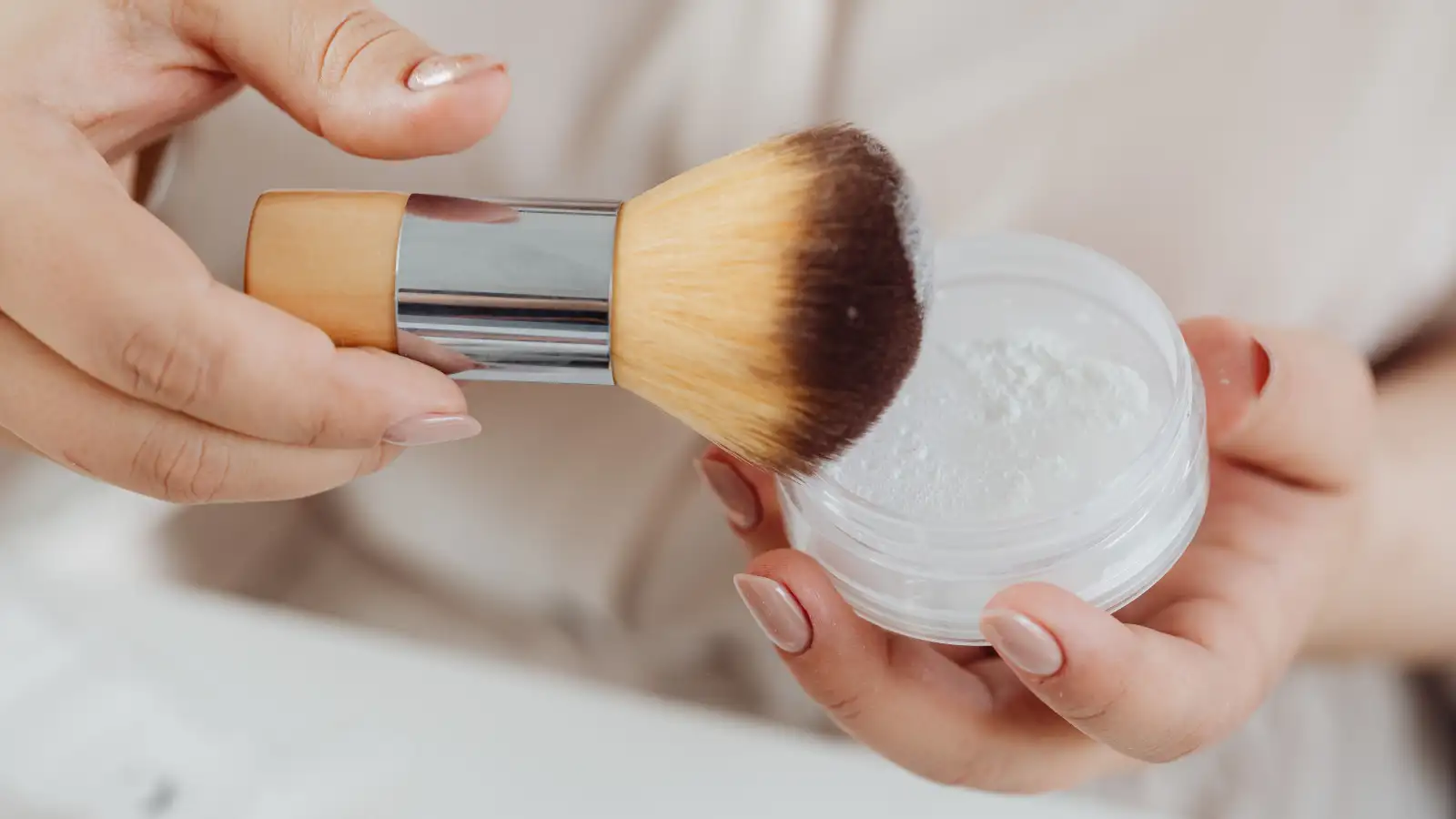
The powder isn't defective and the label isn't lying. What changed is the skin underneath the film, and that changes everything. A setting powder leaves a thin scrim of particles that scatter light back toward whatever is looking at it, and the brightness of that returning light is roughly the same whether the face is deep brown or fair. Against deep, melanin-rich skin it reads as a pale halo sitting on the surface. Against lighter skin it lands close enough to the skin's own brightness that the eye files it away as nothing at all. Put a direct flash on that difference and it stops being subtle. This is a contrast problem long before it is an ingredient problem, and diagnosing it as the wrong powder sends people out to buy replacements that flash exactly the same way.
Let me put you in the room where I finally understood it.
It's my desk, late, and the overhead light is off. I've got a dark brown leather notebook cover on the left and a cream index card on the right, and I've swiped the same translucent powder across both with the same finger, same pressure. My phone is propped against a mug about two feet away, flashlight on, rear camera pointed at the desk. When I look down with my eyes, both swipes are basically invisible. When I look at the photo, the swipe on the leather is a glowing white streak, and the one on the card has disappeared into the paper.
Same powder. Same swipe. Different thing underneath.
Then I do it on my jaw, because a notebook isn't a face and I don't trust a proxy until it matches the real thing. The powder goes on the way I'd actually wear it, pressed in with a damp sponge and then buffed back down. First shot, no flash: my skin looks like my skin. Second shot, flash from arm's length in that dim room: there's a soft pale veil across my jaw and down the center of my forehead, faint but unmistakable, like someone had dusted me with chalk. Nobody in a normally lit room would have seen it. The camera saw nothing else.
What the flash is actually doing to a thin film
Flash is a small, close, hard source. It fires for a fraction of a second and it fires straight at you, and the light that hits those powder particles comes back into the lens instead of scattering off into the room. Your camera doesn't know that the brightest thing in the frame is a cosmetic film; it just exposes for the face, and whatever returns the most light becomes the highlight.
Melanin absorbs across a broad stretch of visible wavelengths, so deep skin doesn't hand much light back. The powder's scattered light then has nothing to blend into. It sits on top, separate, brighter than everything around it. On lighter skin the same scrim is competing with a surface that already returns a lot of light, so it merges. That's the whole mechanism. It's why a fair-skinned person can also get a visible white cast from a heavy powder and why they usually have to be photographed in worse conditions to notice it. Same physics, less contrast.
I want to be careful here, because the ingredient conversation is where people get stuck. Yes, the powders that blur hardest tend to be built from particles that scatter well. But the ingredient list doesn't decide whether you see the veil. The skin under it does, and the amount on top of it does. A blurring powder pressed thin is a different photograph than the same powder caked on.
Why the mirror at home keeps telling you it's fine
Stand in your bathroom and look at your jaw. The light is coming from a big soft ceiling fixture and maybe a vanity bulb off to the side, spreading across your whole face at once. Your eye adapts to all of it. The veil is diluted across a wide field of light and it stops registering.
A flash is not that. It's a pinpoint two feet from your face doing all the work in the frame, and the camera has no adaptation at all. This is the part I had to physically see before I believed it: a mirror in a normally lit room cannot reproduce a close direct source. You can check your makeup in that mirror forty times and still be surprised by a phone photo at a party. The mirror was never testing the thing you were worried about.
Flashback is not ashiness, and mixing them up costs you money
This is the confusion I see most, and I carried it around for years.
Ashiness is a tone mismatch. The powder is the wrong color for your undertone, usually too cool, too pink, or too pale in a way that leaves a gray film on the skin. It shows up in daylight. It shows up in the mirror. It shows up in a window with no camera anywhere near it. You can see it walking past a shop window.
Flashback only exists when a direct flash fires. With no flash, the face looks right. The powder's color may be perfectly matched. What you're seeing is reflected light, not pigment sitting wrong.
The practical consequence is that the fixes don't swap. Buying a warmer powder to solve ashiness won't touch flashback. Cutting your powder down to nothing to solve flashback won't touch ashiness. And the tests are different too: ashiness gets tested in window light with your own eyes, flashback gets tested in a dim room with the flash on and a photo you actually look at.
The lever you really control is how much is on the skin
The shade name is almost a distraction next to film thickness. A thin film scatters less light, full stop. I press powder in with a damp sponge and then take most of it back off with a clean puff, and that single change did more for my photographs than any powder swap ever did.
A few things that hold up in practice:
- Blot first. Powder binds to oil, and oil plus powder builds a thicker film than you intended.
- Powder the zones that will catch the flash, mainly the center of the forehead, the nose, and the chin, rather than the whole face out of habit.
- Press and roll, don't sweep. Dusting kicks up a cloud that settles unevenly.
- Take one shot mid-routine. It's cheaper than finding out at the event.
There's a tradeoff and I won't pretend there isn't. Less powder means more shine. Shine and flashback aren't the same thing, one is specular and one is diffuse scatter, but in a photograph both can read as brightness, so the goal isn't zero powder. The goal is the thinnest film that still keeps the shine down.
Where undertone helps, and where it stops
A warmer or redder powder within the correct depth softens the visible cast. The returning light carries a warmer tint and stops reading as a white patch. It's a real improvement and I use it.
But it doesn't change how much light gets scattered. You're tinting the reflection, not reducing it. On very deep skin, push the warmth too far and the veil starts reading orange under flash, which is its own kind of wrong. Warmer is a second-order fix. Thinner is the first-order one.
What I still can't control
Some formulas are engineered to scatter light, and if you want that blur, you're accepting some flash risk. That's a choice, not a mistake.
And a lot of flashback lives outside your hands. The distance of the flash, its power, whether it's diffused or bounced, and how the camera processes the file all move the result. If the photographer is bouncing light off a ceiling, the whole problem may never appear. So before you rebuild your routine around one bad picture, look at how that picture was lit. One harsh direct flash on a dark room is the worst case, not the normal case, and it isn't worth giving up a finish you like for a situation that happens twice a year.

About the author
The Undertone
The Undertone is a byline for people who learned foundation on brown skin by swatching, mixing, and checking color in real light. They share a practical focus: if the depth and undertone are right, the formula will follow.
More about usRelated posts