Full Coverage Labels Don't Guarantee Coverage on Deep Skin
A full coverage label describes a marketing tier, not a measurement. What actually determines whether a foundation covers deep skin is the ratio of colored pigment to filler, how much white opacifying pigment is carrying the opacity, and how thick a film you lay down. Two bottles with the same word on the carton can behave like two entirely different products on the same face.
Come stand at the window with me. Mid-morning, curtains all the way open, no bathroom bulb overhead. I have two foundations on the back of my hand, both labeled full coverage, and one has already sunk into a gray haze while the other is still sitting there opaque and faintly tacky. Same hand. Same light. Same ten minutes.
The difference is not the shade name and it is not the price. It is what is in the bottle doing the work.
Filler is the part that isn't color
Pick up a bottle and turn it around. Most of what is listed is not pigment. Talc, mica, silica, boron nitride, nylon-12, starches, silicone powders — those are the body of the formula. They give it slip, they blur the edge of the film, they keep it from feeling wet. They are also, functionally, transparent. Fillers change texture and wear time. They do not cover anything.
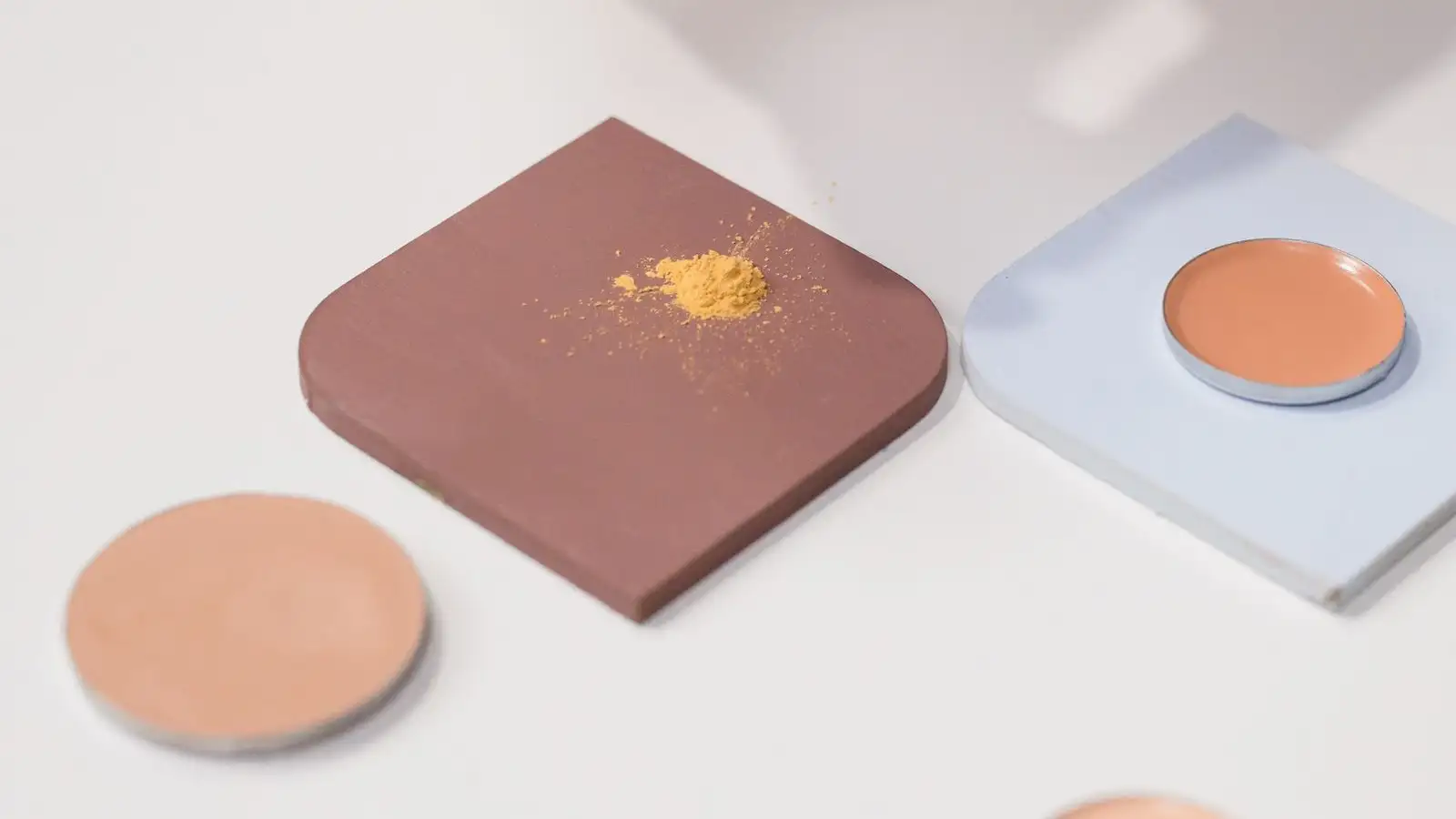
The color comes from a much smaller group: iron oxides, mostly. Red, yellow, black. Occasionally an ultramarine or a chromium oxide green for a specific cast. The opacity comes from a third group, and this is the one that matters most on deep skin — the white opacifiers, titanium dioxide and zinc oxide. They do not simply sit there opaque. They scatter light across the entire visible range, which is exactly what makes them read white.
On a light-medium shade, that white scatter is invisible or even useful. On a deep shade, it is the thing that drags a warm brown toward gray, or turns a rich espresso into something dusty and mauve. The formula is not defective. It is built so that its strongest covering agent is a white one.
That is the first place the marketing word falls apart. Full coverage tells you the film is opaque. It says nothing about whether that opacity came from colorant, which deepens the shade, or from opacifier, which lightens and desaturates it. Same claim on the label. Opposite behavior on the skin.
Two thin layers beat one heavy one, if the film former lets them bond
The first time someone told me to build coverage in layers, I assumed it was a way to make a bottle last longer. It is mechanical, not thrifty.
One heavy layer gets pushed around. You drag it with the brush or the sponge, it pools at the edge of your jaw, it sets unevenly because the top of the film dries before the bottom of it does. Two thin layers have less to push. The first one sets flat and thin, and the second goes down over a surface that is no longer moving.
Whether it actually builds depends on the film former. Silicone resins and some acrylates stay slightly open and grabby for a while, which lets the second layer fuse into the first. Formulas built to set hard and powdery do not do that. The second layer sits on top like dust on a shelf and lifts off the moment you touch your nose.
I test for it with a finger. Press, do not swipe. If the product transfers clean onto the fingertip, the film is still open and a second layer will bond. If it comes away in a powdery flake, stop. Adding more just gives you a thicker version of the same problem.
The gray is not a shade mismatch
Iron oxide black absorbs broadly across the spectrum. That is what makes it useful for deepening a shade. It is also what flattens the way light comes back off the skin. Pile in more colorant to reach the depth and you kill the reflectance along with it — the small variations between the high points and low points of a face that make skin read as skin. Coverage climbs. The face goes matte in the worst sense. Fully covered, no life.
This is the trap hidden inside "just go one shade darker." A deeper shade with the same colorant load is not richer, it is just darker and equally flat. What you want at full opacity is a formula that carries the undertone at that depth, which means colorant load has to scale with depth. That is expensive to formulate, and it is why the deepest end of a range so often has fewer real options than the middle.
Two tests I run before I trust a bottle
Do the dark-surface test. A black ceramic saucer, a piece of dark gray cardstock, anything that is not your skin and not a white countertop. Squeeze a dot and pull it into a thin smear. If it goes chalky and pale gray at the thin edge, the opacifier load is high, and at full coverage it will likely gray you out. If it holds close to its bottle color when thinned, the colorant is doing the work and the formula will probably build without going ashy.
Do the sheer-out test. One drop of foundation, one drop of plain moisturizer, mixed on the back of your hand. Thinning a formula exposes whatever cast is hiding under the depth. Opacifier-heavy products go pale and faintly blue-gray. Colorant-forward ones simply get lighter and keep their hue.
And do not over-read the ingredient list. In the US, color additives may be listed in any order, so the position of the iron oxides relative to the titanium dioxide is a hint at best, not a ratio. The swatch on your hand is the only read you get that reflects the actual proportions.
Where coverage and color pull against each other
Here is the honest tradeoff. On deep skin, covering power and saturation are separate goals, and some formulas can only deliver one. A product can be fully opaque and still look flat because it does not carry enough colorant to hold your undertone at that level of opacity. When you find one that does both, it is usually because the colorant load is genuinely high and the opacifier is doing a smaller share of the work.
The other direction exists too. There are times when you want the white scatter — when the priority is the most uniform film you can get, and you are willing to correct the cast afterward with a drop of a deeper or warmer mixer, or a thin veil of a warm-toned powder over the top. That is a legitimate trade. It should just be a decision you make on purpose, in daylight, rather than one a word on a carton makes for you.
None of this is fixed, either. Humidity, primer, how oily your T-zone runs, how much you have buffed — all of it changes film thickness, and film thickness is half the equation. The formula that builds beautifully in a dry January can slide around in August. The bottle did not change. The film did.
Turn your hand over in that window light and look at both swatches again. The one still holding its color is the one that was built to cover with pigment instead of with white.

About the author
The Undertone
The Undertone is a byline for people who learned foundation on brown skin by swatching, mixing, and checking color in real light. They share a practical focus: if the depth and undertone are right, the formula will follow.
More about usRelated posts