Is It the Pigment or the Oil That Turns You Orange?
The orange isn't the colorant changing. Iron oxides go into the bottle already fully oxidized, which is the reason they work as pigments in the first place; there is no rusting left for them to do on your face. What changes is the film. Your own sebum and the oils already sitting in the base migrate into the pigment layer, the particles get wetted by oil instead of sitting in a drier binder, the film scatters less light, and the shade reads darker, warmer, and more orange. Nearly everything people call foundation oxidation is that one mechanism, which means the useful thing to read is not the colorant but the base system and the film it builds on your skin.
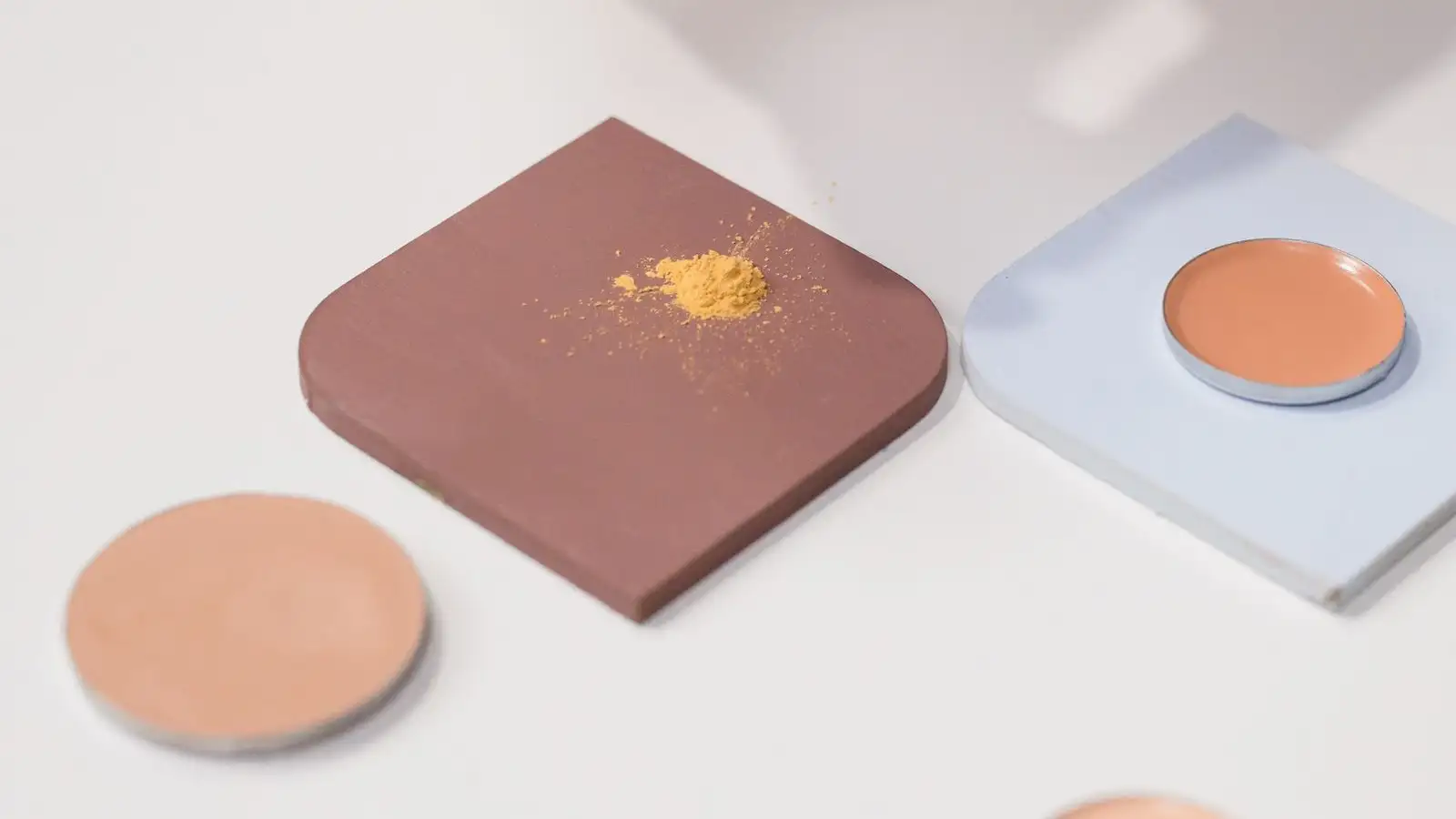
I worked this out on a glass tile before I ever trusted it on my face. Two dots of the same foundation, side by side. Into one of them I worked a single drop of plain oil with a small spatula, the way you'd fold something into paint. Thirty seconds in, the oiled dot is already half a step deeper and noticeably warmer, and it does not come back. Nothing in that dot changed chemically. The medium around the pigment changed, and the pigment is only ever visible through its medium.
So when a foundation goes orange on me, I stop asking what the pigment is doing and start asking what is surrounding it.
The wet-film problem painters already know
A pigment's opacity comes from the difference in refractive index between the particle and whatever is around it. Air sits around 1.0. Water is 1.33. Oil is up near 1.47, which is much closer to the pigment's own index. When oil moves into the pores of a dried-down film and replaces air, the light stops bouncing back off the surface and instead travels through. That is the whole reason a wet film looks deeper and more saturated than the same film once it dries, and every painter learns it the hard way when a color dries lighter than the swatch.
Your skin does the reverse of that. The film lands, the water or the volatile silicone flashes off, and you're left with a porous layer with air in it. Then sebum arrives. It wicks into the film, wets the particles, and the scattering drops.
What drops first is the white. Titanium dioxide and the other high-scattering whites do most of the light-bouncing in a base, so when scattering collapses, the neutral white light leaving the film collapses with it, and what's left is the warm absorbing tone of the iron oxide blend. That is why the change reads orange rather than gray, muddy, or simply faded. Less white in the mix means more visible hue, and the hue underneath is red-brown.
Two bottles, same face, different amounts of drift
The base system is the variable you already own, and it decides how fast your oil gets in.
A water-first formula leaves a more open film once the water is gone. Sebum moves into it quickly and unevenly, which is why this kind shows up as blotchy deepening in the T-zone before it shows up as an overall color change. A silicone-first formula leaves a film that is oil-compatible from the start, and the volatile silicones leave behind a resinous, hydrophobic layer. Your oil doesn't have to fight its way in, it merges, so the drift is slower and more even. But if that same formula carries a heavy load of non-volatile emollients, the film starts out plasticized and stays wet-feeling, and that version can look fine for hours and then move all at once.
Read the first five ingredients. Aqua or water in the top slot tells you one thing. Cyclopentasiloxane, dimethicone, trimethylsiloxysilicate near the top tells you another. That list predicts drift better than anything printed on the front of the bottle.
The pale ones have further to fall
Any shade whose depth is being held up by a lot of white opacifier has more to lose. That includes fair shades, obviously, but it also includes deeper shades that were built by taking a white base and adding brown and black pigment to it. The white is what's holding the depth without warmth. When oil wets the film, the white's scattering is the first thing to go, and the warm iron oxide sitting underneath gets exposed.
This is the ashy-at-first, orange-by-afternoon pattern so many of us know on deeper skin. It isn't your undertone betraying you. It's the architecture of the shade. A shade built around a red-brown iron oxide blend with less white in the mix has less to fall through, which is worth knowing when you're comparing two bottles that look identical in the store.
The first ten minutes are a lie, and the back of your hand is a bigger one
At ten minutes the volatile carriers are often still leaving. The optics are still dominated by a solvent with a low refractive index, which scatters light back and reads lighter and cooler than the film will end up. Then the carrier leaves, the oil arrives, and the color settles somewhere else.
The back of your hand is worse. It has very few sebaceous glands compared to your T-zone, so it under-reports drift badly. A hand swatch will happily tell you a foundation is perfect right up until your forehead disagrees.
What I do instead: put a stripe at the jaw edge and a second one on the forehead, and look at them in daylight by a window at around forty-five minutes and again later in the day. Compare each stripe to bare skin next to it, not to the rest of your face. And do not judge it under a warm bulb or a ring light, because both will hide a warming shift until you're outdoors.
What actually slows it down
Powder, pressed on lightly and early, before oil has reached the surface. Powder at the surface takes up oil at the interface, so sebum has to get through it before it can wet the base film. The timing matters: press it on after the base has set. Powder too soon, while the carrier is still flashing off, and the powder sinks into the film and muddies it.
There's a tradeoff here worth saying out loud. The high-scattering particles you're using to slow the shift are the same kind of particles that flash back in photos. Silica, mica, and mineral filters bounce light straight back at a flash by the same mirror geometry that produces flashback in photos. You can absolutely buy a slower shift and pay for it in flashback, so pick which problem you'd rather have that day.
Blot by pressing, never wiping. Wiping moves pigment around and thins the film, and a thinned film doesn't shift less, it shifts patchy. On layering: a thin film has less white to dilute, so it moves proportionally faster, while a heavy film holds a bigger reservoir of white and has further to fall. Neither is a fix. It's a calibration.
And the honest limitation: a primer with a dry, grippy finish can slow oil coming up from below the film, but oil arriving at the surface has a different path in and primers don't stop that. On a very emollient base, no amount of powder changes the destination, only the speed.
When it really is the colorant
Not never. Some organic colorants, particularly the red lakes used for bright pinks, corals, and certain berry tones, are sensitive to pH and to light, and iron oxides are not the only pigments in cosmetics. Formula oils can also oxidize over a long shelf life, which is a real chemical change, and it can yellow a product that's been open for years.
So here's the fork. If the change is a hue change, a pink going off toward something else, that points at the colorant. If the change is depth and warmth, and it tracks where you're oily and how long you've been wearing it, that's the film. Those are different problems and they don't have the same answer.
What you're actually calibrating
A film of pigment is not a fixed color. It's a system whose color depends on what surrounds the particles, and what surrounds them changes over the course of a day as your own oil arrives. So "does this foundation oxidize" is the wrong question to bring into a store. The questions that pay off are: how much white is holding up this shade, what's the base made of, how fast does my oil reach this film, and what am I doing in the first hour.
And the part that took me longest to accept: if a base reliably warms and deepens on me by about half a step, I should stop buying the shade that matches at minute five. I should buy the one that is half a step too light and slightly too cool when I first put it on, because that is not the shade I'll be wearing at hour three. It's also not a fixed rule. Heat, humidity, and how much I'm moving around all change the rate, which is why the same bottle can behave differently in July than in January. That's not a bad batch. That's a film reacting to its environment, and once you can see it that way you stop hunting for a colorant that won't betray you and start reading the system you're building.

About the author
The Undertone
The Undertone is a byline for people who learned foundation on brown skin by swatching, mixing, and checking color in real light. They share a practical focus: if the depth and undertone are right, the formula will follow.
More about usRelated posts