The Mica in Your Powder Shows Up in Every Flash Photo
Flashback is a light-physics problem, not a shade problem. The pale veil that appears across a face in a flash photo is the camera's own flash bouncing off light-reflecting particles — bismuth oxychloride, mica, silica, titanium dioxide — and traveling straight back into the lens. Because the effect depends on the light source and the shape of those particles rather than on color, a foundation that matches your skin perfectly can flash back exactly as hard as one that's two shades off.
The photo that taught me this is still in my camera roll. Low ceiling, dim room, someone's phone held up at eye level with the flash on. In the preview my face looked normal. In the actual file, my forehead and the tops of my cheeks had gone the color of skim milk while my jaw, my neck, and the outer edges of my face were still unmistakably my own skin.
That unevenness is the whole diagnosis. A foundation that's simply too light is too light everywhere the product sits — evenly wrong, all the way to the hairline. This was a veil that was brightest in the middle of my face and faded toward the sides, and it hadn't been there in the mirror five minutes earlier. Same skin, same night, same product. One patch of it lit by a light source smaller than my thumbnail.
So I did what I do with anything I don't understand. I started taking things apart.
One variable at a time, in a dark bathroom
I turned off the lights, stood in front of the mirror, and took pictures of myself with my phone flash from about arm's length. Bare skin first. Then foundation only. Then foundation plus setting powder. Then powder alone on bare skin. Then I moved the phone off to the side and repeated the whole sequence.
The results were almost boring in how consistent they were. Bare skin: nothing. Foundation alone: a soft haze, visible but not ruinous. Foundation plus powder: the full milk-veil. Powder alone on bare skin: nearly as bad as the full stack. And with the flash off to the side, angled across my cheek instead of straight into it, everything calmed down by half.
That last part is the piece most people never get to, because they're too busy buying a darker foundation.
What the particles are actually doing
A flash sits an inch or two from the lens. Light leaves the flash, lands on your cheek, and comes back to the lens along nearly the same line it went out. That's the geometry of a mirror. Anything flat and reflective lying against your skin will do what a mirror does at that angle: send the light home.
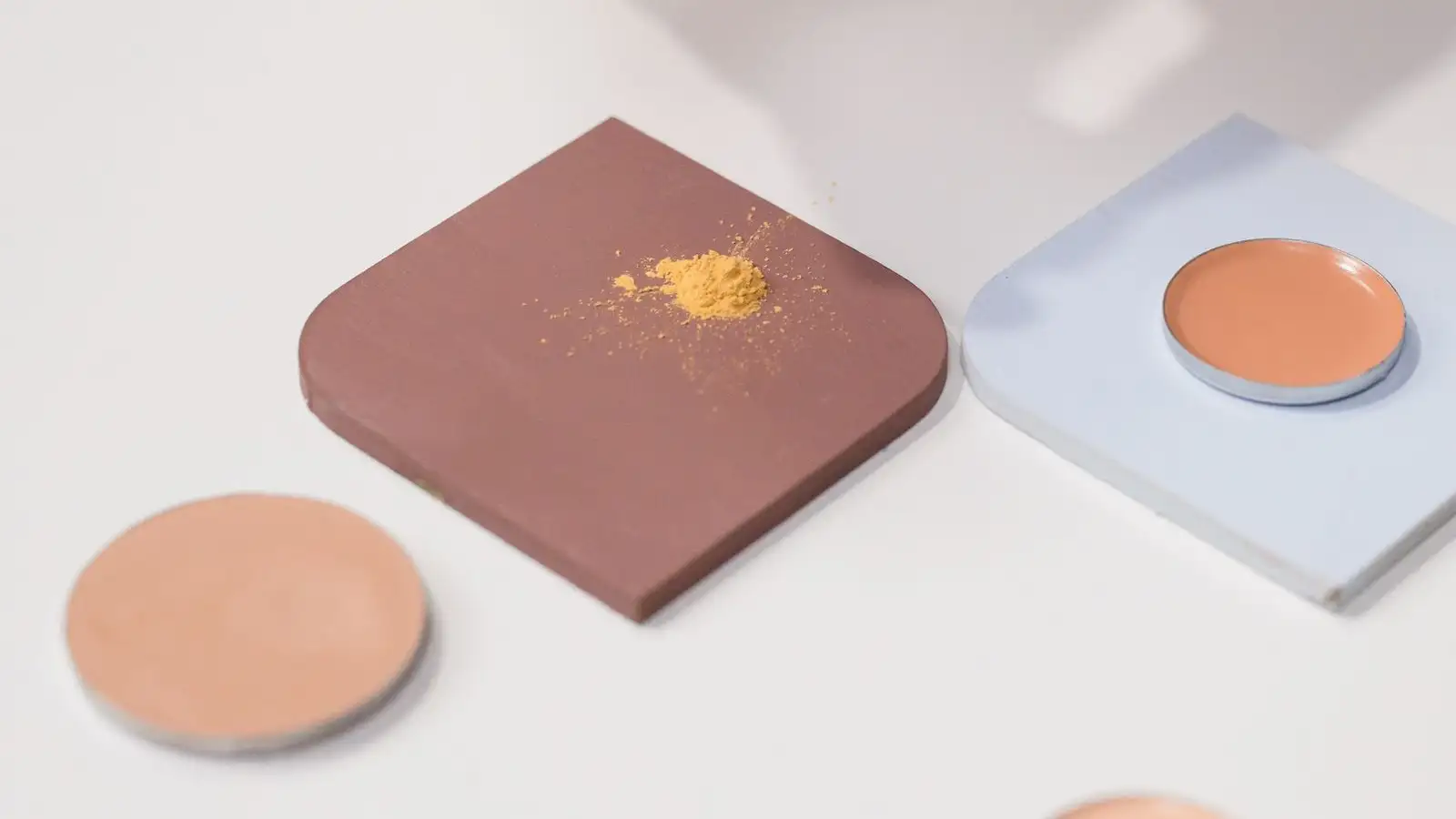
Bismuth oxychloride is the classic offender. It's a platelet — thin, flat, and it stacks on the skin the way roof tiles do — and its refractive index is high enough, a bit over 2, that a thin layer throws back a disproportionate amount of light. Mica is a platelet too, with a lower refractive index closer to 1.6, which is why a high-mica powder reads as a soft sheen in the bathroom and hits much harder in a photo than you'd ever predict from the pan. Titanium dioxide is the most reflective of the group, and it's also the ingredient that makes physical sunscreen work — which is why tinted SPF and mineral sunscreen show up so reliably in flash photos, sometimes when nothing else on your face is misbehaving. Silica, especially the very fine translucent powders, doesn't look like much at all, but a dusting of it scatters flash straight back with almost no color of its own to hide behind.
None of those ingredients are defects. They're doing exactly what they're supposed to do. Mica gives slip. Silica blurs. Titanium dioxide blocks UV. Bismuth oxychloride gives that creamy adherence people love in mineral formulas. Every one of them is a light tool. Flash just makes the tool visible.
The angle matters more than the product
The same face, the same powder, a window instead of a flash, and the veil simply isn't there. That's not because anything changed on your skin — it's that window light arrives from a wide arc and reflects back in a wide arc, so almost none of it funnels into a lens. Bounced flash off a ceiling behaves the same way. A big diffused source wrapped around the face behaves the same way.
The conditions that produce the worst flashback are specific: a small, hard, frontal light close to the lens, in a room dark enough that the flash is doing all the work. Which describes, more or less exactly, a phone photo at a party, a red carpet, a club, a wedding reception after sunset, or a step-and-repeat. Those are the situations people mean when they say a product "photographs badly," and they're the only situations where any of this matters.
Distance changes it too. A phone at three feet is brutal. The same flash at fifteen feet in a bright room barely registers against the ambient light. If your flash photos only go wrong in one particular setting, you've learned something about the setting, not about your skin.
Where it stacks up
Flashback is additive. A tinted SPF contributes a layer. The foundation contributes another. The setting powder adds a third on top, and it lands on the most reflective real estate on the face — the center of the forehead, the tops of the cheekbones, the bridge of the nose, exactly the surfaces that face a camera dead-on.
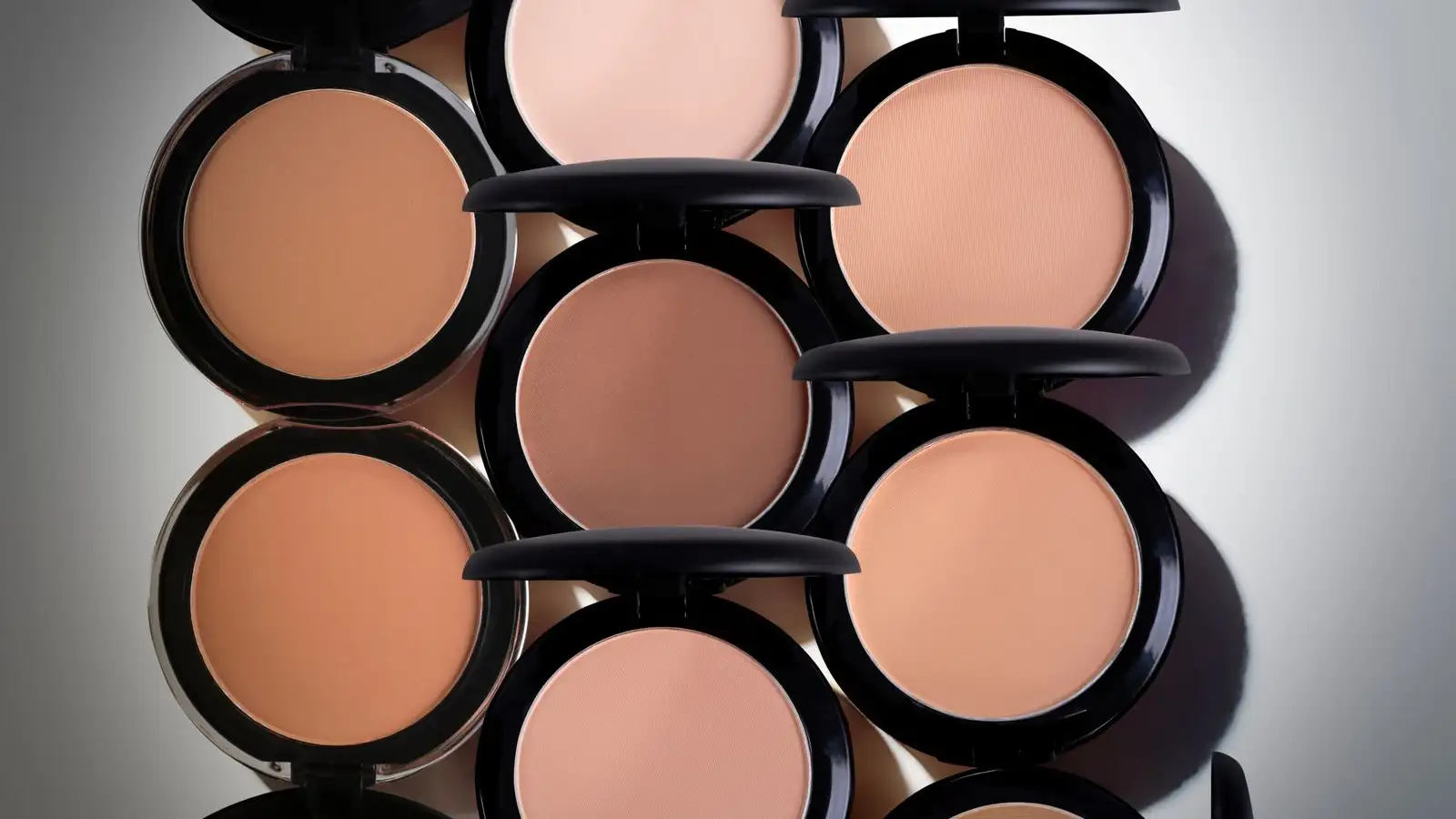
This is why swapping one product rarely fixes it. People change foundations, see a small improvement, and conclude the new one is better, when in fact they just removed one layer of three. If you want to know which layer is your problem, the half-face test tells you in about ninety seconds. Powder one side, leave the other bare, fire the flash, look at the actual file — not the preview, which is processed differently and will lie to you.
One thing I noticed and can only report as observation: pressing powder into the skin with a puff makes it look more seamless in the mirror and seems to make the flash photo worse. Flatter, more uniform platelets are better at reflecting, and pressing is a very good way to lay them flat. A light dusting with a fluffy brush scatters more randomly. Mirror and camera want opposite things from the same powder.
What I actually changed, and what I refused to change
I stopped trying to fix flashback with shade. Going darker to compensate for a pale photo is how you end up too deep in daylight, and then you're chasing the mistake in both directions. If your shade is right in indirect daylight, it's right. The pale photo is evidence about a light source, not about your match.
What I do instead: on nights when I know there will be direct flash, I keep the reflective layers off the center of my face and let them live on the perimeter, where the light rakes across rather than bounces back. I skip the extra powder pass and blot with a tissue instead, because blotting removes oil without adding particles. If I've already over-powdered, a barely damp sponge pressed over the shine knocks the surface back without stripping everything underneath. And I've learned which single product in my rotation is the loudest one, so I can drop it for a night and keep the rest.
The honest limits
Some of this you cannot engineer away. If you're wearing a high-index physical sunscreen because it's the only thing that keeps your skin calm, or you're on camera under a direct frontal flash at close range, you may still see a haze — less of it, not none. There's a real tradeoff between the finish that flatters skin in person and the finish that disappears under a flash — the same silica and mica that slow an oil-driven color shift are the ones that flash back — and nobody gets both at full strength.
And there's a simpler limit: if you're never photographed with direct frontal flash, none of this applies to you, and you should keep wearing the powder you like. The mirror is a legitimate audience.
The photo was never lying about your skin. It was telling you what your face does to a light source two inches from the lens — which is a piece of physics you can see, test, and work around, once you stop reading it as a verdict on your shade.

About the author
The Undertone
The Undertone is a byline for people who learned foundation on brown skin by swatching, mixing, and checking color in real light. They share a practical focus: if the depth and undertone are right, the formula will follow.
More about usRelated posts