Dry, Mature Skin? Why Your Foundation Cracks by Noon
Foundation cracks by noon on dry, mature melanin-rich skin because the skin underneath has run out of moisture and the film on top has been set rigid, not because oil broke through. The order of the fix matters: hydrate in thin layers and let each one settle, choose an emollient formula that bends with your face instead of a matte one that sets hard, keep powder to a minimum or skip it, and when it does break down, refresh with a damp sponge and a thin pass of the same foundation rather than a new product. Do that and the shade stays put because you never changed it.
You can see the whole diagnosis in about four seconds. Stand where the daylight hits you, tilt your chin down, and look. The cracks are never random. They land where your face moves: the two short vertical lines between your brows, the parentheses from nose to mouth, the fine crosshatch under the eyes. Then the patches, on the cheeks and around the mouth, where the foundation has lifted into little plates with visible edges, like paint over a spot that wasn't primed.
What matters is what is not there. No shine. No deepening of the color at the center of your face. If this were oil, your T-zone would be glowing and the pigment would have warmed and gone darker by lunch. This is the opposite failure. The film went stiff and the skin beneath it had nothing left to give.
Why the powder habit makes it worse
I understand why the instinct is to powder. Almost everyone learns setting as a default, and on oily skin it is a genuinely good tool. On dry, mature skin, powder is a desiccant sitting on top of a film that needs to bend. Every expression line becomes a fold, the fold gets stiff, the pigment splits along it, and by midday you are looking at a map of your own face.
Then there is the color problem, and this is the part people misread. A matte translucent powder on deep skin scatters light at the surface — white minerals like titanium dioxide, zinc oxide, and silica doing the scattering — and reads gray. Not lighter exactly. Ashy. A veil of dust over the undertone. Under office lighting that gray convinces you the foundation is too light, so you go a half shade deeper, and now the perimeter of your face is too dark while the center is still ashy and the cracks are still there. The shade was never the problem. The powder was.
If you must set something, set it in one small place: the sides of the nose, or the crease under the lower lip, wherever you actually produce oil. A fan brush, tapped twice, pressed on. Nothing under the eyes, nothing on the cheeks. If you can see powder sitting on the skin, there is too much of it.
Prep is layering, not soaking
Glycerin and hyaluronic acid hold water near the surface, and that water is what lets foundation glide over a flake instead of catching on it. But more is not better. Three heavy layers of anything and the foundation has nothing to grip. It slides, it pools in the laugh lines, and by ten in the morning it has migrated off your nose entirely. That is not dryness. That is slip, and it is its own kind of failure.
The habit that changed this for me was the wait. Thin layer, sixty seconds, thin layer, then let it settle until it feels tacky-dry rather than wet. You are aiming for a soft surface, not a slick one. If your fingers skate, you have gone too far and you should press a tissue over it before foundation, not add more cream.
And the flakes deserve their own moment, because a flake has an edge. Foundation goes on liquid, dries, shrinks slightly, and tightens around that edge. That ring you see by noon is not a coverage problem. Adding more foundation just makes a second ring. Soften first. A warm damp cloth, pressed and rolled while you are washing your face, takes away whatever is loose and lays the rest flat. No scrubbing, no grit. Then proceed.
What the formula has to do
Emollient and cream-based foundations stay flexible. They bend with the face and they rewet slightly with your own warmth, which means at two in the afternoon you can press a dent out of them. Matte liquids and long-wear formulas set into a rigid film, and that film is engineered to resist oil. It does exactly what it was built to do, which is precisely why it cracks on dry skin. It is not a bad formula. It is an answer to a question you are not asking.
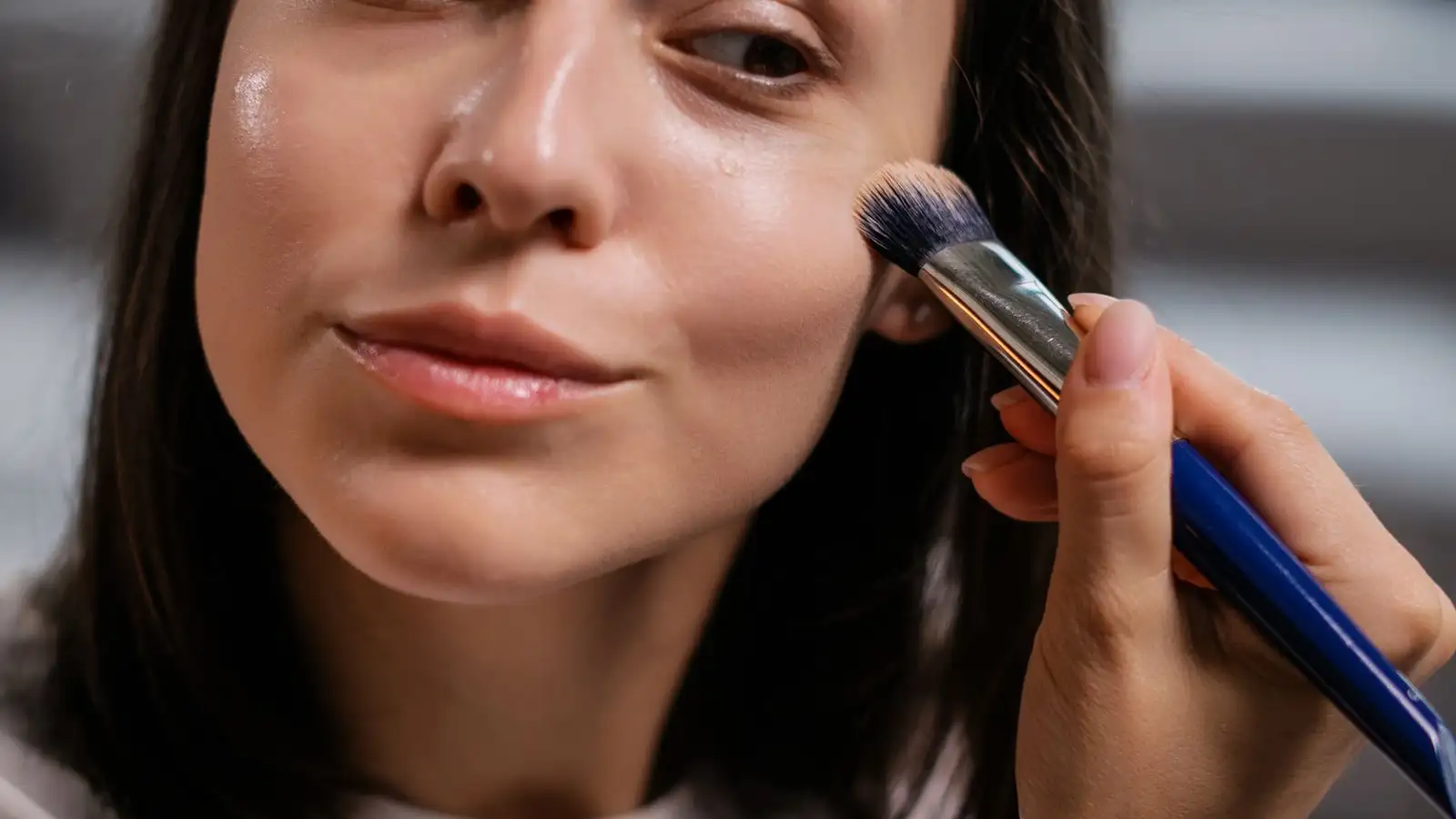
Application matters as much as formula. Press and roll with a damp sponge wrung out until it is barely damp, rather than buffing with a brush. Buffing drags across flakes and lifts them. Two thin layers read like skin. One thick layer reads like coverage and cracks like plaster.
A word on the tradeoff, because there is always one. In real humidity, a rich cream formula can travel on the drier perimeter of the face by mid-afternoon. Plenty of people do better with the emollient formula concentrated on the cheeks and a lighter texture through the center, rather than the same layer everywhere. And if you live with forced-air heat for five months a year, the spray does more work for you than the cream ever will.
The noon reset, in order
A hydrating setting spray first, one fine pass, held back from the face, then let it dry down before you judge it. That re-melts the powder you did use and takes the flatness out of the finish.
Then the sponge, damp, with a thin layer of your foundation, only where the cracks and plates are. Press, do not sweep. You are not building coverage back up, you are reconnecting the film.
Then one more pass of spray, and give it a minute.
Notice what did not happen there. The shade did not shift, because you added the same pigment in a thin layer. What shifts a shade is adding a second product with a different undertone, or powdering a deep tone with something that scatters light gray. Refresh with the thing that was already correct and the color holds.
Where this stops working
Some cracking is simply what a face does. Lines are deep because that face has been making those expressions for forty years, and no prep changes that geography. The goal was never a face that looks untouched at five in the afternoon. It is a face where the shade still reads true in daylight and the skin does not feel tight, and those two things tend to arrive together, because tight skin is what cracks.
If your skin is actively irritated, stinging, or inflamed, put the sponge down and have that looked at before you troubleshoot a formula. Technique cannot solve a surface that is telling you something else.

About the author
The Undertone
The Undertone is a byline for people who learned foundation on brown skin by swatching, mixing, and checking color in real light. They share a practical focus: if the depth and undertone are right, the formula will follow.
More about usRelated posts