Two Thin Layers Beat One Thick Layer for All-Day Wear
Two thin layers beat one thick layer because the first pass gets to set before the second one lands, and a set film flexes with your face instead of sitting on top of it. A single heavy pass never gets that chance. It stays wet underneath while the surface begins to skin over, so it shifts every time you move, and by the time it settles it has pooled in the exact places that crease.
Where this actually gets decided
I do this at an east-facing bathroom window around seven-forty in the morning, and that light is the most honest thing I own. Not the ring light. Not the bulb over the sink that flatters everything by a shade and a half. The window shows me texture, and texture is what tells you whether a layer is thin enough.
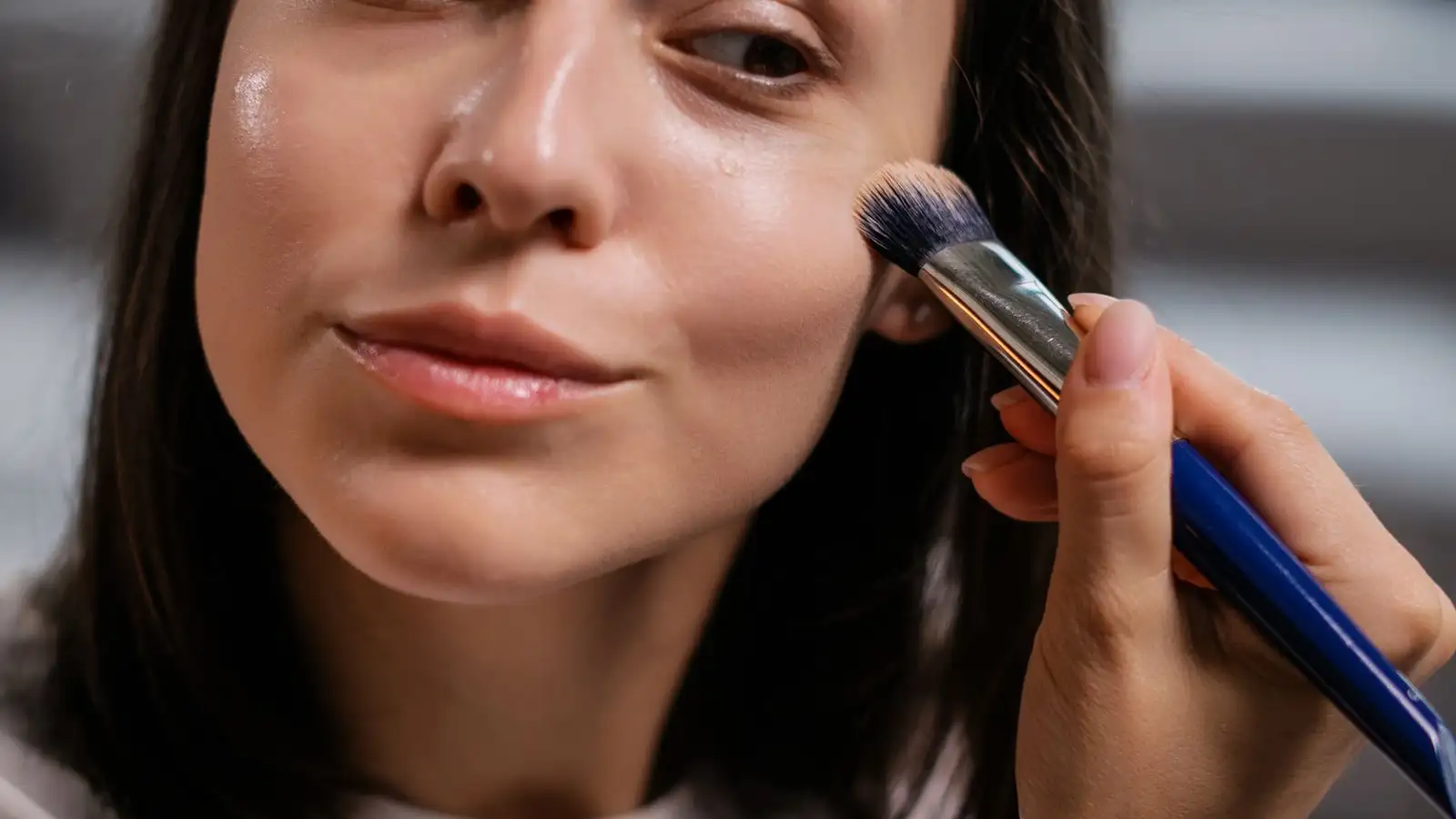
The sponge sits damp in a small dish, squeezed until it stops dripping. One pump of foundation goes onto the back of my hand, not onto my face. That matters more than it sounds like it does. Product on the face is a decision you have to make in a hurry. Product on the hand is a reservoir you can dip into twice and still control.
I spread that one pump across the back of my hand and keep it there for the whole application. Nothing else comes out of the bottle. If I pump again, I will use it, and using it means one thick pass wearing a thin pass's clothing.
The first layer is not supposed to hide anything
The first pass goes on so sheer that I can still see the dark spots under it. People watch me do this and think I have made a mistake. I have not. That layer's job is to even out the surface, not to cover it. It gives the second layer something consistent to sit on, which is why the second layer then goes on evenly instead of grabbing in some places and sliding in others.
Thin here means one skim of the tool over a zone, pressed and lifted, pressed and lifted, moving across the cheek in small overlapping steps. The sound is a soft tap, not a swipe. If I hear a drag, there is too much product on the tool.
Then I stop. This is the part everyone skips.
The wait is the whole trick
I let it set for thirty to sixty seconds. Not until it feels dry, until it stops feeling like anything. Wet to tacky to nothing. The nothing is the cue. In that window I do not fan my face, I do not powder, I do not touch it to check. I put the cap back on the bottle and stand there, or I do my brows, which takes about the same amount of time and keeps my hands off my cheeks.
If the second layer lands while the first is still tacky, the two layers merge into one wet film and I have done a thick application in two steps, which is worse than doing it in one because now I have also spent the time. If it lands after the first layer has fully set and hardened, the second layer sits on top like a separate skin and it will separate at the edges by mid-afternoon.
That thirty to sixty second band is narrow enough that I check it with the back of a fingernail near my jaw, barely touching. If the nail comes away clean, it is ready.
What one thick layer actually costs
A thick layer does not dry evenly. The surface sets first, the underside does not, and the difference shows up later as movement. Smile and the film has to go somewhere, so it bunches along the fold near the nose. Talk and it cracks at the corners of the mouth. Press a phone to your cheek and the imprint is on the screen, not on your face where it belongs.
There is a second cost that gets misread constantly. On deeper skin, an uneven film reads as an uneven tone, and uneven tone looks exactly like a shade that is off. I have watched people decide their foundation is too light or too dark when the real problem was that they laid it on thick in the center of the face and thin at the perimeter. The shade was never the issue. The distribution was.
Thick product also oxidizes differently—more formula in one place means more pigment and oil reacting with air at once, so the orange shift shows strongest where the product is deepest. Two thin passes that each set give you far less of that, because there is less wet material sitting around waiting to change color.
The tool is really a motion decision
I don't think about tools by name. I think about what motion they let me make.
A dense brush buffs. That is its nature, and buffing drives product down into pores and along texture, which is great for blurring and bad for anyone whose texture you can already see. A damp sponge presses. Pressing lays the product on the surface and leaves the pores alone, and because it does not drag, it does not disturb the shade underneath when I go in for the second pass. Fingers warm the formula, which makes it spread more easily, and that warmth also makes it settle into creases faster, especially around the eyes and mouth where the skin is thin and moves constantly.
Every one of those is a legitimate choice for a first layer. The mistake is using a buffing motion for the second layer, because by then the first layer has set and buffing will lift it in patches. Second layer is stipple only. Press, lift, press, lift, roll the tool slightly, move on.
The difference in finish is not subtle. Sweeping leaves a faint directional streak that catches the window light exactly wrong. Stippling leaves the same tone everywhere.
Use less where your face moves
Around the mouth, at the corners of the nose, under the eyes, I do not dip back into the reservoir. I use whatever is left on the tool after the cheeks. Usually that is enough. Frequently it is more than enough.
Those zones are where transfer starts. Not because the formula is bad, but because the skin there folds and stretches hundreds of times a day, and any product sitting on top of a fold gets pushed off it eventually. Less product in a moving area means less to push off.
Where two layers is the wrong answer
Two thin layers is a method, not a religion. It costs three or four extra minutes, and there are mornings when that matters. If your formula is already very fluid, two passes may be more than you need in the center of the face and you can stop at one plus spot placement. Very pigmented creams can go on as one skimmed pass with a second touch only on the areas that need it.
And if your skin is actively textured or flaking, layering can make the texture more visible by giving it more edges to catch. In that case one thin pass, pressed rather than buffed, plus spot coverage, usually reads better.
The thing I would want anyone to take from this is that layer count is per zone, not per face. The center of your face might get two. The perimeter gets one. Around your mouth gets whatever was left on the sponge. That is not a compromise, that is the technique. One even film, built in pieces, set between each piece, is what survives a day. Volume never was.

About the author
The Undertone
The Undertone is a byline for people who learned foundation on brown skin by swatching, mixing, and checking color in real light. They share a practical focus: if the depth and undertone are right, the formula will follow.
More about usRelated posts