The Foundation Color Shift Fix Most Guides Skip on Deep Skin
The fix most guides skip is diagnosis. Before you buy a pigment mixer, swap your powder, or decide the bottle is a lost cause, sort the shift into one of four causes: oxidation, undertone mismatch, lighting illusion, or base-system incompatibility. Each one produces a different kind of wrong, each one shows up on a different timeline, and each one has a different repair. The way to separate them is a stripe of foundation on the jaw and neck, left untouched for fifteen to thirty minutes, read in daylight, then checked again around the two-hour mark.
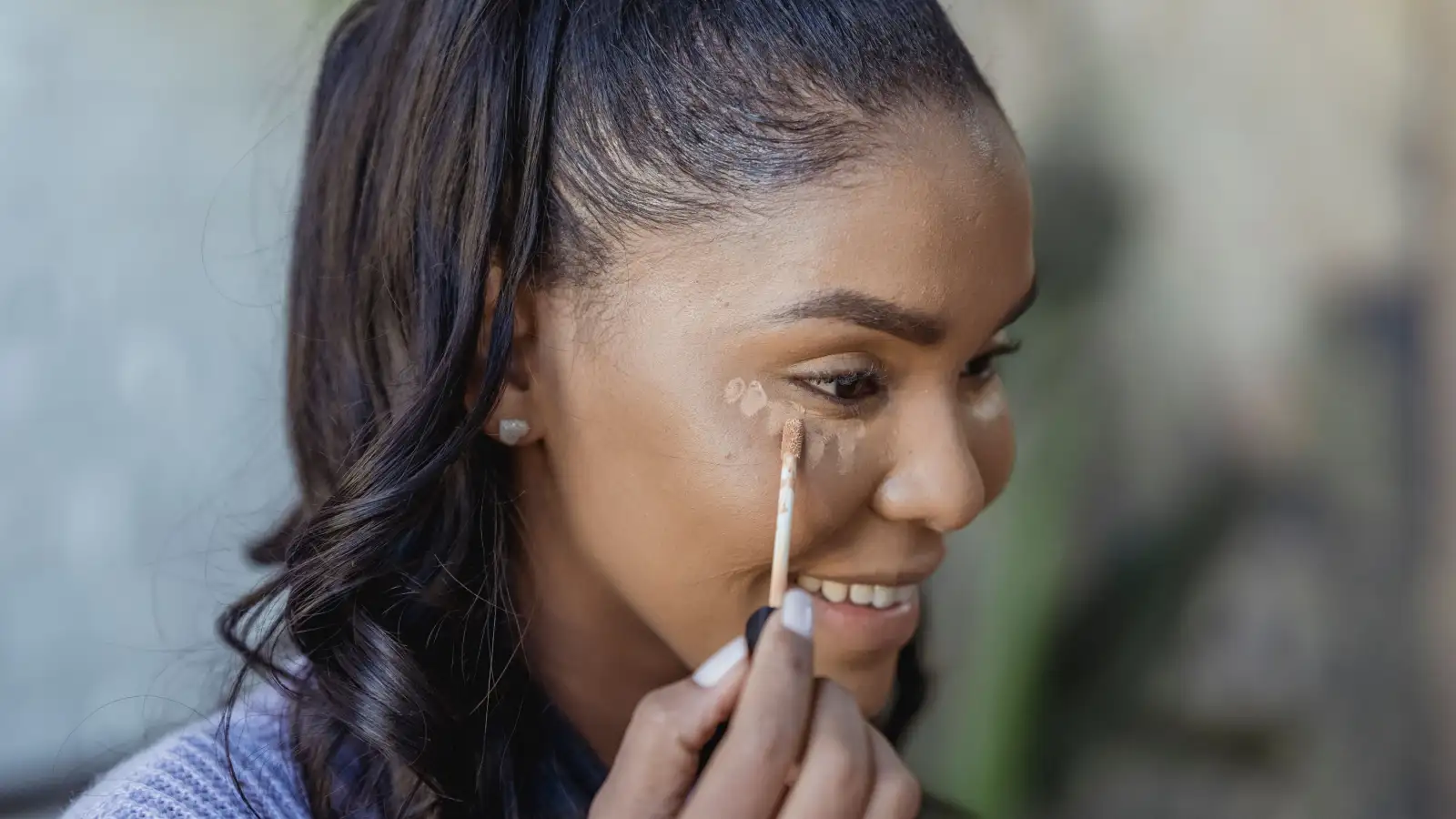
I want you standing at the window with me. It is early, the light through the glass is flat and colorless, and there are three stripes drying on my jaw. One is from a bottle I nearly threw out last month. One is a mix I have been fiddling with. One is a shade a counter person swore was my match. I set a timer on the sink and then I leave the room. That part matters more than anything else I am going to tell you. A swatch you stare at is a swatch you unconsciously fix, and you will not learn a thing from a stripe you keep touching.
When I come back, I do not ask whether it matches. That question is too vague to answer. I ask four specific questions in order, and the order is the whole trick.
Four kinds of wrong, and how each one gives itself away
Here is the sequence I run, and you can run it in the same order at your own window.
First: was it right in the first minute? If the stripe looked correct the second you laid it down and drifted later, you are dealing with oxidation or with something you put over it. Undertone mismatch does not wait. It is wrong immediately, before it dries, and it stays wrong in the same direction.
Second: if it was wrong from the start, is it the depth or the undertone? On deep skin this is where most people get lost. A foundation can be exactly your depth and still read too light or too dark, because the undertone underneath it is fighting your skin. That is not a depth problem, and buying a darker bottle will not solve it.
Third: does it look wrong in the bathroom and right at the window? Then it was never a color problem. It was a lighting problem, and the bottle was fine the whole time.
Fourth: does it break apart, pill, or go patchy wherever you layered moisturizer, sunscreen, or primer? That is not color at all. That is two base systems refusing to cooperate, and it reads as a color shift because the pigment is sitting on top of a film instead of settling into skin.
Oxidation is patient, and it lies about depth
Oxidation is the one that gets warmer and darker as it sits. It does not announce itself. You put it on at seven, you catch your reflection at the elevator at ten, and something looks off in a way you cannot name. The tell is timing: dry-down deepens within five to ten minutes and stops, while true oxidation keeps shifting over hours. If the stripe on my jaw is a half shade warmer at the two-hour mark than it was at the fifteen-minute mark, I stop looking at undertone entirely and start looking at what is underneath the foundation.
Oil, heat, and whatever skincare layer you put down first all feed it. So does the rest of your routine sitting on top of it. I have watched a foundation that behaved all morning turn orange the moment a specific powder went over it, which is why I never test a foundation on a bare jaw anymore. Bare skin tells you half the story. Bare skin plus your actual primer plus your actual powder tells you the truth.
Undertone mismatch is immediate, and it comes in two directions
This is the one I can usually call in the first five minutes, and it is the one people misdiagnose longest.
An orange or peach cast that is there from the first second is a foundation that is too warm for you, or warm in the wrong way. A gray, ashy, or dusty cast that is there from the first second is a foundation that is too cool, or, more often on deep skin, one that has been over-desaturated. This happens constantly with shades built to be safely neutral. Someone chased away the orange by adding white and gray until the color had no life left in it, and now it sits on brown skin like a film of dust.
Gray is not the same as too light. If I see gray, I do not go darker. I put chroma back with a small amount of yellow, peach, or orange mixer — a dot of mixer can restore saturation without lifting depth — and I go there slowly.
Lighting illusion is the one that costs you the most money
Store light is designed to sell, not to tell. Plenty of indoor bulbs push yellow or green — warm vanity bulbs stack warmth onto a golden foundation, and fluorescents can drain deeper skin toward gray — and a foundation that reads perfectly under them can look like a different product at your kitchen window, because bathroom light adds its own color before your foundation ever gets a chance to show its own. Then there is the reverse, the bottle you rejected in a shop that was probably right all along.
My rule is blunt. If a shade is wrong in indirect daylight at a window, it is wrong. If it is only wrong in one room of my house, the room is wrong. Test the bottle again the next morning before you decide anything, because a decision made under a bulb is a decision you will spend money undoing.
The other lighting trap is flash. Setting powders built on silica, titanium dioxide, zinc oxide, or mica scatter light — the light-reflecting mineral powders behind flashback — which is what makes them look smoothing in person and what makes them flash back white in a photograph. On deep skin that flashback is not subtle. I test it by taking one photo with flash in a dim room before I wear a new powder anywhere that matters.
Base-system incompatibility looks like color but is not
If your foundation is water-based and your primer is silicone-based, the two can separate, and separated pigment reads uneven, patchy, and sometimes a shade off — and the hidden silicone can be in your moisturizer or sunscreen, because the base system is the whole stack, not just the primer. Same story mixing a water-based and a silicone-based foundation together in the back of your hand. They may not blend into one color. They may just sit next to each other and dry that way.
I learned to check this with texture before color. I spread the stripe thin, wait, and look at the edges. If the edges crawl, bead, or grab, I have a base problem and no amount of pigment is going to fix it.
The swatch, in the order I actually do it
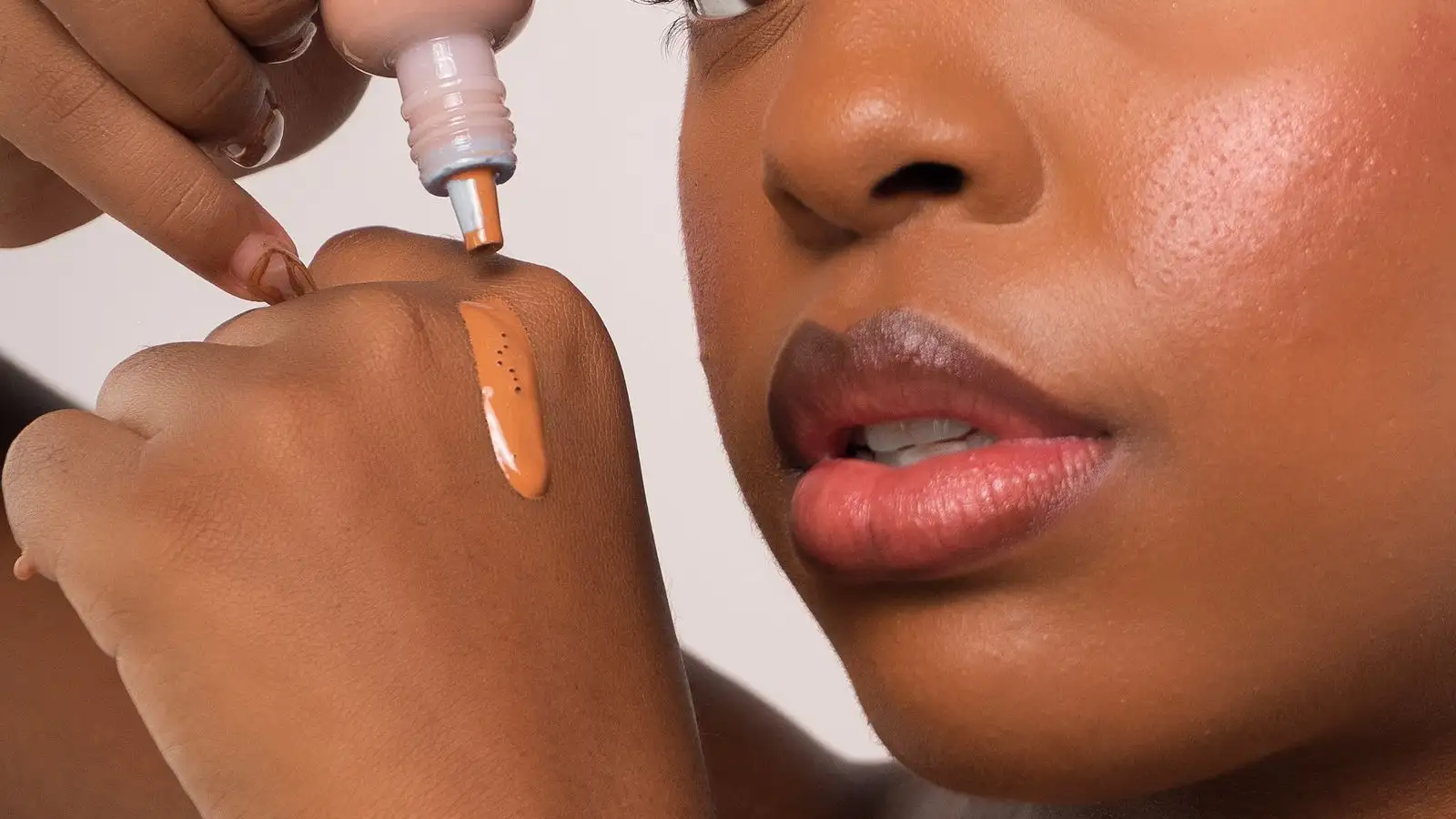
Three stripes, side by side, starting at the jaw and running down onto the neck. Not the back of the hand, which is a different color from your face on almost everyone. Not the cheek alone, which is often the most reactive part of the face.
Blend the bottom edge only. Leave the top edge intact so you can see the actual color of the product against the actual color of you.
Set a timer for twenty minutes and walk away. Come back and read it at the window in indirect daylight, not in direct sun, which blows everything out. Judge the edges first, then the center.
Then wait. Two hours is when oxidation shows itself, and two hours is when most people have already left the house and stopped paying attention.
When you do adjust, use less pigment than feels reasonable
I mix, but I mix like someone who has ruined a full bottle before. Pigment mixers are concentrated, and the amount that moves a shade is often smaller than a grain of rice. Put that on a metal spatula or the back of a clean palette, not into the bottle. Add, test, wait. You can always add more. You cannot take it back out.
One direction at a time. If it is gray, add warmth and saturation. If it is orange, blue is the counter, and for a full pump of deep foundation one drop of blue is usually the entire correction — so add a fraction and test, rather than dumping and hoping. Take a small amount of the foundation and add the tiniest touch of a cooler or more neutral mixer, then swatch it on the jaw again in daylight. Two adjustments, tested separately, will teach you more than five adjustments blended together.
The prevention list is short and boring
Match undertone before depth, because depth is the easier thing to fudge with powder and the harder thing to live with. Keep your primer in the same base family as your foundation. And go light on powder, applied in thin layers only where you actually shine, because a heavy powder layer is the quietest way to change the color of a foundation that was working fine.
Where this breaks down
Sometimes it is two causes at once. Oxidation plus a too-warm undertone is common, and so is a lighting illusion stacked on top of a base mismatch. In those cases, fix the base and the lighting first, because they are free to fix, and re-test before you spend anything. Also, one bad week of testing does not condemn a bottle. Skin shifts with weather, hormones, and whatever your skincare is doing, and I have had shades behave differently in July than they did in February. Test twice, on two different days, before you decide.
When I finally took the timer off the sink, the answer was almost never a new bottle. It was one of four things, and once I knew which one, the repair was small.

About the author
The Undertone
The Undertone is a byline for people who learned foundation on brown skin by swatching, mixing, and checking color in real light. They share a practical focus: if the depth and undertone are right, the formula will follow.
More about usRelated posts