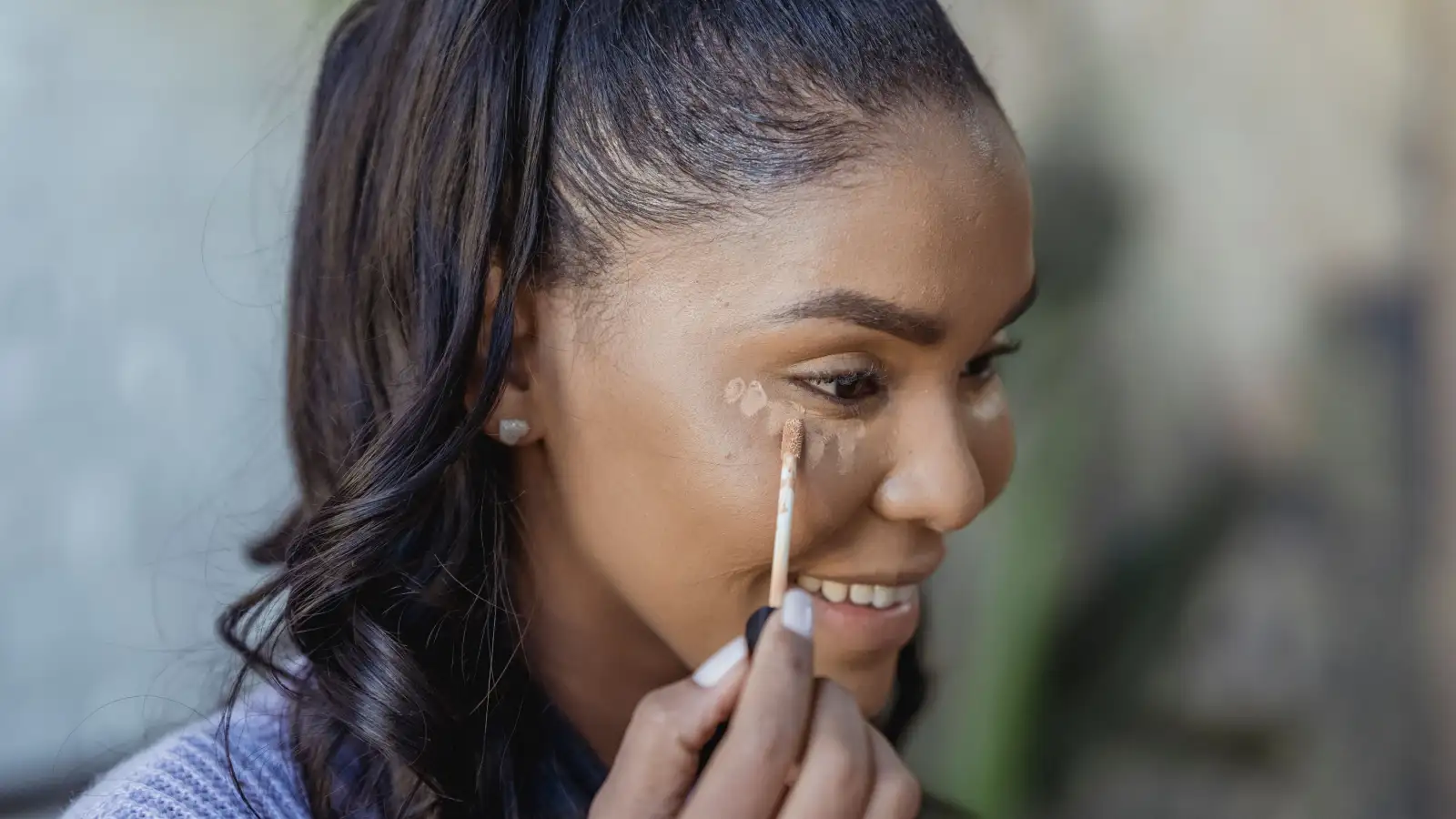
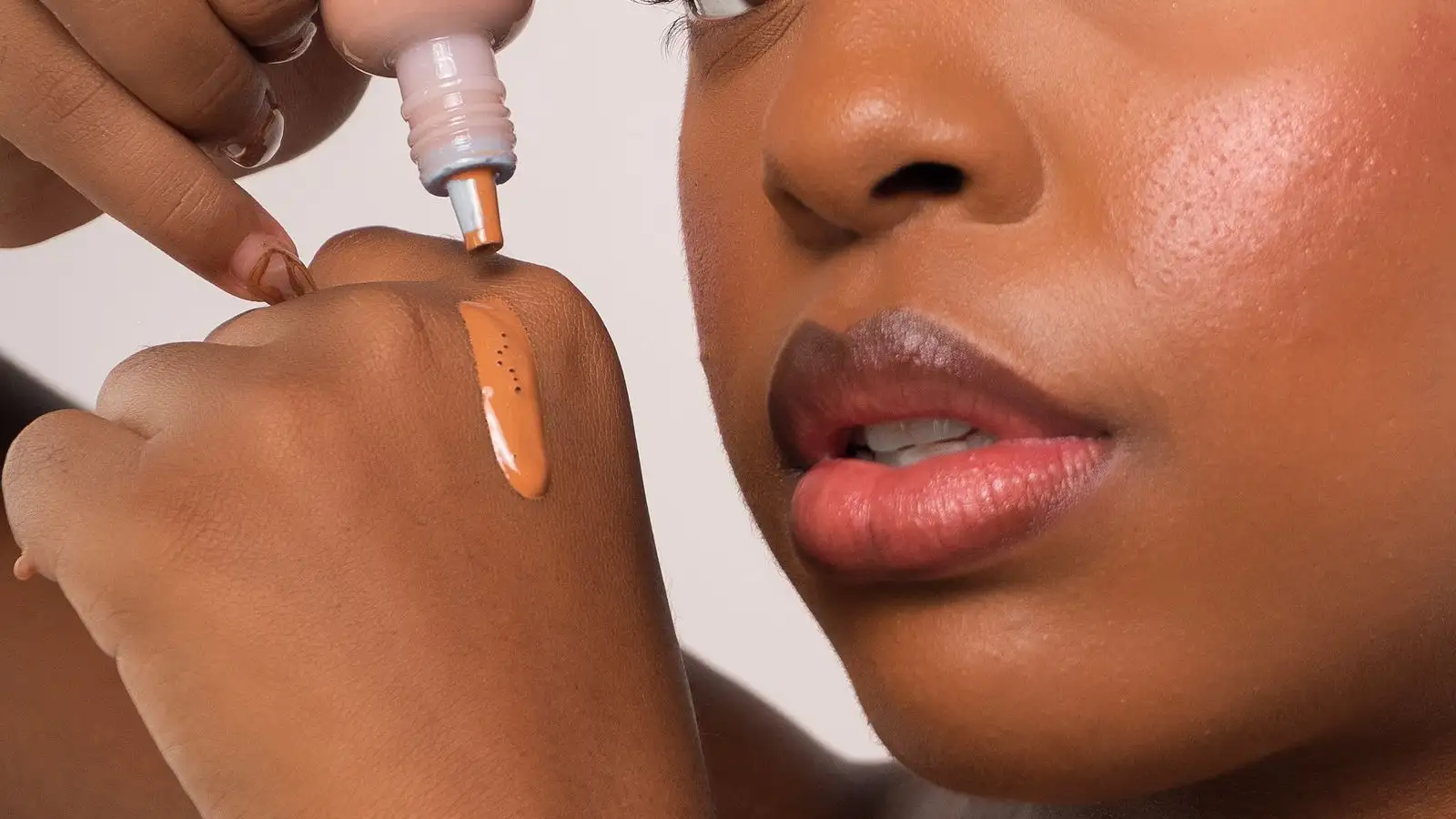
The Ingredient That Makes Deep Skin Look Ashy in Flash
The cast comes from light-reflecting mineral powders — titanium dioxide, zinc oxide, silica, and mica — sitting on top of the skin and bouncing the flash straight back into the lens. Whatever in the routine carries one of those high on the ingredient list is the suspect, and the only honest test is a flash photo of your own face, taken in a dim room, before you walk out the door.
I found mine in a hallway, about twenty minutes before a birthday dinner. Phone propped on the stair rail, flash on, six-second timer, one overhead bulb off to the side so the hall was dim but not dark. In the bathroom mirror I had looked fine — even, warm, nothing to fix. In the photo, my forehead and the tops of my cheekbones were the color of wet newspaper. Not lighter. Drained. The red and the gold that had been there a minute earlier were simply gone, and there was a visible edge along my jaw where the powder stopped.
I went back and read the back of the compact. Mica first. Silica third. The loose "translucent" powder I had been baking my under-eyes with was worse.
Why the mirror and the camera disagree
A mirror shows you reflected ambient light, and ambient light is soft and comes from everywhere. It bounces off your skin at a hundred angles, and what you mostly see is the pigment in the foundation.
A flash is a single hard point of light. It hits the face, and whatever is sitting on the surface with a high refractive index or a flat, plate-like structure throws a big chunk of it straight back at the lens. The camera records that return as white. On lighter skin it reads as a faint glow. On deep skin it reads as a mask, because the gap between reflected white and your actual depth is so much wider.
That is the part I had to see to believe: the cast does not just lighten you, it desaturates you — ash is what is left when chroma gets diluted, before it is an undertone problem. The depth goes muddy, the undertone slides toward gray-lavender, and the face in the photo stops looking like a lighter version of you and starts looking like a copy of you printed on the wrong paper.
The four ingredients, and where they hide
Titanium dioxide and zinc oxide
These are white pigments before they are anything else. They appear as UV filters in mineral sunscreens, as opacifiers in cream foundations and tinted moisturizers, and as the base of many pressed and loose powders. In a foundation with a real pigment load, they are dispersed and mostly behave. In a sheer mineral sunscreen, they are the film — that thin white layer sitting on top of everything you put over it.
Silica
Silica does not look white in the jar, and in a thin layer it is not. The trouble is volume. Pile it on the way a lot of us were taught to, and it forms a fine matte veil that scatters the flash instead of absorbing it. Words like blurring, soft focus, and HD on a label are usually a silica signal. So is the texture — that weightless, almost slippery feel that makes you want to use more than you need.
Mica
Mica is the reason a powder feels silky and the reason it catches light. It is a platelet, and platelets reflect. It hides in translucent setting powders, finishing powders, and anything with a soft-focus claim. A powder can be mostly mica and still look like nothing in the pan.
Talc
Talc is not a mirror the way mica is, but it is a veil. A finely milled, high-talc powder laid on thick leaves a pale film, and on deep skin the practical difference between a heavy talc powder and a silica powder is smaller than the marketing suggests. I stopped treating talc as the safe option and started treating it as just another thing to photograph.
"Translucent" is a relative word
It means translucent compared to something. On light-to-medium skin a translucent powder is genuinely near-invisible. On deep skin, that same powder is a pigment, and the jar is lying to you in a way it is not lying to your friend. This is not a conspiracy, it is just that the product was tested against a different face.
So you test it yourself. Which brings us to the routine I actually use.
The flash test, step by step
Kill the ambient light first. A bright bathroom defeats the whole exercise. Under strong room light the flash contributes so little to the exposure that a bad powder will pass. Use a closet, a hallway at night, a room with one lamp behind you rather than above you.
Shoot at two distances. An arm's-length selfie is harsh and unforgiving, and it exaggerates everything. A shot from six to ten feet is closer to what a real photographer or a wedding guest across the room will produce. Take both. The far one is the one that matters.
Turn the phone's helpfulness off. Disable auto HDR and scene optimization, kill the beauty filter, and do not let the camera warm the tone. You want the ugly file.
Read the file, not the preview. Open the photo full screen and zoom into the forehead, the nose bridge, and the under-eye. Look for gray-lavender, for a loss of warmth, for a hard boundary where the powder stops and bare skin starts.
Test the stack, not the products. Sunscreen plus primer plus foundation plus powder is one system. A powder that photographs clean over bare skin can fail over a mineral sunscreen, because the layers compound.
Write down what you wore. I keep the test photo and the routine in the same note on my phone, because three weeks later I will not remember which combination produced that gray forehead.
Flashback, oxidation, and white cast are three different problems
I mixed these up for years, and it cost me money.
Oxidation is a color shift over time — the base darkens, or turns orange, by hour six, and it is a chemical reaction that unfolds over hours rather than a dry-down that stops in minutes. Flashback only exists in a photograph and it is there the instant the shutter fires. White cast is a pale film you can see in daylight with your own eyes, usually from a sunscreen or a base that is too light. Different causes, different fixes.
The mistake I see most is buying a darker foundation to fix a flashback problem. That does nothing to the reflector sitting on top, and it gives you an orange face in daylight while the photograph still comes out gray. Fix the layer, not the depth.
What actually fixes it, in order of what it costs you
Use less. This is free and it works more often than anything else. Press the powder in with a light hand, then dust the excess off the brush onto a tissue before it ever touches your face.
Place it, do not blanket it. Powder the T-zone and the under-eye lightly and leave the cheekbones — the exact planes the flash hits hardest — closer to bare.
Then change the powder. Look for a pressed powder where the first ingredients are a binder and a pigment rather than mica or silica, and get it in a depth close to your own. A pigmented powder in your shade leaves a far smaller signature in a photo than a pale veil.
Then look at the sunscreen underneath. Sheer mineral formulas are the most common culprit I have found under foundation, and the cosmetic workaround is a tinted mineral formula or a different filter system altogether. That is a cosmetic swap, not a sun-protection decision, and it should not be made as one.
Then, and only then, the spray. A setting spray knocks down the powdery look and helps the powder melt into the skin, which genuinely reduces how much of a veil you see. What it cannot do is neutralize a strong reflector. If the powder is loaded with mica, spraying it just gives you a wetter version of the same white cast. Spray is a texture fix. It is not a color fix.
If you are stuck with a powder that flashes and nothing else is available, use it under the eyes only, thin, and skip it entirely through the center of the face. A slightly shiny forehead photographs better than a gray one.
What I wish someone had told me first
The mirror is not the reviewer. The mirror is the rehearsal. The photo is the performance, and it is the only one that is going to be on somebody's wall or in somebody's camera roll for the next ten years.
So take the ugly hallway picture. Ten seconds, once, before you leave. It is the difference between knowing and hoping, and on deep skin the gap between those two is usually several shades wide.

About the author
The Undertone
The Undertone is a byline for people who learned foundation on brown skin by swatching, mixing, and checking color in real light. They share a practical focus: if the depth and undertone are right, the formula will follow.
More about usRelated posts