Dewy Foundation Does Not Mean Hydrating on Dry Mature Skin
Dewy describes how a foundation's surface throws light back at you. It does not describe what the formula will do to the skin underneath, and on dry mature skin those two things split apart fast — a foundation can bounce light off the cheekbone like glass at eight in the morning and still leave the skin beneath it tight and crepey by lunch. Pick the finish as a look, pick the formula as a behavior, and read them off two different things: the film on the glass for finish, the ingredient list for formula—the four base behaviors that decide how a formula wears. Treating one word as if it covers both is where most of the disappointment starts.
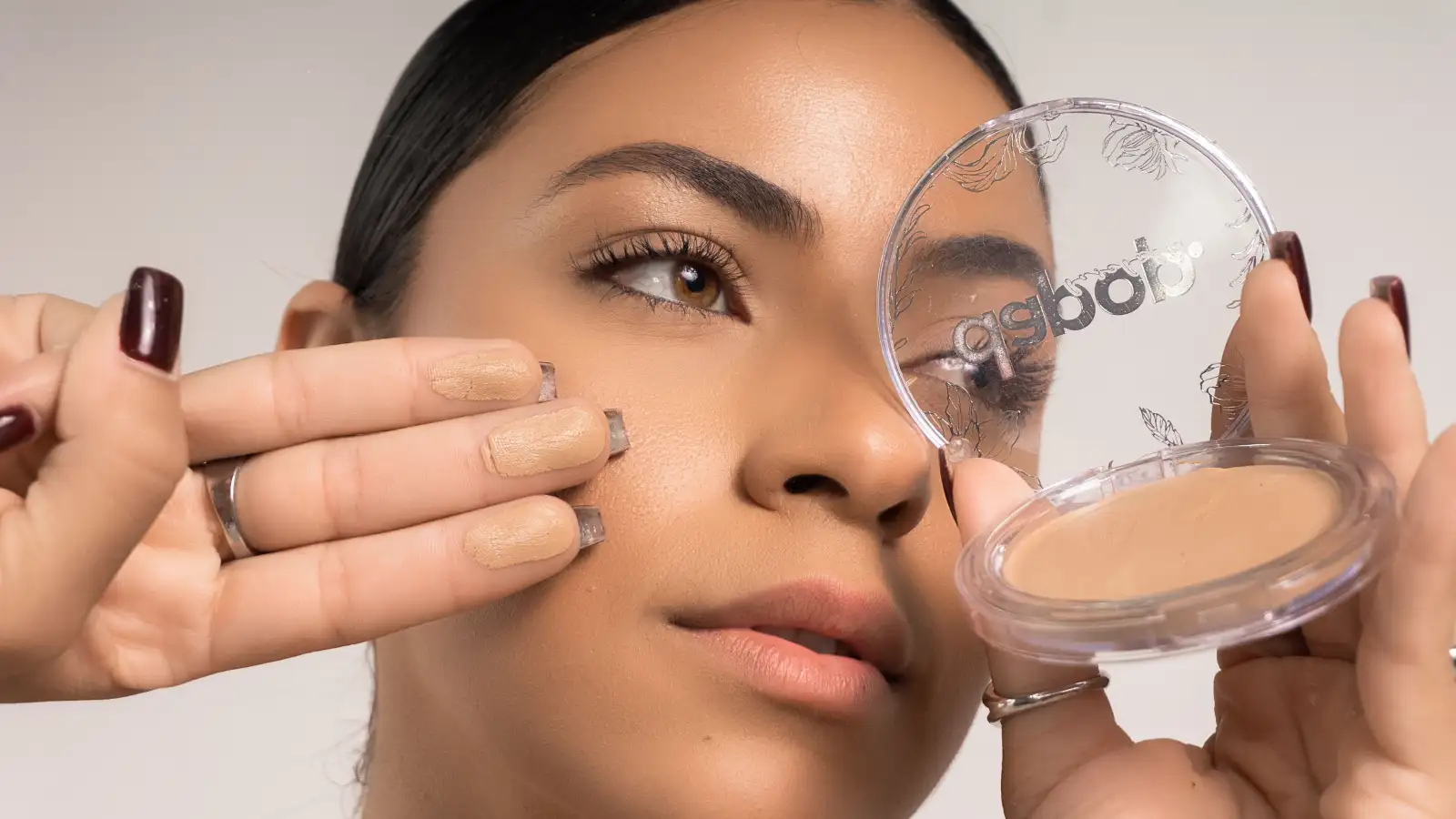
I'm at my bedroom window at about 7:40 on a weekday, because that's the only light in this apartment that doesn't flatter me into a mistake. North-facing, no bulb, no store spotlight. You've got the bottle in your hand — tip the neck so it catches the window and not the lamp, and look at the film of foundation smeared on the inside of the glass. If it sits there like a little mirror, that's the surface you'll be walking around with all day. It tells you nothing at all about hour four.
That's the first thing I'd put in your hands: bottle held up to window light is a finish test, not a moisture test. Two different questions, two different tools.
What dewy actually is, physically
Dewy is high reflectance plus a film that stays slightly wet-looking. Sometimes that comes from oils and emollient-rich bases, sometimes it comes from a formula heavy in water and silicone that never fully sets into a matte film, sometimes it comes from fine light-scattering particles suspended in the base. Only the first of those has anything to do with how the skin feels afterward.
I learned this with a bottle that looked gorgeous in the swatch and left my cheeks feeling like paper by mid-afternoon. Nothing was wrong with the finish. The finish was doing exactly what it promised. The base just had very little in it that my skin wanted to hold onto, and a wet-looking film is not the same as a film that keeps anything in.
So when you're standing in the aisle, don't ask "is this hydrating?" and then go looking for the word dewy. Ask them separately. The finish question is answered by the swatch and the light. The formula question is answered by reading what the base is actually built out of — emollients, oils, butters, glycerin-type humectants — and by how your own face feels two hours in, which no label can tell you in advance.
Matte, satin, natural, dewy on a mature dry face
Matte is low reflectance. It bounces very little light back, and that's the whole appeal if you want structure and control. On mature, dry, deeper skin the cost is specific: with no light scattering across the surface, texture reads harder. Fine lines get a shadow line on either side of them instead of a softening highlight. Flakes that were invisible become a small topographic map. It's not that matte damages anything — it just shows more, and if what's underneath has any dry texture, you're now displaying it in high definition.
Satin and natural finishes are the middle. Enough reflection to keep the face from going flat, enough structure that it doesn't slide into shine along the nose and forehead by noon. On deeper skin I find these the easiest to live with, because they don't require you to pick a side between greasy and gray.
Dewy is the most reflective of the four, and that's also where deeper skin runs into a problem nobody warns you about. Reflectance has a color. If the particles doing the reflecting are white or silver, they don't read as glow on brown skin — they read as a pale cast, a gray film along the cheekbone, a dullness that looks like ash rather than light. Warm or neutral reflectors read like skin catching light. Cool ones read like powder.
Here's the test I use, and it takes ten seconds. Swipe the dewy one along your jaw, then turn the side of your face away from the window so the light hits it at an angle. If the glow goes gray or bluish at the edges, the reflector is cool-toned and it will do that in every photograph you take outdoors. If it warms up or stays neutral, it's going to behave.
The powder is doing more than you think
Most of what people call a finish problem is a placement problem. I don't powder my whole face anymore, and I have dry skin, so that sounds backwards until you look at where the shine actually needs to go.
Set the sides of the nose. Set the crease where the nose meets the cheek. Set the center of the forehead and the corners of the mouth if you're going to be talking all day. Press, don't sweep, and use less than feels correct. Leave the cheeks and the high points alone — that's where the dewy film is doing its best work, and it's the first place a full-face powdering kills it. You get the healthy surface you wanted and the shine stops running away from you in the two places it always does.
Daylight and photographs are two different judges
A bathroom mirror with a warm bulb over it will tell you that everything is fine. It's the most forgiving light in the house, which is exactly why it's useless for this.
Take the same face to a window. Then take a photo of it, because a camera flattens reflectance in ways the eye doesn't. Direct flash on a dewy finish goes to a single flat white sheet across the high points; that glow you saw in the mirror becomes a shine blob. Daylight from the side is closer to what people actually see when they're standing next to you. Check both, and check them at hour three rather than minute three, because the film keeps settling and the surface keeps changing while the color underneath you may also be shifting as the base oxidizes. Oxidation is a color problem, not a moisture problem, and it's worth keeping those separate in your head too.
Where I've landed
I buy for behavior and adjust for finish. That's the whole method. The thing I can change in thirty seconds with what's already on the shelf is the surface — a lighter hand with powder, a press instead of a sweep, skipping the cheeks entirely. What I cannot change after the fact is a base that had nothing in it for my skin. So the formula decision gets made carefully, once, and the finish decision gets made every morning in the mirror.
One honest limit: if the skin is actively flaking, no finish choice rescues that. Dewy doesn't hide scale, it lights it. That's a skin prep question and it's a different conversation than the one about surfaces.
So when you're holding two bottles and one says dewy and one says matte, don't let the word decide for you. Read the base, swatch the surface in window light, turn your face away and watch what color the glow goes, and powder only what moves. The look is yours to pick. The formula is the part you can't fake later.

About the author
The Undertone
The Undertone is a byline for people who learned foundation on brown skin by swatching, mixing, and checking color in real light. They share a practical focus: if the depth and undertone are right, the formula will follow.
More about usRelated posts