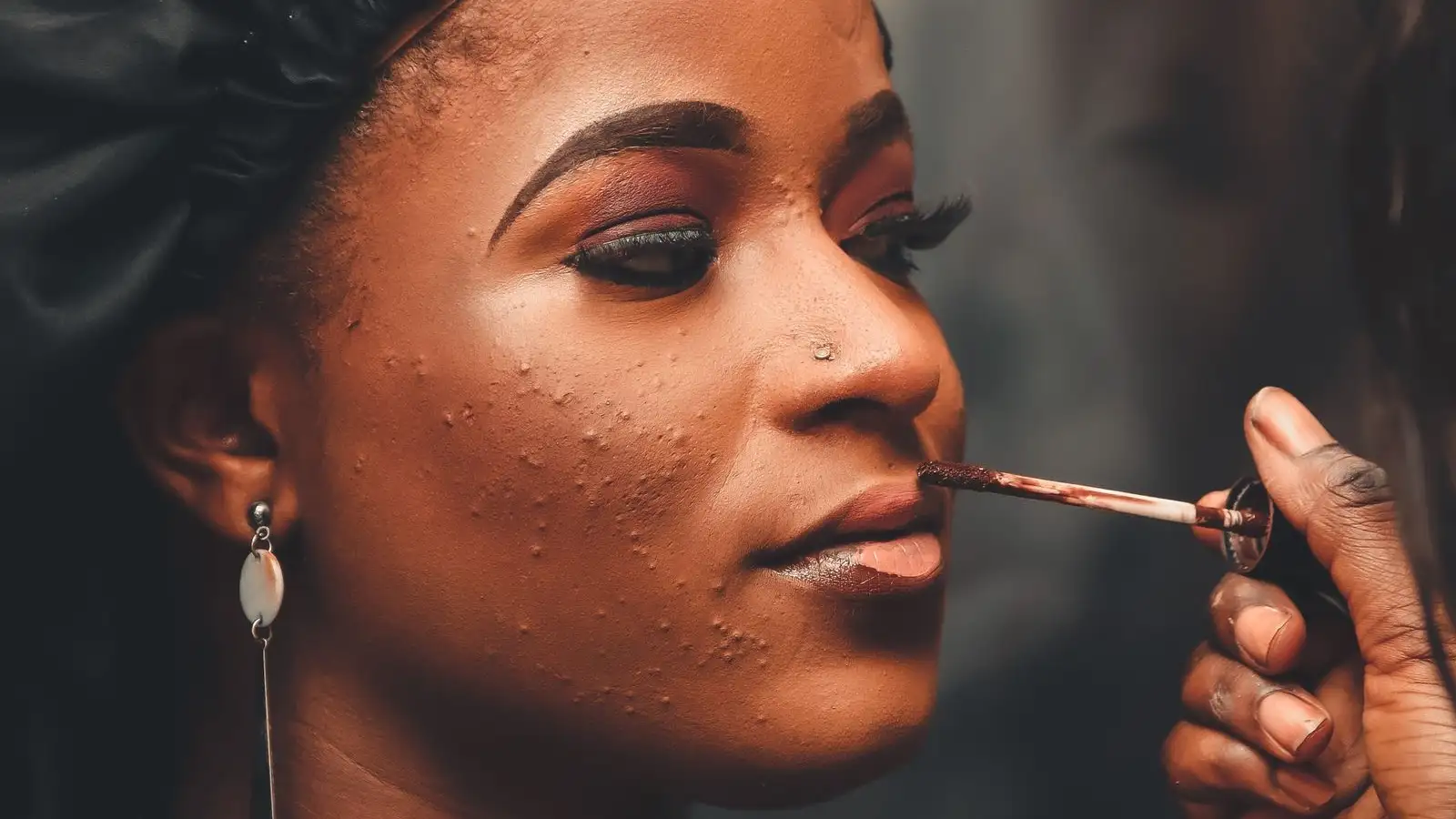
Why Does Foundation Break Up on Oily Deep Skin by Midday?
Foundation breaks up on oily deep skin by midday because sebum rises through the film, softens it, and lifts it off the skin in patches, and the oil that stays on the surface mixes with the pigment and pushes the shade warmer and more orange. The fix runs against instinct: thinner layers over the oily zones, and blotting before you powder. More product and more powder is exactly what turns a two-tone face into a textured one.
I know the minute it happens. Not "midday" as a concept — 1:40, the office restroom, the flat white light over the mirror, the paper towel dispenser that shrieks when you pull too hard. I press a blotting sheet to my nose, count to five, peel it off.
You can read everything on that sheet. It's translucent, which you expect. What matters is the ring — a faint beige halo where the sheet touched down. If it comes away completely clear, you're only fighting shine. If it comes away tinted, the product is moving, and no amount of powder will put it back where it was.
Then you look up. Between the brows the shine returns within ten seconds of blotting, which isn't leftover oil, it's a fresh push coming up. Around the nostrils and just above the upper lip the shade has gone a half-step warmer than the forehead, close to copper. Same foundation. Same morning application. Two different faces on one head.
The oil doesn't sit on top, it comes up through
Sebum doesn't politely stay beneath the foundation. It moves up through it.
Most long-wear foundations hold their shape with a film — silicone resins, acrylate copolymers, the ingredients that make a liquid set into something you can't smudge with a fingernail. Those films are flexible by design, and oil plasticizes them. It works between the polymer chains, softens the set, and the whole layer starts to slide on the skin instead of sitting on it.
Where the film is thinnest, it lifts first: the sides of the nose, the crease between the brows, the chin. That's the patchiness you see in the mirror. Not cracks exactly, more like the foundation has separated into islands with bare skin running in the channels between them.
And the T-zone isn't uniformly oily, which is the part that took me years to actually use. There's a small cluster of glands right at the crease of the nostril that will out-produce your forehead by a wide margin, and that one patch is where the whole face starts reading as uneven. Treat the T-zone as one zone and you'll over-powder the forehead trying to save the nose.
The shade shift is oil, not rust
People call it oxidation, and the word makes it sound like the pigment is reacting with air. Mostly it isn't. Iron oxide pigments, which is what gives every foundation its color, are about as stable as cosmetic colorants get. What's changing is the environment around them.
Sebum is a solvent. When it works into the film, it changes how the pigment particles wet out and how densely they pack, and it changes the refractive index of the medium surrounding them. The color reads deeper and warmer. Because deep foundations generally carry a heavier pigment load with more warm oxide in the blend, that shift has more to push against. On lighter skin the same mechanism reads as half a shade darker. On deep skin it reads as a hue change — browner, redder, sometimes visibly orange by late afternoon.
The tell that it's oil and not just the formula: the shift shows up in the oily zones first, and it matches the shine. The patch that turned copper is almost always the patch that was wettest when you blotted. Humidity and time on your feet compress the whole timeline.
Powder fixes shine, not oil
Distinguish the two. Powder changes how oil looks. It does not stop oil from coming up.
And on deep skin, powder has a second job it does badly when you overdo it: it scatters light. Silica, talc, mica — the standard mattifiers — are white or near-colorless particles. A heavy veil of them over a deep base reads grey. Not lighter, grey. That ashy cast people blame on their foundation is often the powder sitting on top of it — the reason setting powder makes texture look worse on deep skin.
Powder applied over live oil doesn't sit anyway. It clumps. It mixes with the sebum into a paste that fills pores and every fine line around the mouth, and then it sets there. That's the cakey texture everyone complains about. It isn't too much powder in the abstract. It's powder on top of oil.
So the order of operations is the whole thing.
Build thin where the oil is
The instinct with oily skin is coverage. More foundation, more powder, more of everything, because you're bracing for the collapse. The collapse just arrives faster.
Press the product in with a sponge and use what's left on it across the nose and the center of the forehead, rather than adding a fresh dot. Let the cheeks and jaw take the fuller layer, because they aren't the problem. A thinner film has less material to lift, and when it does break, it breaks in a smaller area — small enough that you'll see it forming instead of discovering it at 2 p.m.
Morning powder goes only where you're already shine-prone. The nostril crease, the center of the forehead, the chin. Leave the cheeks bare; they'll get their powder later, when they ask for it. Give the foundation a minute to set on its own before you go in with anything.
The touch-up order: blot, wait, press
- Press a blotting sheet onto the shine and hold for a few seconds. Press, don't wipe. Wiping drags the film sideways and leaves streaks of bare skin that no powder will hide.
- Wait. Thirty seconds, a minute. What you're waiting for is the surface to stop being tacky. Powder pressed into tacky foundation is the paste. Powder pressed into set foundation is a finish.
- Powder only the spots you blotted. Small brush, tap off the excess until almost nothing comes off it, then press — press, don't sweep. Sweeping lifts the film you're trying to protect and drives powder down into the pores.
- If a patch is genuinely gone, not shiny but bare, use a dot of foundation tapped in with a fingertip or a small dense brush on that spot alone. Not a fresh layer over the top. That last habit is how a face ends up three shades deep by dinner.
Setting mists are a real option, but know what they do: many of them re-wet the powder you just pressed in, and a mist over a heavy powder layer brings the paste back.
Where this doesn't hold
Some formulas set hard on volatile silicones and resist for hours; others are built on emollient esters and go soft within one. That's the formula, not your technique, and no amount of blotting discipline rescues the second kind. If you've done all of the above and you're still sliding by noon, you're fighting the bottle, not your skin.
Combination skin complicates it. If your cheeks are dry and your T-zone is not, powdering the whole face to control the center will make the cheeks look dusty and pull texture out of them. Keep the powder local, always.
And some shine on deep skin is the barrier doing its job. Chasing a fully matte finish on a deep base usually produces a flat, grey, light-absorbing look that reads worse than a little glow. The goal is even, not dry.
I still check the sheet every afternoon. It tells me whether I'm looking at oil or at moving product, and those two need completely different hands.

About the author
The Undertone
The Undertone is a byline for people who learned foundation on brown skin by swatching, mixing, and checking color in real light. They share a practical focus: if the depth and undertone are right, the formula will follow.
More about usRelated posts