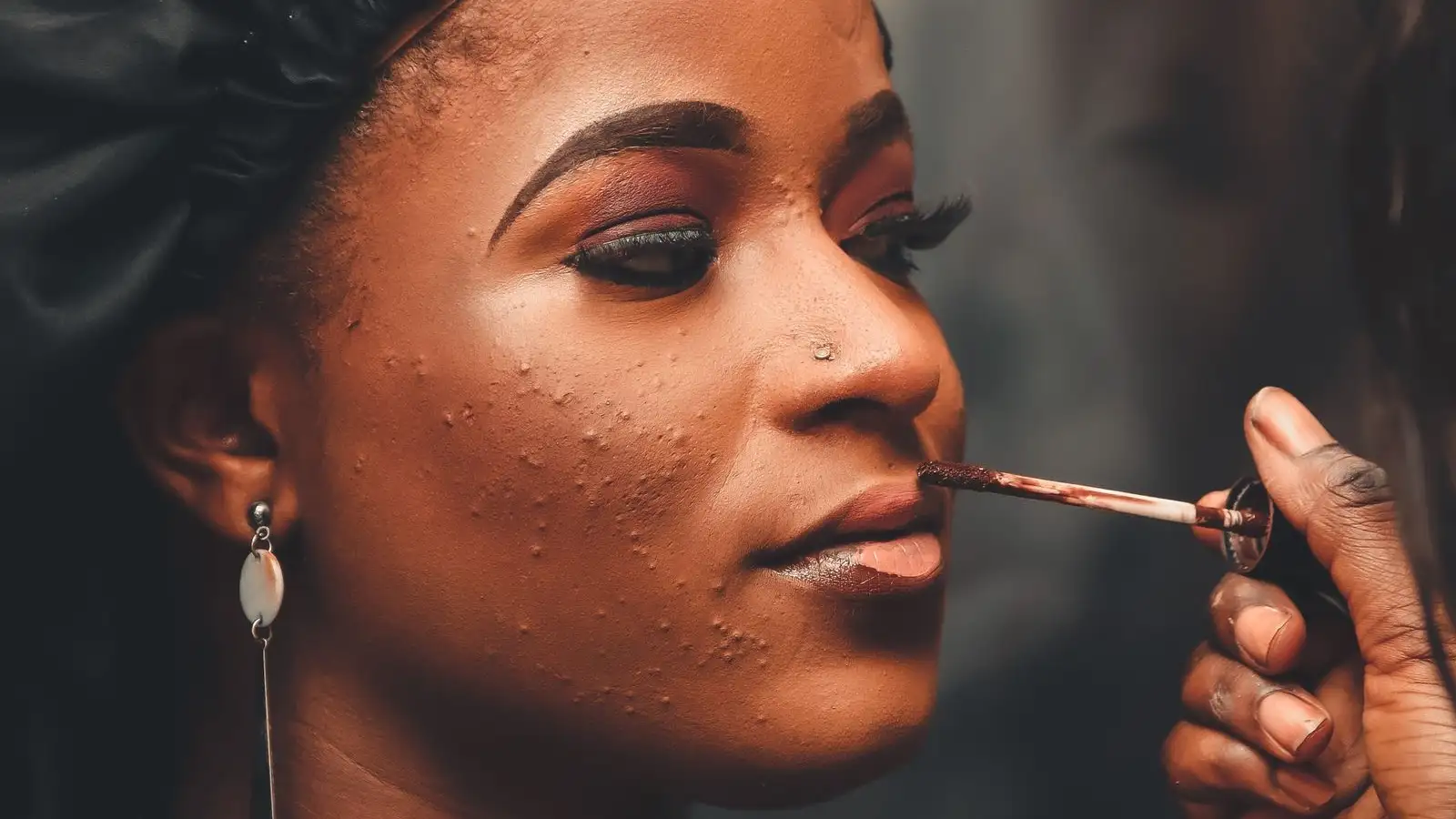
How to Stop Foundation Settling Into Pores and Fine Lines
Foundation settles into pores and fine lines because too much product is being pressed into them, not because the bottle is wrong. Cut your usual amount roughly in half, lay it down in two or three thin passes with a damp sponge or a synthetic stippling brush, press or stipple instead of dragging, and give each pass thirty to sixty seconds to set before the next one goes on. That order of operations changes textured skin more than a new formula does.
Stand at my bathroom window at seven in the morning, the one with the old aluminum frame that throws a hard horizontal band of light across the mirror. Turn your face into it. This is the light that shows the pores running down beside the nose and the two lines from my mouth that I can otherwise pretend aren't there. On the counter: a pump bottle, a sponge the size of a plum, a flat-topped brush with white synthetic bristles, and a hand towel I don't mind staining.
Watch me do it the wrong way first, because I did it the wrong way for years.
One pump. That is the whole adjustment, and it feels absurd. I used to do three. I would pump three, dot it across my cheeks and forehead, and then paint it out with the brush until it looked even. It looked even in that window light for about twenty minutes. By the time I got to my desk and glanced at myself in the black mirror of a turned-off monitor, the foundation had organized itself into the texture. Every pore along the nose had a little ring around it. The lines from my mouth had drawn themselves a fraction deeper, and the product sat in the groove like sediment.
I blamed the foundation for a long time. I bought a different one, then another. Same result, different bottle.
The amount has to be wrong before the tool can help
Here is what I finally understood, and it is the thing that made everything else work: foundation is not paint sitting on a flat surface. It is pigment, oil or water, and film formers that are supposed to dry down into a thin continuous film. A thick layer cannot form that film evenly over a surface with dips in it. It bridges the pore openings, sags into the depressions, and piles against the raised edge of a line. Then the film sets in that shape, and it stays in that shape until you wash it off.
A thin layer conforms. It follows the terrain instead of spanning it. That is the whole mechanism, and it is why the fix is a count and a motion rather than a purchase.
So: one pump, on the back of my hand, spread into a stripe about the width of two fingers. That is my palette for the entire face. If you have a very large face or you are covering a lot of ground, go to a pump and a half. Not two.
Pressing is a different verb than painting
Wet the sponge and then wring it hard in the towel. If you can squeeze a drop out of it, it is still too wet, and a soaking sponge will thin the foundation past the point where it covers anything and leave you reaching for more product to compensate. Barely damp is the target. The water is there to keep the sponge from drinking your foundation, and to help shear the product thin as it goes down.
Now the motion. Not a sweep. A press. You are bouncing the sponge against the skin, tap tap tap, short and quick, moving a half inch at a time. The sponge picks up what it just put down and redistributes it. Listen for it: a soft wet tap while there is product to move, and then a faint squeak when the sponge has given everything it has to that patch. The squeak means move on, not add more.
With the brush it is the same idea, just with bristles instead of foam. A flat-top synthetic, held so the bristles meet the skin straight on, tapped rather than stroked. Dragging is what causes most of the trouble people blame on their skin. When you drag, the bristles push product sideways into the ridges, lift what was already sitting there, and leave the streaky, patchy surface that makes you go back over it a second and third time. Three passes with a dragging brush is a thick layer with a bad attitude.
If you only change one thing, change this one. Press, don't sweep.
Give it a minute, and I mean an actual minute
Here is the part nobody wants to hear at 7:15 in the morning.
After the first pass, walk away. Rinse the sponge, put the cap back on the bottle, do something for forty-five seconds. The film formers need that time to set, and until they do, the surface is still live. Touch it too early with a loaded brush or sponge and you drag the half-formed film into ridges you will be looking at all afternoon.
I test it on the back of my hand, on the stripe I laid down at the start. When that stripe stops feeling wet and starts feeling like skin, the face is ready for pass two. Usually that is under a minute. If it still feels tacky, it will move, so wait.
Some areas get less, not more
The fold beside the nose. Between the brows. The lines from the corners of the mouth. The chin, if it has any texture to it.
My instinct for years was to give those spots extra, because they were the spots that looked uneven after the first pass. That instinct is backwards. Those are the areas where the surface drops away, and the more product you put there, the more there is to collect in the dip and outline the edge. The camera, the window light, the fluorescent panel in the office bathroom all read depth by contrast. Product shows the contrast. Nothing there shows less.
So on the second pass, the sponge goes to the cheeks and the center of the face, and it skips the fold by the nose entirely. Whatever faint haze lands there from the edge of the sponge is enough. On pass three, if there is a pass three, it is only where I actually need it — usually the redness around the nose, applied with the tip of the sponge and pressed in with one finger's worth of pressure.
What this costs you
Thin layers take longer. Not much longer, but longer. It is two minutes of pressing instead of forty seconds of painting, plus the waiting. Some mornings I do not have those two minutes, and on those mornings I get one thin pass and spot-correct anything that is shouting at me, and I accept that the coverage is lighter. That is the trade.
The other trade is coverage. If you have deeper pigmentation you want to even out, a single thin veil over the whole face will not do it. What works better is the reverse of what feels natural: correct the specific spots first with a small brush and a small amount of concealer, pressed in thin, and then veil the entire face with one thin layer over it. You get the coverage without a thick film sitting across all the texture at once.
And sometimes the formula really is the constraint. A foundation with a lot of slip, or one that is fighting a primer underneath it, will pill when you press a second layer on — the mismatch explained in why foundation pills because of formula, not texture. If you see little rolls of product gathering under the sponge, that is not you doing it wrong. Wait longer, or accept one layer and spot-correct, or set that bottle aside for a different kind of day.
What I would not do is buy your way out of this before you have tried the count. Same foundation, half the amount, pressed instead of dragged, with a pause in the middle. Do it tomorrow morning in window light and then look at yourself at one in the afternoon. That is the only test that has ever told me the truth.

About the author
The Undertone
The Undertone is a byline for people who learned foundation on brown skin by swatching, mixing, and checking color in real light. They share a practical focus: if the depth and undertone are right, the formula will follow.
More about usRelated posts