Which Foundation Finish Hides Texture on Deep Skin?
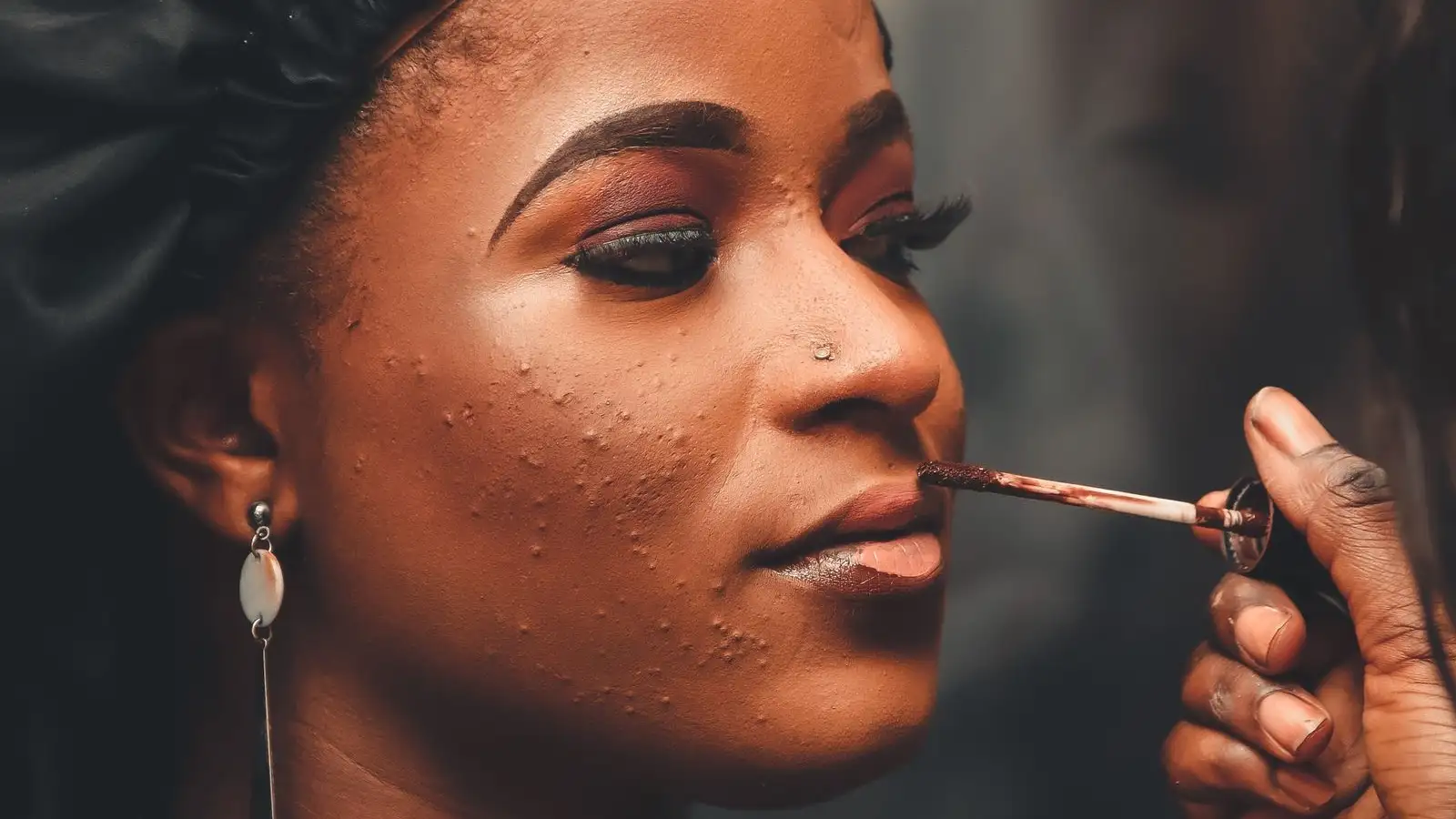
A satin finish — soft, low-sheen, what some lines call natural — hides texture on deep skin better than either extreme, because it keeps a reflection on the skin without letting that reflection break into a hard edge. Matte removes the reflection and leaves each bump reading as raw shadow. Dewy pours on so much reflection that the shine becomes the subject. Satin stays in the middle, and the middle is where texture stops announcing itself.
I do the same thing most mornings before I trust any bottle, and I want you to do it with me. Take a hand mirror to a window where daylight comes in from the side, not over the top. Hold the glass at arm's length and tilt it slowly, a few degrees at a time, until the reflection of the window slides across your cheek. Watch the spot where your texture lives. At one angle that spot nearly disappears. Tilt two more degrees and it comes back, with a small shadow tucked under it and a bright edge running along the top.
Nothing on your face changed. The angle of the light did. That is the entire mechanism behind finish, and once you see it in a mirror you stop shopping by name and start shopping by how a thing behaves in light.
Texture is a contrast problem, not a coverage problem
Your eye doesn't detect bumps. It detects the boundary between a lit surface and a shadowed one. A bump on your cheek is a tiny hill, and it becomes visible the moment it has a lit side and a shadow side. A finish doesn't fill that hill in — nothing does — it changes the size of the lit side.
Matte shrinks the lit side to almost nothing. Dewy stretches it until it spills past the hill and swallows the edge. Satin keeps it small and soft, narrow enough that the hill still casts a shadow, soft enough that the shadow has no hard line to catch your eye. That's the whole trick, and it's why "which finish hides texture" has a real answer instead of a shrug.
There's a second thing happening on deep skin specifically. Deeper skin holds light near the surface in a way that reads as life — it's part of the face, not a flaw sitting on top of it. A full matte finish turns that off. The face goes flat and slightly masked, and then every bit of texture in it reads like a crack in the mask, more noticeable than it was bare.
Where matte earns its reputation, and where it costs you
Matte formulas are built to cut reflection, and they're genuinely good at one job: killing shine in a specific area. If your T-zone greases up by mid-morning, matte across the center panel is the difference between a face and a mirror. In humid summer air, matte is the finish that stays where you put it.
The cost is what it does to the rest of the face. Under a bathroom downlight — light coming straight down from above your head — matte looks flawless for about ten seconds, because downlighting is already a rake and there's nothing left for it to catch. Step into a window and the same finish turns every pore edge into a shadow roughly the size of the pore. Matte powder also has a habit of sitting on top of deep skin rather than melting into it, and where it sits heavy it can read a shade or two lighter than the skin underneath — the cast I explain in why setting powder makes texture look worse on deep skin.
Where I use it: the center of the forehead, the sides of the nose, the chin. Three small zones. Never the whole face.
Satin and the width of a highlight
Satin — natural, soft-matte, whatever the label says — reflects a moderate amount of light, and the reflection it throws is narrow with a soft edge. It moves when you move. Turn your head and the sheen travels along the curve of your cheek instead of stamping a fixed bright patch on it.
That travel is what softens texture. A bump gets partly lit on one side and partly shadowed on the other, so your eye reads it as a shape under a gentle light rather than a divot. On deep skin, satin also leaves enough sheen that the face keeps its own luster. That's the difference between skin and a surface.
Satin isn't invisible, though. Under cool overhead fluorescents it can shimmer into a shine patch across the forehead, because office lighting hits the top of the face and satin answers it. If you sit under those lights all day, keep the sheen lower on the cheeks and take the shine down at the forehead.
Dewy blurs, then it drifts
Dewy finishes blur better than anything else, and they blur for a slightly dishonest reason: the reflection is so large and so soft that it covers the edges your eye would use to find the texture. The hill is still there. You just can't see its outline, because the light has spread across it.
On dry skin that's a gift. On an oily T-zone, dewy breaks down faster than either other finish, and the shine slides from "glow" to "slick" by mid-afternoon. There's a color problem too, one that doesn't get discussed enough: the pearl and shimmer that create the blur can read as a pale film on deeper skin in daylight, especially at the high points of the face where the light is strongest and the finish is thickest.
So dewy is a tool for specific places — the top of the cheekbone, the center of the eyelid if you like it, the bridge of the nose if yours is narrow — and a liability everywhere you actually produce oil.
Check the room, not the bottle
Here's what I trust when I'm deciding: the light I'll be standing in. Not the store. Not the ring light. Not the mirror over the bathroom sink.
Bathroom downlights flatter matte and punish dewy, because the light comes from above and the reflection goes down. Car visor mirrors are brutally honest, but they're a rake, and a rake exaggerates texture on every face. The window at three in the afternoon — you facing the glass, not with your back to it — is the closest thing to the light other people actually see you in. Fluorescents in an office are the worst case: cool, overhead, flat, and unforgiving of a sheen in the wrong place.
Test a finish at the window, then walk outside for thirty seconds. Two lights, half a minute apart, and you'll know more than any swatch strip will tell you.
Skin type sets the base, lighting sets the adjustment
Oily all over: start satin, matte only the center panel. Dry all over: satin with a dewy touch on the cheeks. Combination, which is most of us: satin overall, matte across the middle, a small amount of dew on the high point. That's one finish adjusted three ways, and it reads better in daylight than any single finish applied evenly.
If your skin is textured and dry at the same time — flaking plus bumps — matte is the wrong direction entirely, as I explain in how to stop foundation clinging to dry patches on deep skin. It will find every flake and outline it for you.
Re-finishing what's already in the drawer
You probably don't need a new foundation. You need to move the one you have along the scale.
A matte base that's too flat can be nudged toward satin by mixing a small amount of a hydrating or dewy product into it on the back of your hand — start with a quarter of the amount you think you need. A base that's too dewy can be brought back by pressing a light veil of powder into the center panel with a damp sponge, then pressing — not sweeping — a tissue over it to lift the excess.
Powder placement matters more than powder choice. Most people who swear powder makes them look ashy are powdering the whole face to fix shine in three spots.
And press, don't sweep, when you set. Sweeping drags the finish around; pressing locks it without disturbing what's underneath.
What no finish will do
No finish erases texture. It changes where the light lands and how wide the bright spot is — that's all, and it's most of what you see in a mirror. A finish that looks wrong at the window will still look wrong at the window after a setting spray. The spray is not the variable.
So tilt the mirror again. Find the angle where the light rakes across your cheek, and choose the finish that keeps a soft edge there instead of a hard one. That's the version of you the rest of the world gets.

About the author
The Undertone
The Undertone is a byline for people who learned foundation on brown skin by swatching, mixing, and checking color in real light. They share a practical focus: if the depth and undertone are right, the formula will follow.
More about usRelated posts