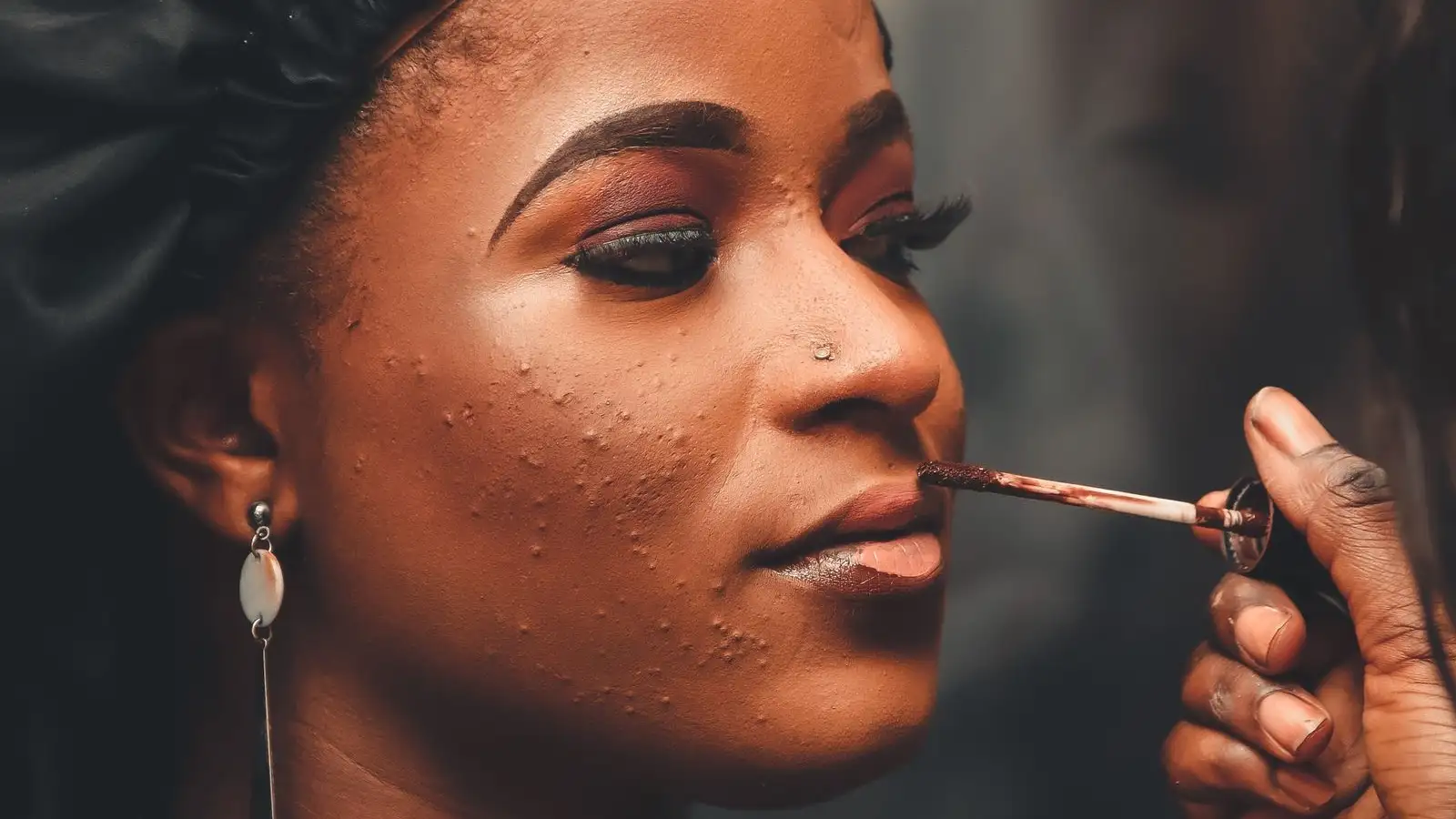
How to Stop Foundation Clinging to Dry Patches on Deep Skin
Foundation clings to dry patches because flaky skin never gives pigment an even surface to sit on, so the answer is not a different shade but a different order of operations: hydrate in thin layers and let each one settle, reach for a cream or hydrating formula instead of a matte liquid, press the product on with a damp sponge instead of buffing it, and keep powder off the dry zones entirely, saving it for the center of the face where oil actually shows.
I figured that out at my bathroom window at 7:40 in the morning, in the hard sideways light that comes in when the sun clears the building across the street. That light is unforgiving. It shows every flake on my cheeks and every place product has settled into the lines around my mouth. For years I did what you're taught to do: moisturizer, primer, foundation, powder all over, then a setting spray on top like an apology. By the time I got to the car, the dry parts of my face looked like a wall with bad plaster, and the oily parts looked fine. It took me an embarrassingly long time to notice that the powder was only helping half of my face and actively ruining the other half.
Two different problems wearing the same coat
The thing that unlocked it for me was separating the flakes from the lines. They look like one problem in the mirror but they behave nothing alike.
Flaking is a surface problem. Pigment catches on the raised edges of dry skin and skips the flat parts in between, so you get that speckled, dusty look that no amount of blending fixes. Blending makes it worse, actually, because the more you work the brush, the more you lift the flakes and drag them around.
Creasing is a movement problem. Around the mouth, between the brows, at the outer corner of the eye, product collects in the fold every time your face moves. A heavy layer makes this dramatically worse because thick product can't flex. It cracks along the fold like dried mud and then sits there in a visible line all day.
Both of those get solved by the same three moves, which is why I stopped buying things and started changing the order I do them in.
The step that mattered most wasn't a product
It was time.
I used to put moisturizer on and go straight into foundation thirty seconds later, because I was in a hurry and because it feels productive. That's exactly backwards. Product applied onto skin that's still wet with moisturizer slides, pills, and never really sets, so it moves around all day and collects in every crease. Now I put on a thin layer of moisturizer, wait, and put on a second thin layer on the cheeks and around the mouth where I need it most. Then I wait again, long enough to brush my teeth or find my keys. When I touch my cheek it should feel soft and slightly tacky, not wet. That's the moment to start.
One thick layer of moisturizer does not do the same job as two thin ones. The thick layer sits on top and the foundation rides around on it. The thin layers actually sink in, and the foundation has something to hold onto that isn't a flake.
If my skin is really behaving badly that week, I'll use a soft damp washcloth in the shower, no scrubbing, just enough to knock the loose edges off. I don't chase it further than that. Aggressive buffing and grainy scrubs leave me with more visible texture, not less.
Cream formulas forgive what matte formulas expose
Matte liquid foundation is engineered to absorb and hold. On an oily forehead that's a gift. On a dry cheek it pulls whatever little oil is there and then sits on top of the flakes like paint on a peeling wall. I wore matte for years because it matched my depth so well in the bottle, and I couldn't understand why the same foundation looked flawless on someone else at the same depth.
A cream or hydrating formula has more slip and more oil in it, and it moves with the face instead of sitting rigidly on top of it. When my skin flexes, the product flexes. That's the whole difference, and it's why the texture problem I blamed on my skin for a decade was partly a formula problem — which is why a satin finish hides texture better than matte or dewy.
The tradeoff is real: cream formulas transfer more, they don't hold for fourteen hours, and by mid-afternoon I'm blotting my nose. I'll take that trade every time. Blotting takes ten seconds. Chalky cheeks follow me around all day.
Press, don't sweep
I use a damp sponge, wrung out and wrapped in a towel so it's damp and not dripping. I press it into the skin and roll slightly, working in sections, and I don't sweep the sponge back and forth across my cheek. Sweeping creates friction, friction lifts flakes, and lifted flakes are the entire problem I'm trying to avoid.
My brush is what was causing half the damage. A dense brush buffing in circles over a dry cheek is basically exfoliating the makeup off as you apply it.
Thin layers, every time
Two thin passes over the same area look better than one heavy one, for the same reason a thin coat of paint doesn't crack. I do a light first pass across the whole face to even out the depth, then a second only where I need more coverage, and I add it in small amounts rather than going back with a big pump. If I can feel the product sitting on my skin, I've already gone too far and I know how the afternoon is going to go.
Powder is a spot treatment, not a finish
This is the change that made the biggest visible difference. Powder now touches four places: the sides of my nose, between my brows, my chin, and the very center of my forehead. That's it. My cheeks and the area around my mouth get nothing.
I use a small brush rather than a puff, tap most of the powder off on the back of my hand, and press it into those spots instead of dusting it across my face. The idea that powder "sets" a whole face is the belief that cost me years of patchy cheeks — the trap I unpack in why setting powder makes texture look worse on deep skin. Powder doesn't set a dry cheek. It flags it.
On the cheeks I use cream blush instead of powder blush. A cream blush on well-moisturized skin melts in and looks like a flush. A powder blush on a dry cheek looks like dust on a windowsill, and it emphasizes a texture that wasn't even visible before I put it there.
Check in daylight before you leave the house
Bathroom light lies. It's warm, it's overhead, it flattens everything. I do my makeup near the window and then walk to the front door and look at my face in whatever natural light comes through, because that's the light I'll actually be seen in. If something is going to go wrong with my cheeks, it goes wrong there, and I'd rather catch it with a damp sponge in my hand than in a car mirror at noon.
The car mirror is my second check, and it's the honest one. It tells me whether the product has settled into the lines around my mouth yet. If it has, I press the area with a clean fingertip to lift the excess instead of adding more product on top, which just gives the crease more to collect.
What I've stopped doing is trying to fix texture with more makeup. The instinct is always to add another layer to cover the patchiness, and the patchiness is caused by layers. Softer skin, fewer layers, cream instead of matte, powder only where the oil is. That's the whole method, and it holds up in the sideways morning light.

About the author
The Undertone
The Undertone is a byline for people who learned foundation on brown skin by swatching, mixing, and checking color in real light. They share a practical focus: if the depth and undertone are right, the formula will follow.
More about usRelated posts