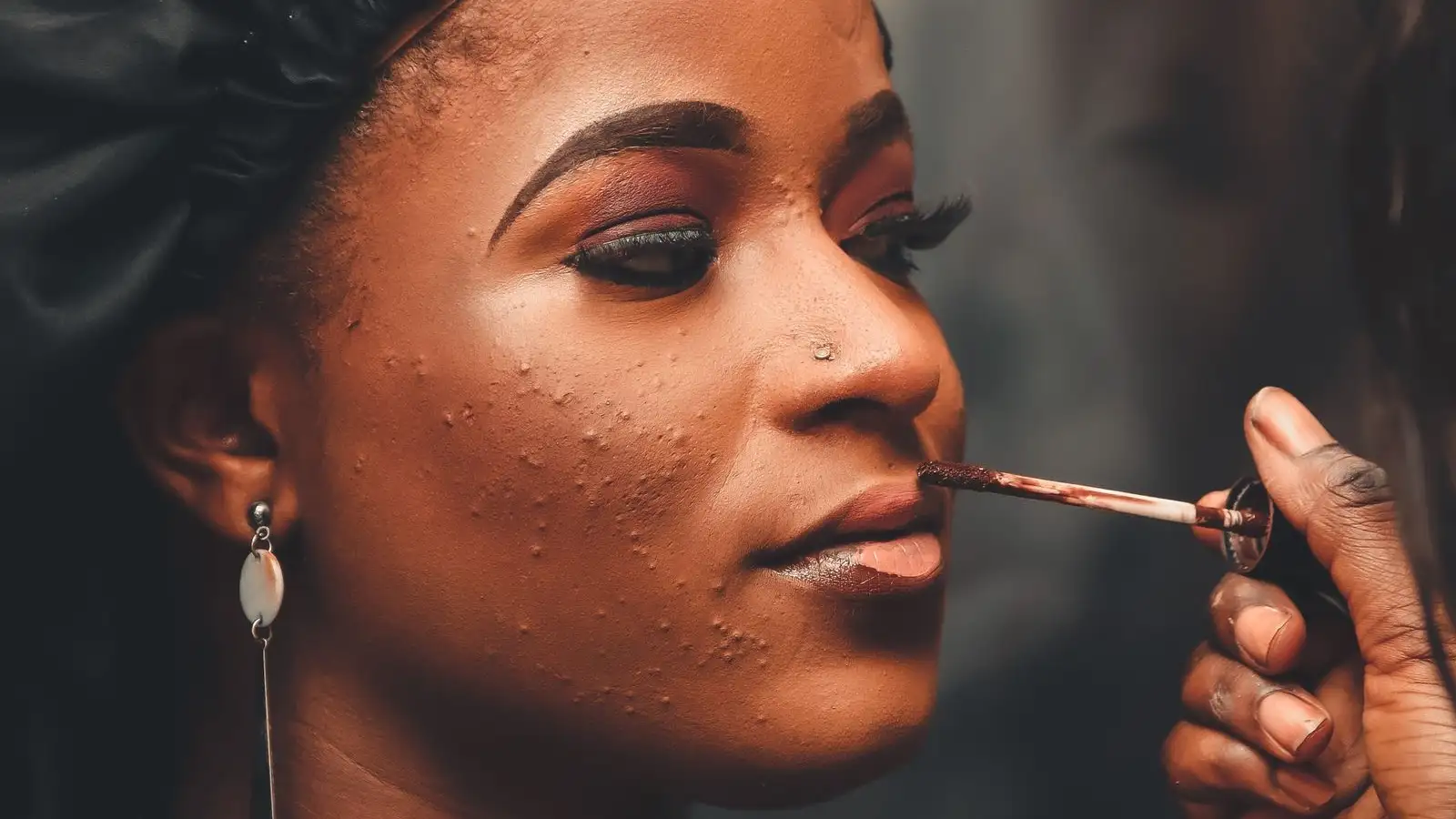
Why Setting Powder Makes Texture Look Worse on Deep Skin
Setting powder makes texture look worse on deep skin because it does two jobs at once and only one of them gets advertised: it absorbs oil, and it leaves a layer of light-scattering particles sitting on the surface. Those particles are milled to bounce light, which is how they blur — and it is also how they find every pore rim, every fine line under the eye, and every dry patch you did not know you had. And most powders sold as "translucent" contain no pigment at all, so the only color they can contribute is their own, which is white. The working fix is a finely milled powder that carries some color close to your actual depth, laid down in a thin veil with a fluffy brush rather than a dense one, pressed only into the zones that genuinely get oily.
I worked this out in a parked car at 8:10 in the morning with the visor mirror down. Ten minutes earlier the bathroom mirror had told me I was fine. The visor mirror told a different story. There was a line under my left eye I had never seen before, and my cheekbones looked like someone had sifted flour over them and walked away. Same face, same product, same morning. The only thing that changed was the light.
Hold onto that, because it is the whole problem in miniature. Powder does not create texture. It lights it up.
The word on the label is doing the damage
Translucent does not mean invisible. It means no pigment. On fair skin that works out, because the powder's own pale color is roughly the color of the skin under it. On deep skin, a pigment-free powder is a veil of white sitting on brown, and your eye reads that as gray long before it reads it as smooth.
I spent an embarrassing amount of time thinking I was buying the neutral option. I was buying the palest possible thing and asking it to disappear.
The other half of the trap is the under-eye advice. Somewhere along the way, "one shade lighter under the eyes" became universal law, and on deep skin that is exactly how you get the ash-gray half-moons you were trying to cover. A powder a shade or two lighter than your foundation under a deep-set eye is not brightening. It is drawing a pale ring around the one feature that already catches shadow. Match the depth. Let concealer do the lifting.
What is actually in the jar
Powders are not one material, and the differences are not marketing. They behave differently on the skin, and they behave differently in a photograph.
Talc is the old workhorse. It absorbs oil, it is usually milled fine, and when it carries a little pigment it disappears into deep skin better than anything else I have used. It is not exciting. It just sits there and does the job without announcing itself.
Silica is the strong one. It soaks up oil hard, and in soft indoor light it gives that soft-focus thing people chase. But it is also the powder most likely to go chalky, because silica particles are literally white and they scatter light back at the camera. You can look flawless in the bathroom and pale and powdery in a phone photo taken with flash in a dim room.
Mica is the slippery one. It gives powder its glide and a faint sheen, which feels lovely and photographs badly. Mica plus flash is one of the classic routes to a cast on deep skin. It is also why some powders look beautiful in a car at noon and ghostly at a wedding.
And if a powder has titanium dioxide or zinc oxide in it — usually because it is carrying a sunscreen claim — expect the strongest cast of all. Those are the physical UV filters, and they reflect visible light right along with the UV. No amount of blending fixes physics. If you know you are being photographed, that is the day to reach for a different jar.
Use less, and put it in fewer places
Here is the shift that changed my face more than any product: I stopped powdering my face and started powdering three zones. Down the center of the forehead. Around the creases of the nose. The chin. That is it. Everything else — cheeks, jaw, the perimeter — stays bare.
That is not laziness, it is structure. Powder is matte, and matte recedes. If you powder the whole face, you flatten the planes that make a face read as a face, and then you wonder why you look like a mask. Bare skin at the edges keeps some dimension and keeps the foundation looking like skin.
Dry patches and fine lines do not need powder. They need to be left alone. The moment powder touches a dry patch it grabs, and every flake becomes a bright spot. Same with a line under the eye: powder settles into it, light hits the powder, and the line gets an outline it never had.
So the rule is not "powder less." It is "powder where the oil is" — the same logic behind why foundation breaks up on oily deep skin by midday. Run a finger across your forehead at 2 p.m. That is your map. Nothing else needs it.
The brush is doing half the damage
A dense, flat-topped brush is a delivery system for too much product. It packs powder into pores and drags it across the surface, and then you press harder to blend it out, which pushes more in.
What I use instead is a large, loose, fluffy brush — something that feels almost floppy. I load it, then knock most of it off against the rim of the jar and then against the back of my hand until almost nothing is coming off. What is left on the bristles is the actual dose, and it is startlingly small. Then I press and roll rather than sweep. Sweeping lifts the foundation underneath and leaves you with patchy, streaky areas that look like texture even when there is none.
If the powder is loose and I want it really pressed in around the nose, I will use a small brush and a tapping motion, not a rubbing one. Same principle, smaller tool.
Baking is a studio technique in a daylight costume
I baked my under-eyes for about a year because the internet told me to. A thick layer, left to sit, then swept away. It looks extraordinary under the flat, bright, controlled light of a ring light or a studio setup, which is exactly where that technique came from and exactly where it belongs.
In a car in daylight it is a disaster on deep skin. The powder keeps reflecting after you have brushed off the excess, the area goes pale and flat, and by hour four it has cracked into the fine lines it was supposed to smooth. If you are doing a shoot, bake. If you are going to work, do not.
The light test that settles it
Stop evaluating your powder in the bathroom. Turn off the overhead light — that flat greenish light hides everything — and walk to a window. Face the glass, then turn your head slowly left and right so the light rakes across your cheek at an angle. Raking light is the honest light. It shows you powder sitting on top of skin, and it shows you where a powder has gone gray against your undertone.
Then do the second test, the one that matters if you are ever in a photo: go into a dim room, open your phone camera, turn the flash on, and take one picture of yourself. Not for posting. For information. That is where silica and mica announce themselves.
When I did those two tests on the powders in my drawer, the sorting was immediate and it had nothing to do with price or how the powder felt. Some of the ones I loved the texture of were the worst offenders in flash. Some of the plain ones were invisible in both.
When to skip it entirely
I want to be honest about the limits here, because powder genuinely earns its place. If your skin is oily, especially in summer humidity, skipping powder means your foundation is sliding by lunchtime, and no application trick fixes that. Powder is not the enemy of oily skin — too much powder in the wrong places is.
But if your skin runs dry, or it is January, or you are wearing a cream blush you love, powder is optional and often actively unhelpful. Cream and liquid products move with the face. Powder sits still while the face moves, and that is the whole mechanism behind cracking. On a dry-skin day I will set the nose and the chin and leave everything else, and my makeup looks better at 6 p.m. than it does when I powder properly.
One more thing worth saying plainly: no powder treats anything. It does not shrink a pore, smooth a scar, or fix a dry patch. It decides how light behaves on the surface for a few hours. Once you accept that it is a lighting tool and not a skincare step, the decisions get much easier — a lighter touch, a powder with some actual color in it, and a brush you barely load.

About the author
The Undertone
The Undertone is a byline for people who learned foundation on brown skin by swatching, mixing, and checking color in real light. They share a practical focus: if the depth and undertone are right, the formula will follow.
More about usRelated posts